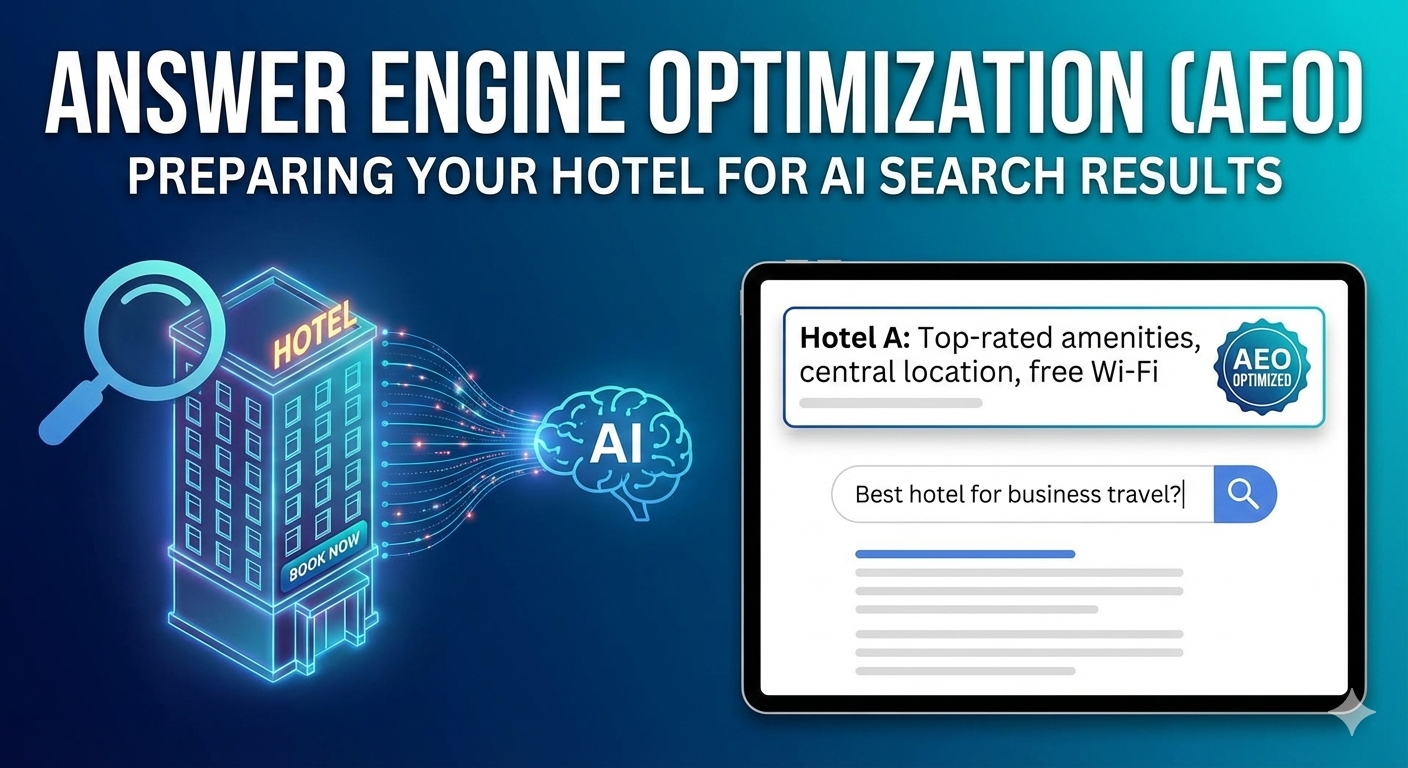
The way travelers search for hotels is changing faster than ever. Traditional search engines that display a list of blue links are gradually giving way to AI-powered answer engines such as Google’s AI Overviews, voice assistants, and generative search platforms. Instead of scrolling through multiple websites, users now expect direct, accurate answers to their questions—often without clicking through to a website at all.
For the hospitality industry, this shift represents both a challenge and an opportunity. Hotels that rely only on traditional SEO strategies risk losing visibility, while those that adapt to Answer Engine Optimization (AEO) can gain a powerful competitive advantage. This article explores what AEO is, why it matters for hotels, and how hospitality brands can prepare for AI-driven search results.
Understanding Answer Engine Optimization (AEO)
Answer Engine Optimization (AEO) is the practice of structuring and presenting content so that AI-driven platforms can easily understand, extract, and deliver it as a direct answer to user queries.
Unlike traditional SEO, which focuses on ranking web pages, AEO focuses on:
- Providing concise, authoritative answers
- Structuring content for AI comprehension
- Optimizing for conversational and voice-based queries
- Becoming the “trusted source” AI systems rely on
In an AI-first search environment, visibility is no longer just about rankings—it’s about being the answer.
Why AEO Matters for the Hospitality Industry
Hospitality is inherently question-driven. Travelers search for information at every stage of their journey.
Common hotel-related queries include:
- “Which hotel near the airport offers free shuttle service?”
- “Is this hotel family-friendly?”
- “What are the best boutique hotels in the city center?”
- “Does the hotel offer late check-out?”
AI search tools aim to answer these questions instantly. If your hotel content is not optimized for AEO, AI platforms may source answers from competitors, OTAs, or third-party websites instead.
From SEO to AEO: What Has Changed?
Traditional SEO focused on:
- Keywords and backlinks
- Page rankings
- Traffic generation
AEO focuses on:
- Intent-based queries
- Context and clarity
- Structured data and semantic understanding
- Trust and authority
For hotels, this means shifting from keyword stuffing to answer-focused content that clearly addresses guest questions.
How AI Search Engines Choose Answers
AI-powered search systems analyze multiple signals to select answers, including:
- Content clarity and relevance
- Structured data (schema markup)
- Authority and credibility
- Consistency across platforms
- User engagement signals
Hotels that present clear, structured, and trustworthy information are more likely to be featured in AI-generated responses.
Key AEO Strategies for Hotels
To prepare for AI search results, hotels must rethink their content and digital presence.
1. Optimize for Guest Questions, Not Just Keywords
AI search thrives on natural language queries.
Hotels should identify:
- Frequently asked guest questions
- Long-tail, conversational search phrases
- Voice-search style queries
Examples:
- “What amenities does the hotel offer for business travelers?”
- “Is breakfast included in the room rate?”
- “How far is the hotel from popular attractions?”
Creating content that directly answers these questions increases AEO visibility.
2. Create Clear and Concise Answer-Based Content
AI engines favor content that delivers clear answers quickly.
Best practices include:
- Using short paragraphs
- Writing in simple, conversational language
- Placing direct answers near the top of the page
- Avoiding unnecessary jargon
Hotels should think like an AI assistant: What is the most helpful answer for the guest?
3. Structure Content with Headings and FAQs
Well-structured content helps AI systems understand context.
Use Clear Headings
Each section should answer a specific question, such as:
- “Does the hotel offer airport transfers?”
- “What dining options are available on-site?”
Develop Comprehensive FAQ Pages
FAQ sections are particularly valuable for AEO because they:
- Match conversational queries
- Provide direct answers
- Improve AI extractability
A strong FAQ strategy can significantly boost a hotel’s presence in AI-generated results.
4. Implement Structured Data (Schema Markup)
Structured data helps AI systems interpret hotel information accurately.
Hotels should implement schema for:
- Hotel details
- Room types
- Amenities
- Pricing
- Reviews and ratings
- Location and contact information
Schema markup increases the likelihood of content being featured in rich results, AI summaries, and voice responses.
5. Optimize for Voice Search and Conversational AI
Voice search plays a major role in AEO.
Guests using voice assistants tend to:
- Ask longer questions
- Use natural language
- Expect immediate answers
Hotels should:
- Use conversational phrasing
- Focus on “who, what, where, when, and how” queries
- Ensure mobile-friendly website design
Voice-optimized content improves visibility across AI-driven platforms.
6. Strengthen Local AEO for Hotels
Most hotel searches are location-based.
To improve local AEO:
- Keep Google Business Profile updated
- Ensure consistent NAP (name, address, phone) details
- Optimize for “near me” queries
- Include local landmarks and attractions in content
AI systems prioritize accurate local information when answering travel-related queries.
7. Build Authority and Trust Signals
AI engines favor reliable sources.
Hotels can strengthen authority by:
- Publishing expert-led content
- Maintaining accurate and up-to-date information
- Earning positive reviews
- Being consistent across platforms
Trustworthiness increases the likelihood of being chosen as an AI answer source.
8. Optimize Hotel Content Beyond the Website
AI engines pull information from multiple sources, not just hotel websites.
Hotels should ensure consistency across:
- Online travel agencies (OTAs)
- Review platforms
- Social media profiles
- Local directories
Inconsistent information reduces AI confidence and visibility.
9. Focus on Experience-Based Content
AI search increasingly highlights experiential information.
Hotels should create content around:
- Unique guest experiences
- Wellness offerings
- Culinary highlights
- Cultural and local experiences
Experience-driven answers help hotels stand out in AI-generated summaries.
10. Monitor Performance in an AI-Driven Search Landscape
Traditional analytics may not fully capture AEO performance.
Hotels should track:
- Featured snippets and AI mentions
- Voice search visibility
- Engagement quality, not just traffic
- Brand mentions in AI-generated answers
Continuous optimization is essential as AI algorithms evolve.
Challenges of AEO for Hotels
While AEO offers opportunities, it also presents challenges:
- Reduced direct website traffic
- Increased competition for “answer space”
- Dependence on AI interpretation
- Need for constant content updates
However, hotels that adapt early can shape how AI platforms present their brand.
The Strategic Advantage of Early AEO Adoption
Hotels that invest in AEO gain:
- Higher visibility in AI-driven search
- Stronger brand authority
- Increased trust among travelers
- Better alignment with future search behavior
AEO ensures hotels remain discoverable even as search engines evolve.
The Future of Search in Hospitality
As AI continues to advance, search will become:
- More conversational
- More personalized
- More predictive
Hotels must shift from being “search-optimized” to being answer-ready.
Those that provide clear, trustworthy, and guest-focused answers will dominate AI-driven discovery channels.
Conclusion
Answer Engine Optimization is redefining how hotels are discovered online. In an era where AI search engines deliver instant answers, hotels must adapt their digital strategies to remain visible, relevant, and competitive. By focusing on guest questions, structured content, authority, and conversational optimization, hotels can position themselves as trusted sources in AI-generated search results.
At Booksmart, we believe AEO is not a replacement for SEO but its natural evolution. Hotels that prepare today will lead tomorrow’s AI-powered hospitality landscape—where being the best answer matters more than being the highest-ranking link.
Leave a Reply