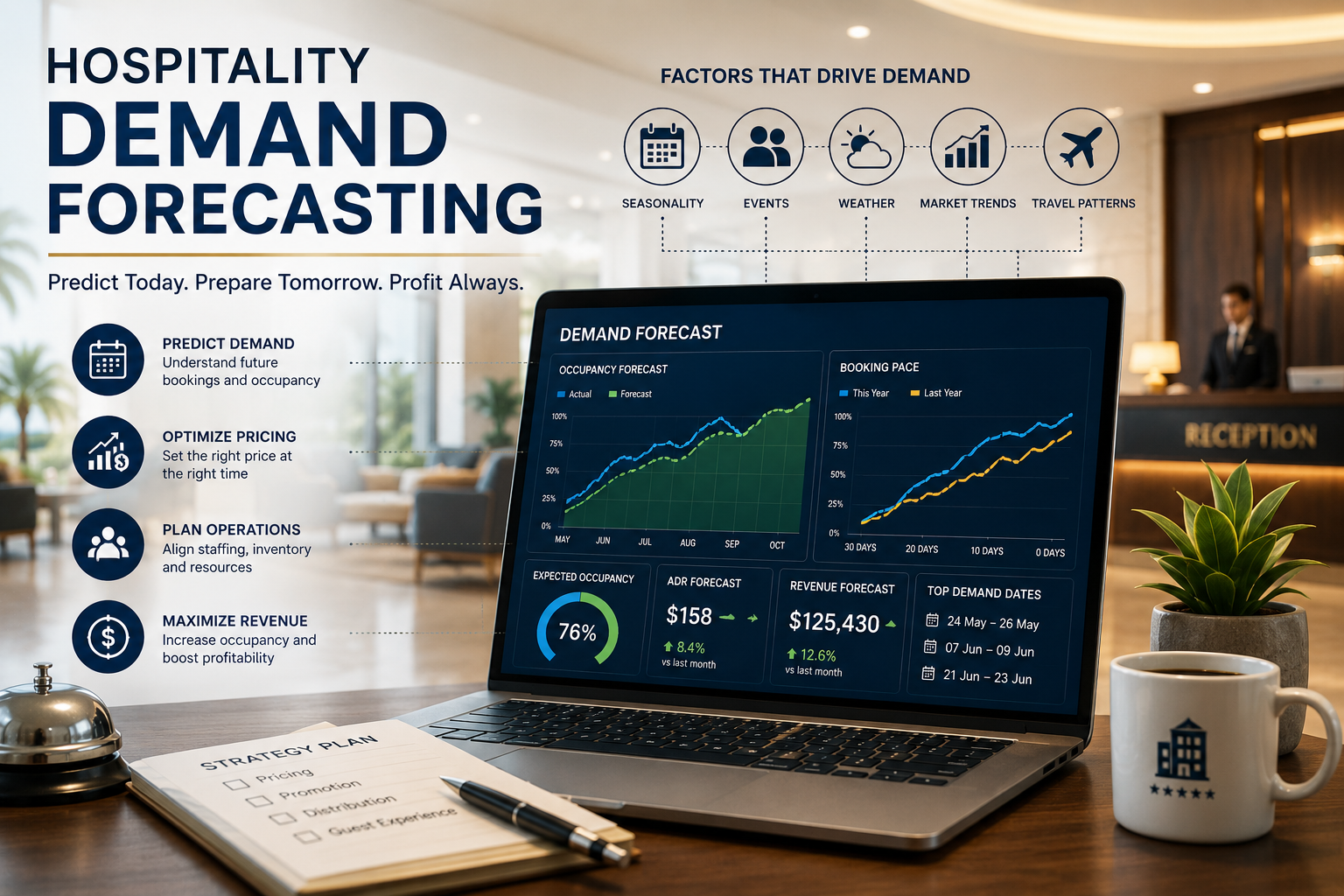
The hospitality industry operates in an environment where demand can change rapidly. Hotel bookings can rise during holidays, fall during off-season periods, and fluctuate because of local events, weather, economic conditions, airline capacity, or changing traveler preferences. For hotels, understanding these patterns is essential for making better decisions about pricing, staffing, inventory, marketing, and operations.
This is where hospitality demand forecasting plays a critical role. Demand forecasting enables hotels to estimate how many rooms, services, and experiences guests are likely to purchase during a specific period. By using historical data, current booking patterns, market trends, and external factors, hotels can prepare for future demand instead of relying entirely on guesswork.
For modern hospitality businesses, demand forecasting is becoming increasingly data-driven. Platforms such as BookSmart can support hotels in building smarter, more efficient approaches to managing guest demand and optimizing operations. When forecasting is integrated into revenue management and daily hotel decision-making, it can help businesses improve profitability while delivering better experiences to guests.
What Is Hospitality Demand Forecasting?
Hospitality demand forecasting is the process of predicting future customer demand for hotel rooms and other hospitality services.
A hotel may use forecasting to estimate:
- Future room occupancy
- Number of expected bookings
- Average daily rate (ADR)
- Revenue potential
- Cancellation patterns
- Length of stay
- Booking pace
- Demand by customer segment
- Demand across different dates
- Demand for food and beverage services
- Demand for additional hotel amenities
The goal is to understand what demand may look like in the future and use that information to make informed business decisions.
For example, if a hotel expects demand to increase significantly during a major festival or sporting event, it may adjust room rates, increase staffing, prepare additional inventory, and launch targeted marketing campaigns. If demand is expected to be weak during a particular period, the hotel may introduce special packages or promotional offers to attract guests.
Why Demand Forecasting Matters in Hospitality
Hotels have a unique challenge: an unsold room represents lost revenue that cannot be recovered after the night has passed. At the same time, pricing rooms too high during periods of weak demand can reduce bookings.
Effective demand forecasting helps hotels find a better balance between occupancy and profitability.
Better Revenue Management
Forecasting gives revenue managers a clearer understanding of future demand. This allows them to adjust room rates based on expected market conditions.
When demand is strong, hotels may increase prices to maximize revenue. During slower periods, they may offer targeted discounts or packages to stimulate bookings.
Improved Occupancy
Accurate forecasts can help hotels identify periods when occupancy may be lower than expected. Hotels can then take action early through promotions, partnerships, targeted advertising, or special packages.
Smarter Staffing
Demand forecasting is not only about rooms and revenue. It also helps hotels plan staffing requirements.
A hotel expecting high occupancy may need more employees across:
- Front desk operations
- Housekeeping
- Food and beverage
- Guest services
- Maintenance
- Concierge services
Forecasting helps managers align staffing levels with expected demand.
Better Inventory Management
Hotels need to manage inventory for restaurants, banquets, spas, room amenities, and other services. Accurate forecasts can help reduce overstocking and shortages.
Improved Guest Experience
When hotels anticipate demand effectively, they can prepare their teams and resources in advance. This can reduce waiting times, service delays, and operational pressure during busy periods.
Types of Demand Forecasting in Hospitality
Hotels can use several approaches to forecasting, depending on their size, available data, and business objectives.
Short-Term Forecasting
Short-term forecasting focuses on the coming days or weeks.
Hotels may use it to predict:
- Occupancy for the next few days
- Last-minute booking patterns
- Expected arrivals and departures
- Staffing needs
- Restaurant demand
This type of forecasting is particularly useful for operational planning.
Medium-Term Forecasting
Medium-term forecasting may cover several weeks or months.
Hotels can use it to plan:
- Promotional campaigns
- Pricing strategies
- Staffing requirements
- Group bookings
- Seasonal offers
Long-Term Forecasting
Long-term forecasting looks further into the future, often covering several months or even years.
It can help hotel businesses make strategic decisions related to:
- Expansion
- Renovation
- New property development
- Capital investment
- Market positioning
- Annual budgeting
Key Factors That Influence Hotel Demand
Demand forecasting requires hotels to consider multiple variables. Historical booking data is important, but it is only one part of the equation.
Seasonality
Seasonality is one of the most significant factors affecting hotel demand.
Demand may increase during:
- Summer holidays
- Winter vacations
- Festive seasons
- School breaks
- Wedding seasons
Hotels need to understand their specific seasonal patterns and how they affect different customer segments.
Holidays and Festivals
Public holidays and cultural festivals can significantly influence travel behavior. Some destinations experience major increases in demand during specific celebrations, while others may see reduced business activity.
Forecasting models should account for these recurring events.
Local Events
Conferences, exhibitions, concerts, sports competitions, and festivals can bring large numbers of visitors to a destination.
Hotels that track local event calendars can anticipate potential demand increases and adjust their strategies accordingly.
Historical Booking Data
Historical data provides valuable insights into recurring patterns.
Hotels can analyze:
- Past occupancy
- Booking lead time
- Cancellation rates
- Average room rates
- Length of stay
- Customer segments
However, historical data should be combined with current market information because past trends do not always predict future behavior perfectly.
Economic Conditions
Economic changes can affect travel demand. Inflation, consumer confidence, employment levels, and broader economic conditions may influence how frequently people travel and how much they spend.
Hotels should consider these factors when creating longer-term forecasts.
Competitor Pricing
A hotel’s demand is also influenced by competitor behavior.
If competing hotels reduce prices or launch aggressive promotions, a property’s booking performance may change. Monitoring market pricing can therefore improve demand forecasting and revenue decisions.
Weather
Weather can significantly affect certain destinations.
Beach resorts, mountain destinations, and outdoor tourism locations may experience demand changes based on weather forecasts and seasonal conditions.
Data Sources for Hospitality Demand Forecasting
Modern hotels have access to more data than ever before. The challenge is turning that data into useful insights.
Important sources may include:
- Property management systems
- Central reservation systems
- Booking engines
- Online travel agencies
- Historical occupancy reports
- Revenue management systems
- Customer relationship management platforms
- Website analytics
- Social media trends
- Local event calendars
- Competitor rate information
- Market intelligence platforms
By bringing these data sources together, hotels can build a more complete picture of future demand.
The Role of Technology in Demand Forecasting
Technology has transformed the way hotels forecast demand. Traditional forecasting methods often relied heavily on spreadsheets and manual analysis. While these tools can still be useful, modern technology enables hotels to process much larger datasets more quickly.
Advanced hospitality technology can help identify patterns that may be difficult to detect manually.
For example, a forecasting system may analyze booking pace and identify that demand for a particular weekend is increasing faster than expected. The hotel can then respond by adjusting room rates or limiting discounts.
Technology can also make forecasting a continuous process rather than a task performed only once a month or once a quarter.
Artificial Intelligence and Machine Learning in Forecasting
Artificial intelligence and machine learning are increasingly being used to improve demand forecasting.
Machine learning models can analyze large amounts of historical and real-time data to identify relationships between different variables.
These systems may consider:
- Booking behavior
- Search activity
- Historical demand
- Pricing
- Seasonality
- Events
- Market trends
- Customer behavior
The models can then generate demand predictions that help revenue managers make better decisions.
However, technology should support human decision-making rather than completely replace it. Experienced hotel professionals can provide context that automated systems may not fully understand, especially when unexpected events affect demand.
Demand Forecasting and Dynamic Pricing
Demand forecasting is closely connected to dynamic pricing.
Dynamic pricing allows hotels to adjust room rates according to market conditions and expected demand.
For example, when demand is expected to be high, a hotel may increase rates and reduce discounts. When demand is lower, the hotel may introduce targeted offers to attract additional bookings.
The effectiveness of dynamic pricing depends heavily on forecast accuracy. If a hotel incorrectly predicts demand, it may increase prices too early and lose bookings or discount rooms unnecessarily.
This is why demand forecasting and revenue management should work together.
Demand Forecasting for Different Customer Segments
Not all guests behave in the same way.
A hotel may serve:
- Business travelers
- Leisure travelers
- Families
- Couples
- Groups
- Corporate clients
- Event attendees
- International tourists
- Local staycation guests
Each segment may have different booking patterns, price sensitivity, and travel motivations.
Segment-based forecasting allows hotels to predict demand more accurately.
For example, business travel may increase during weekdays, while leisure demand may be stronger on weekends. A hotel that understands these differences can create more effective pricing and marketing strategies.
Common Challenges in Hospitality Demand Forecasting
Despite the benefits, forecasting is not always easy.
Unpredictable Events
Natural disasters, geopolitical developments, health emergencies, transportation disruptions, and sudden economic changes can affect travel demand unexpectedly.
Incomplete Data
Forecasting quality depends on data quality. Inaccurate, outdated, or incomplete data can lead to unreliable predictions.
Changing Consumer Behavior
Travel preferences change over time. A forecasting model based entirely on historical behavior may fail to account for emerging trends.
Overdependence on Historical Data
Past performance is useful, but it should not be treated as a guarantee of future demand.
Lack of Integration
When data is spread across disconnected systems, hotel teams may struggle to create a complete view of demand.
How Hotels Can Improve Demand Forecasting
Hotels can take several steps to strengthen their forecasting processes.
Use Multiple Data Sources
Combining historical booking data with market trends, competitor pricing, events, and current booking pace can improve forecasting accuracy.
Monitor Booking Pace
Hotels should regularly compare current bookings with previous periods. If bookings are coming in faster or slower than expected, forecasts should be updated.
Segment Demand
Forecasting demand by customer type, room category, and booking channel can provide more actionable insights.
Review Forecasts Regularly
Demand forecasts should be continuously updated as new information becomes available.
Combine Technology With Human Expertise
Automated systems can process data quickly, but hotel professionals provide valuable business context. The strongest forecasting strategies combine both.
Measure Forecast Accuracy
Hotels should compare predicted demand with actual performance. This helps identify weaknesses in the forecasting process and improve future predictions.
How BookSmart Can Support Smarter Hospitality Operations
Modern hotel management requires connected systems that can help businesses understand demand and respond efficiently.
BookSmart can support the broader goal of smarter hospitality management by helping hotel businesses embrace technology-driven operations and guest-focused decision-making. By using relevant operational and booking insights, hospitality businesses can work toward more informed planning and better resource allocation.
When demand forecasting is connected with other hotel processes, businesses can create a more coordinated approach to:
- Revenue management
- Room inventory
- Guest services
- Staffing
- Marketing
- Promotions
- Operational planning
The objective is to move from reactive decision-making toward proactive hospitality management.
The Future of Hospitality Demand Forecasting
The future of demand forecasting will likely become more automated, predictive, and connected.
Artificial intelligence, machine learning, real-time data, and advanced analytics will allow hotels to respond more quickly to changing market conditions.
Future forecasting systems may increasingly incorporate:
- Real-time booking behavior
- Search trends
- Travel demand signals
- Competitor pricing
- Weather information
- Local event data
- Customer preferences
- AI-generated predictions
This evolution will help hotels make faster and more informed decisions.
However, successful forecasting will continue to depend on more than technology. Hotels must also develop strong data practices, invest in skilled teams, and create processes that allow insights to translate into action.
Conclusion
Hospitality demand forecasting is an essential part of modern hotel management. By predicting future demand, hotels can make smarter decisions about pricing, occupancy, staffing, inventory, marketing, and guest services.
The combination of historical data, real-time information, technology, and human expertise allows hospitality businesses to respond more effectively to changing market conditions. While no forecast can predict the future with complete certainty, a well-designed forecasting process can significantly reduce uncertainty and improve decision-making.
For hotels looking to become more data-driven and operationally efficient, demand forecasting should be viewed as an ongoing strategic process rather than a one-time exercise. With the right technology and a connected approach to hospitality management, businesses can better anticipate guest demand, optimize available resources, and create stronger experiences for both guests and teams.
BookSmart represents the broader shift toward smarter, technology-enabled hospitality—where better information leads to better decisions, more efficient operations, and a more responsive guest experience.
Leave a Reply