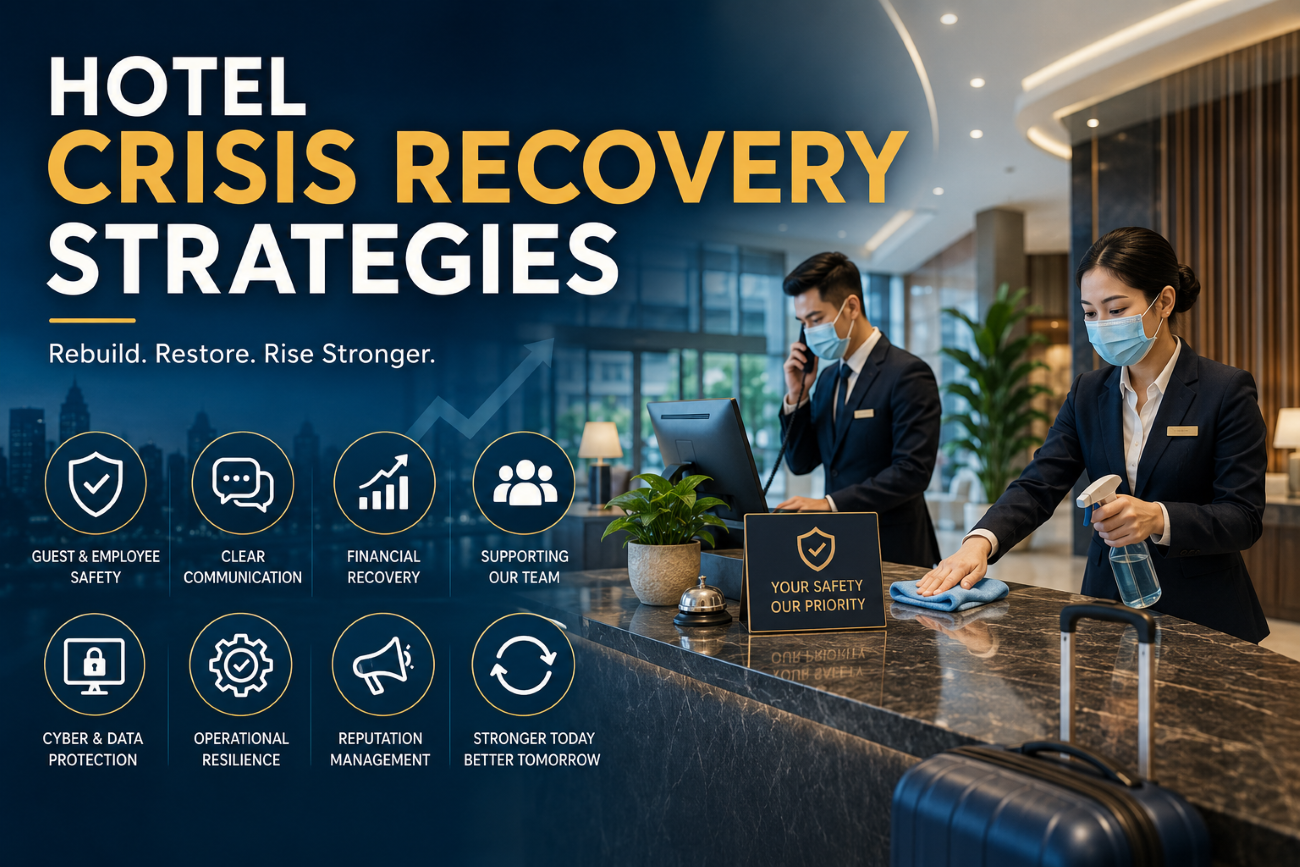
The hospitality industry is highly sensitive to unexpected disruptions. Natural disasters, health emergencies, economic downturns, cybersecurity incidents, operational failures, political instability, and reputational crises can quickly affect hotel bookings, revenue, staffing, and guest confidence. Even a short disruption can have long-lasting consequences if a hotel is not prepared to respond effectively.
Hotel crisis recovery is therefore more than simply reopening after an emergency. It involves restoring operations, rebuilding guest trust, supporting employees, protecting the hotel’s financial health, and adapting the business to prevent similar problems in the future.
A strong recovery strategy allows hotels to move from immediate response to long-term stability. It also creates an opportunity to identify weaknesses and develop stronger systems.
At BookSmart, we believe that successful crisis recovery combines preparation, transparent communication, technology, financial discipline, employee support, and a strong focus on guest experience. Hotels that learn from disruption can emerge more resilient and better prepared for future challenges.
What Is Hotel Crisis Recovery?
Hotel crisis recovery refers to the strategies and actions a hospitality business takes to restore normal operations after a major disruption.
A crisis can take many forms, including:
- Natural disasters
- Public health emergencies
- Cybersecurity attacks
- Data breaches
- Fire or property damage
- Major equipment failures
- Food safety incidents
- Economic downturns
- Labor shortages
- Negative publicity
- Security incidents
- Supply chain disruptions
Recovery does not necessarily happen immediately after the crisis ends. Hotels may need weeks or months to restore revenue, rebuild their reputation, stabilize staffing, and regain customer confidence.
Effective recovery planning addresses both short-term operational needs and long-term business resilience.
Why Crisis Recovery Matters for Hotels
Hotels depend heavily on customer confidence. Travelers need to believe that a property is safe, reliable, clean, and capable of delivering the experience promised during booking.
A crisis can quickly weaken that confidence.
For example, a hotel affected by a natural disaster may have to close temporarily. Even after reopening, travelers may hesitate to book if they are uncertain about safety or service availability.
Similarly, a cybersecurity incident can create concerns about whether guests’ personal information is protected.
A structured recovery strategy helps hotels communicate clearly, demonstrate improvements, and gradually rebuild trust.
Start With a Crisis Impact Assessment
Before developing a recovery plan, hotel management should understand exactly how the crisis has affected the business.
An impact assessment should examine:
- Property damage
- Room availability
- Technology systems
- Financial losses
- Staffing levels
- Supplier relationships
- Guest cancellations
- Future bookings
- Online reputation
- Regulatory requirements
The hotel should identify which operations can resume immediately and which require additional resources.
This allows management to prioritize recovery rather than attempting to solve every problem simultaneously.
Prioritize Guest and Employee Safety
Safety should always be the first priority during recovery.
Hotels should not reopen facilities or services until they are confident that guests and employees can safely use them.
Depending on the nature of the crisis, this may involve building inspections, equipment testing, sanitation procedures, cybersecurity assessments, or emergency preparedness reviews.
Employees should receive clear information about new safety procedures before the hotel resumes normal operations.
Communicating these improvements to guests can also help rebuild confidence.
Communicate Transparently With Guests
Communication is one of the most important elements of hotel crisis recovery.
Guests want accurate information about what happened, whether the property is operating normally, and what measures have been implemented.
Hotels should communicate through appropriate channels, including:
- Website updates
- Social media
- Booking platforms
- Mobile applications
- Direct customer service
- SMS notifications
Communication should be factual, timely, and consistent.
Hotels should avoid making unrealistic promises or hiding important information.
When guests believe that management is being honest and proactive, trust is easier to rebuild.
Manage Cancellations and Refunds Professionally
Cancellations are often unavoidable during a crisis.
Hotels should create clear policies for affected reservations and ensure that staff can explain available options.
Depending on the circumstances, hotels may offer:
- Refunds
- Date changes
- Flexible rebooking
- Credits
- Alternative accommodation
- Upgrades for future stays
A fair and transparent approach can protect the hotel’s reputation even when revenue is temporarily lost.
Guests often remember how a company treated them during a difficult situation.
Restore Core Operations First
Hotels should prioritize the services that are essential to delivering a functional guest experience.
For example, management may initially focus on:
- Safe guest rooms
- Front desk operations
- Housekeeping
- Essential maintenance
- Food and beverage services
- Payment and reservation systems
- Guest communication
Additional facilities can reopen gradually as resources and demand recover.
A phased recovery approach reduces pressure on employees and allows management to maintain service quality.
Rebuild Hotel Revenue Strategically
Revenue recovery is a major challenge following a crisis.
Hotels may experience lower occupancy, increased cancellations, and greater price sensitivity.
Simply reducing room rates dramatically is not always the best solution.
Hotels should instead analyze current demand and develop targeted pricing strategies.
Possible approaches include:
- Flexible pricing
- Local resident offers
- Extended-stay packages
- Business travel promotions
- Family packages
- Direct booking incentives
- Value-added packages
- Loyalty member offers
The objective is to stimulate demand while protecting the hotel’s long-term positioning.
Use Data to Understand Changing Demand
Guest behavior may change significantly after a crisis.
Travelers may prefer shorter booking windows, flexible cancellation policies, different destinations, or specific types of accommodation.
Hotels should analyze booking data to understand these changes.
Important indicators include:
- Occupancy
- Average Daily Rate (ADR)
- Revenue Per Available Room (RevPAR)
- Booking pace
- Cancellation rates
- Length of stay
- Customer segments
- Booking channels
Data helps hotels identify where demand is returning and where additional marketing efforts are needed.
Strengthen Direct Booking Strategies
During recovery, hotels may want greater control over customer relationships and distribution costs.
Direct booking strategies can help achieve this.
Hotels can encourage direct reservations through:
- Exclusive website rates
- Loyalty benefits
- Flexible booking conditions
- Complimentary services
- Personalized offers
- Direct communication
A strong direct booking strategy also gives hotels greater access to customer data and enables more personalized communication.
Rebuild the Hotel’s Online Reputation
A crisis can generate negative publicity and online discussions.
Hotels should actively monitor reviews, social media, travel websites, and other digital channels.
Management should respond professionally to guest concerns and provide updates about improvements.
If a crisis caused service disruptions, hotels should explain what has changed rather than simply asking guests to forget the previous experience.
Positive guest experiences after reopening can gradually strengthen the hotel’s online reputation.
Encouraging genuine reviews from satisfied guests can also help future travelers understand the hotel’s current condition.
Support Employees During Recovery
Employees often experience significant stress during and after a crisis.
Staff shortages, changing schedules, increased workloads, and uncertainty about job security can affect morale.
Hotels should communicate openly with employees and provide appropriate training and support.
Management should also recognize employees who contribute significantly during difficult periods.
A motivated workforce is essential to rebuilding the guest experience.
Employees are often the first people guests interact with after a crisis, making their confidence and attitude especially important.
Strengthen Supplier Relationships
Crisis recovery can expose weaknesses in a hotel’s supply chain.
Hotels may struggle to obtain food, cleaning supplies, linens, maintenance materials, or technology equipment.
Management should review supplier performance and identify alternative sources for critical products.
Maintaining relationships with multiple suppliers can reduce dependency on a single source.
Hotels should also maintain appropriate emergency inventory for essential items.
A resilient supply chain supports consistent service even during periods of uncertainty.
Invest in Technology and Automation
Technology can accelerate hotel recovery.
Cloud-based hotel management systems allow businesses to access important information from different locations and maintain operational flexibility.
Automation can also reduce administrative workloads.
Hotels can use technology for:
- Digital check-in
- Contactless payments
- Automated guest communication
- Revenue management
- Staff scheduling
- Inventory management
- Customer relationship management
- Predictive maintenance
- Data analytics
Technology should be selected based on actual business needs rather than simply following trends.
The goal is to make the hotel more efficient, flexible, and resilient.
Improve Cybersecurity After a Digital Crisis
If a crisis involves a cyberattack or data breach, cybersecurity should become a major recovery priority.
Hotels should review their digital infrastructure and identify vulnerabilities.
Important measures include:
- Strong access controls
- Multi-factor authentication
- Data encryption
- Regular software updates
- Secure payment systems
- Employee cybersecurity training
- Data backups
- Incident response procedures
Hotels should also review which employees and third-party providers have access to sensitive systems.
Cybersecurity recovery should focus not only on fixing the immediate problem but also on preventing future incidents.
Review Insurance and Financial Protection
A crisis can reveal gaps in financial protection.
Hotels should review their insurance coverage and understand which types of events are covered.
Business interruption insurance, property coverage, liability protection, and cyber insurance may play important roles depending on the hotel’s operations and risk profile.
Financial planning should also include emergency reserves and contingency budgets.
Maintaining financial flexibility allows hotels to continue investing in essential operations during recovery.
Rebuild Through Local Partnerships
Local communities can play an important role in hotel recovery.
Hotels can work with local tourism organizations, restaurants, attractions, event organizers, transportation providers, and businesses to encourage destination recovery.
Joint promotions can help bring travelers back to the area.
For example, hotels can create packages that combine accommodation with local dining, cultural experiences, tours, or activities.
This approach supports both the hotel and the wider destination economy.
Use Marketing to Communicate Recovery
Marketing campaigns after a crisis should focus on confidence rather than aggressive selling.
Hotels should communicate what has improved and why guests can feel comfortable returning.
Content can highlight:
- Renovated facilities
- Enhanced safety measures
- New services
- Local experiences
- Flexible booking policies
- Positive guest experiences
- Sustainability improvements
Authentic storytelling is more effective than exaggerated claims.
Marketing should reflect the actual guest experience.
Learn From the Crisis
One of the most important recovery steps is conducting a post-crisis review.
Management should evaluate:
- What happened?
- How quickly did the hotel respond?
- Which systems worked?
- Where were the weaknesses?
- What did guests need most?
- What did employees struggle with?
- Which suppliers performed well?
- What should be changed?
The findings should be documented and incorporated into future emergency plans.
A crisis should become a learning opportunity rather than simply an event to move past.
Develop a Strong Business Continuity Plan
Hotels should not wait for another crisis before improving preparedness.
A business continuity plan should identify essential operations, backup systems, emergency contacts, alternative suppliers, communication procedures, and recovery priorities.
Plans should be tested regularly through simulations and staff training.
Employees should know who is responsible for decision-making and how information should be communicated during an emergency.
Preparation can significantly reduce confusion when a real crisis occurs.
Building Long-Term Hotel Resilience
Crisis recovery should ultimately lead to greater resilience.
A resilient hotel is capable of adapting to changing circumstances while maintaining essential services and protecting its guests, employees, and financial health.
Long-term resilience may involve:
- Diversifying revenue streams
- Strengthening digital infrastructure
- Improving employee training
- Building stronger supplier networks
- Maintaining financial reserves
- Using data-driven decision-making
- Investing in preventive maintenance
- Developing flexible operating models
Hotels that invest in resilience are better positioned to handle future disruptions.
The Role of Leadership in Crisis Recovery
Strong leadership is essential throughout the recovery process.
Hotel leaders must make difficult decisions while maintaining employee confidence and guest trust.
Effective leaders communicate clearly, prioritize safety, remain adaptable, and make decisions based on reliable information.
They also need to balance immediate recovery with long-term business objectives.
A crisis can test a hotel’s culture and leadership. Strong leadership can turn uncertainty into an opportunity to strengthen the organization.
The Future of Hotel Crisis Recovery
The future of hotel crisis management will increasingly involve Artificial Intelligence, predictive analytics, automation, cloud technology, and real-time monitoring.
Hotels will be able to identify emerging risks earlier and respond more quickly.
Predictive systems may help forecast demand changes, supply disruptions, staffing requirements, and equipment failures.
At the same time, human judgment will remain essential.
Technology can provide information and automate processes, but leaders and employees must determine how to respond appropriately.
The most resilient hotels will combine intelligent technology with strong people, effective planning, and flexible operating models.
Conclusion
Hotel crisis recovery is a complex process that requires more than simply reopening the doors. Hotels must restore operations, protect guests and employees, manage finances, rebuild reputation, support staff, and adapt to changing market conditions.
Effective recovery begins with a clear assessment of the crisis and continues through transparent communication, strategic revenue management, technology adoption, employee support, supplier diversification, cybersecurity improvements, and continuous learning.
At BookSmart, we believe that every crisis can also become an opportunity to build a stronger hospitality business. Hotels that learn from disruption, invest in resilience, and remain focused on guest needs can recover more effectively and emerge better prepared for whatever challenges the future may bring.
Leave a Reply