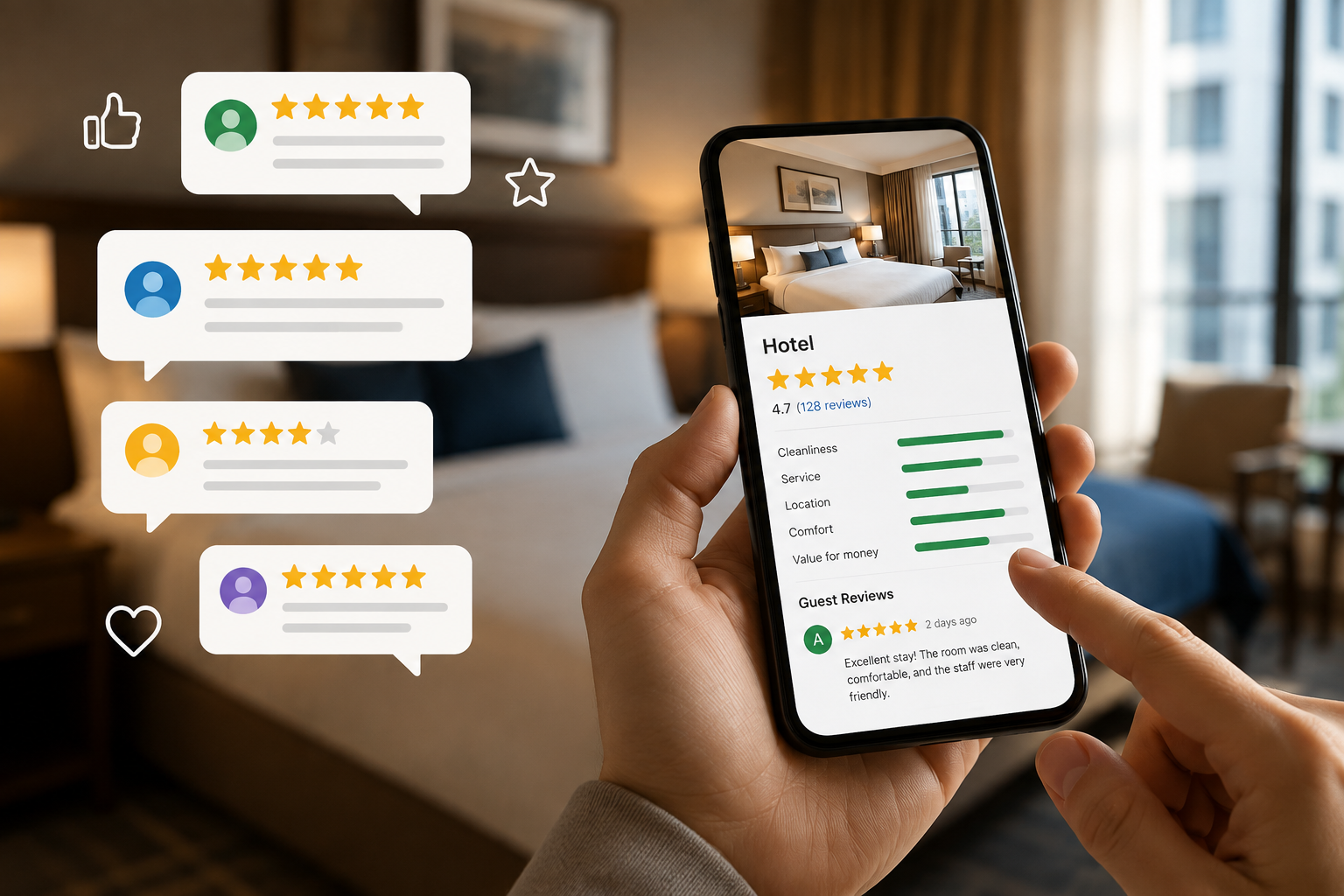
Choosing a hotel is no longer a decision based only on location, room prices, photographs, and amenities. In today’s digital travel environment, online reviews have become one of the most influential factors shaping where travelers choose to stay. Before making a reservation, guests often browse reviews, compare ratings, read other travelers’ experiences, and look for honest feedback about everything from room cleanliness to staff behavior.
For hotels, this means that reputation is now a critical business asset. A property can have beautiful rooms and excellent facilities, but a series of negative reviews can discourage potential guests from making a booking. On the other hand, consistently positive reviews can build trust, increase visibility, and encourage travelers to choose one hotel over another.
At BookSmart, we believe that reviews are more than simple comments left by previous guests. They are an important part of the modern hotel booking journey and a valuable source of information that can help hotels improve their services, understand guest expectations, and build long-term customer relationships.
Why Online Reviews Matter to Modern Travelers
Travelers often face uncertainty when booking accommodation in an unfamiliar destination. They may not know whether a hotel’s rooms are truly comfortable, whether the location is convenient, or whether the service matches the hotel’s promises.
Online reviews help reduce this uncertainty.
Guest feedback provides real-world perspectives that photographs and marketing messages cannot always communicate. Travelers can learn about actual experiences from people who have stayed at the property.
Reviews can answer practical questions such as:
- Is the hotel really as clean as advertised?
- Is the staff friendly and responsive?
- Is the location convenient?
- Are the rooms comfortable?
- Is the hotel suitable for families or business travelers?
- Does the property provide good value for money?
This information helps travelers make more confident booking decisions.
Reviews Build Trust and Credibility
Trust is one of the most important factors in hospitality.
Travelers are more likely to trust the experiences of previous guests because reviews are perceived as independent opinions rather than promotional content created by the hotel.
A hotel with hundreds of detailed and authentic positive reviews can appear more trustworthy than a property with little or no guest feedback.
Reviews also provide social proof. When potential guests see that many travelers have enjoyed their stay, they may feel more confident about making a reservation.
This is particularly important for independent hotels and lesser-known properties that may not have the same brand recognition as large hotel chains.
Ratings Influence Booking Decisions
Star ratings and review scores provide travelers with a quick way to compare properties.
When browsing multiple hotels, guests often use ratings as an initial filter.
A hotel with a consistently high rating may attract more attention than a similar property with a lower score.
However, travelers do not always look only at the overall rating. Many also examine the number of reviews and how recently they were posted.
A hotel with a high rating based on thousands of reviews may appear more credible than one with the same rating based on only a handful of comments.
Hotels should therefore focus on delivering consistently positive experiences rather than attempting to improve ratings through short-term tactics.
The Impact of Detailed Guest Experiences
Detailed reviews can have a powerful influence on potential guests.
A simple statement such as “Great hotel” may provide limited information. In contrast, a detailed review describing the cleanliness of the room, quality of breakfast, friendliness of staff, and convenience of the location gives future travelers a clearer understanding of what to expect.
Detailed reviews can also help hotels attract specific customer segments.
For example, comments from families may help other families understand whether the property is child-friendly. Business travelers may look for information about Wi-Fi, workspaces, and transportation.
Authentic guest experiences create a more realistic picture of the property.
Negative Reviews Can Influence Travelers
Negative reviews can significantly affect hotel booking decisions.
Travelers may become hesitant when they repeatedly see complaints about poor cleanliness, unhelpful staff, maintenance problems, hidden charges, or inaccurate descriptions.
However, not every negative review is necessarily harmful.
The hotel’s response can influence how potential guests interpret criticism.
A thoughtful response that acknowledges the issue and explains how it has been addressed can demonstrate professionalism and accountability.
Ignoring negative reviews may create the impression that the hotel does not care about guest concerns.
The Importance of Hotel Responses
Responding to reviews is an essential part of online reputation management.
Hotels should respond to both positive and negative feedback in a professional and authentic manner.
When responding to positive reviews, hotels can thank guests for their feedback and invite them to return.
When responding to negative reviews, the focus should be on acknowledging the guest’s concerns, apologizing where appropriate, and explaining what steps are being taken to improve.
Responses should avoid arguments, defensive language, or blaming the guest.
A well-written response can demonstrate to future travelers that the hotel values feedback and takes service quality seriously.
Reviews as a Source of Service Improvement
Guest reviews are not only important for attracting new customers. They also provide valuable insights into hotel operations.
Management teams can analyze reviews to identify recurring complaints and positive trends.
If multiple guests mention slow check-in processes, the hotel may need to improve front desk operations.
If guests consistently praise the breakfast, management can identify it as a competitive advantage.
Reviews can reveal issues that internal management may not notice.
By treating feedback as operational data, hotels can continuously improve their services.
Identifying Common Review Themes
Hotels receive feedback about many aspects of the guest experience.
Common review themes include:
- Room cleanliness
- Staff behavior
- Location
- Food quality
- Check-in experience
- Room comfort
- Wi-Fi quality
- Facilities
- Value for money
- Maintenance
- Noise levels
Analyzing these themes helps hotels understand which areas are performing well and which require attention.
Modern sentiment analysis tools can also help larger hotel groups analyze thousands of reviews across multiple properties.
This allows management to identify patterns and prioritize improvements.
The Connection Between Reviews and Revenue
A hotel’s online reputation can have a direct impact on its financial performance.
Properties with strong reviews may attract more bookings and experience higher demand.
Positive reviews can also support stronger pricing because travelers may be willing to pay more for a hotel they perceive as reliable and high quality.
On the other hand, consistently poor reviews may force hotels to reduce prices to remain competitive.
This creates a strong connection between guest satisfaction, reputation, and revenue management.
Investing in service quality can therefore deliver financial benefits beyond immediate guest satisfaction.
Reviews and Direct Bookings
Positive reviews can also support direct booking strategies.
Travelers who trust a hotel’s reputation may be more willing to visit its official website and make a reservation directly.
Hotels can showcase authentic guest feedback across their digital channels while encouraging satisfied guests to share their experiences.
Direct bookings can help hotels reduce dependence on third-party distribution channels and strengthen direct relationships with customers.
However, hotels should ensure that review presentation remains transparent and authentic.
Mobile and Social Media Reviews
The way travelers share feedback is changing.
Guests can now post reviews, photos, videos, and social media stories almost instantly.
Visual content can be particularly influential because it provides potential travelers with a more immediate impression of the hotel.
A positive social media post can generate interest and encourage bookings, while viral complaints can damage a hotel’s reputation quickly.
Hotels should therefore monitor multiple digital channels rather than focusing exclusively on traditional review platforms.
Encouraging Authentic Guest Feedback
Hotels should make it easy for guests to share feedback after their stay.
Automated post-stay emails, mobile applications, SMS messages, and digital surveys can encourage guests to provide reviews.
The goal should be to collect genuine feedback rather than manipulate ratings.
Hotels can also ask guests about their experiences during their stay. If an issue is identified early, staff may have an opportunity to resolve it before the guest leaves.
A successful service recovery can turn a potentially negative experience into a positive one.
Managing Fake or Misleading Reviews
The growth of online reviews has also created concerns about fake or misleading feedback.
Hotels may occasionally encounter fraudulent reviews that do not accurately represent the guest experience.
When this happens, properties should follow the appropriate platform’s reporting procedures and provide evidence where possible.
However, hotels should avoid responding emotionally or accusing reviewers without clear evidence.
Maintaining professionalism is important because future travelers may also evaluate how a hotel handles disputes.
The Role of Technology in Review Management
Technology is making review management more efficient.
Reputation management platforms can collect reviews from multiple sources and organize them into centralized dashboards.
Hotels can monitor ratings, identify recurring complaints, track sentiment, and respond more quickly.
Artificial Intelligence and natural language processing can analyze large volumes of feedback and identify common themes.
These insights can help management prioritize operational improvements.
Technology does not replace human judgment, but it allows hotels to understand guest feedback at a larger scale.
Reviews in the Future of Hospitality
As digital technology continues to evolve, reviews will become even more integrated into the hotel booking experience.
Travelers may increasingly rely on video reviews, verified guest content, AI-powered recommendations, and personalized review summaries.
Artificial Intelligence may help travelers analyze thousands of reviews and identify the information most relevant to their individual needs.
For example, a family could receive a summary focused on child-friendly facilities, while a business traveler might see insights about Wi-Fi and workspaces.
Hotels will need to focus on delivering consistently excellent experiences because authentic guest feedback will remain difficult to replace.
Conclusion
Online reviews have become an essential part of hotel booking decisions. They help travelers evaluate properties, reduce uncertainty, compare alternatives, and make more confident choices.
For hotels, reviews represent both an opportunity and a responsibility. Positive feedback can build trust, strengthen reputation, increase bookings, and support revenue growth. Negative feedback, when handled professionally, can provide valuable insights into areas that require improvement.
At BookSmart, we believe that the most effective review strategy begins with delivering exceptional hospitality. Hotels that listen to their guests, respond thoughtfully to feedback, and continuously improve their services can build strong digital reputations that attract new travelers and encourage repeat visits.
In the modern hospitality industry, every guest experience has the potential to become a public recommendation. By treating reviews as a valuable part of the guest journey rather than simply a marketing metric, hotels can turn customer feedback into a powerful tool for trust, service improvement, and long-term business success.
Leave a Reply