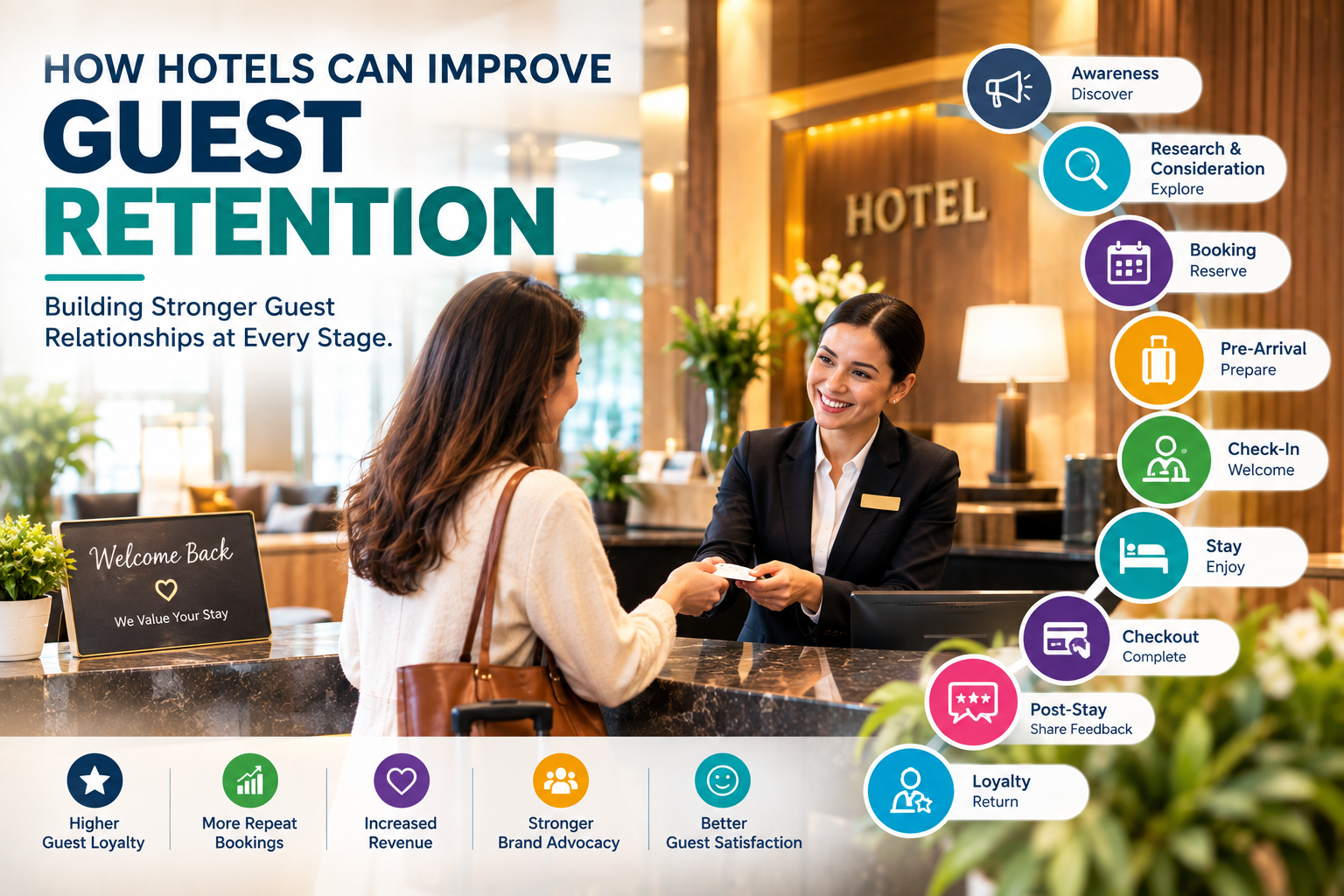
Attracting a new guest is important, but encouraging that guest to return can be equally valuable for a hotel. A guest who has already experienced a property’s service understands its location, facilities, staff, and overall experience. If the stay was positive, that familiarity can create a strong foundation for future bookings.
Guest retention is therefore an important part of long-term hospitality management. It involves creating experiences that encourage guests to choose the same hotel again while building trust and maintaining meaningful relationships between stays.
In a competitive hospitality market, hotels cannot rely only on discounts to bring guests back. Consistent service, personalization, convenience, communication, loyalty initiatives, and effective service recovery can all contribute to stronger guest relationships.
At BookSmart, we believe that guest retention begins with understanding what guests value and consistently delivering an experience that gives them a reason to return.
What Is Guest Retention in Hospitality?
Guest retention refers to a hotel’s ability to encourage existing guests to return for future stays rather than choosing another property.
Retention can involve several types of returning guests, including:
- Business travelers returning to the same city
- Families returning for holidays
- Guests visiting the same destination regularly
- Corporate travelers with recurring accommodation needs
- Loyalty program members
- Guests who recommend the hotel to others
A strong retention strategy focuses on the entire guest relationship rather than a single booking.
Why Guest Retention Matters for Hotels
Existing guests already have some familiarity with a hotel. They may know its services, location, room types, and booking process.
A returning guest may also require less introductory communication than someone who has never stayed at the property.
More importantly, repeat guests can become valuable sources of long-term business and referrals.
Strong retention can help hotels:
- Increase repeat bookings
- Strengthen guest loyalty
- Improve customer lifetime value
- Encourage direct bookings
- Generate referrals
- Build stronger brand relationships
- Reduce dependence on constant customer acquisition
However, retention should always be based on genuine guest satisfaction rather than simply trying to prevent guests from considering alternatives.
Deliver Consistent Guest Experiences
Consistency is one of the foundations of guest retention.
A guest who enjoyed excellent service during one visit may expect a similar standard during the next.
Hotels should therefore establish clear service standards across departments.
Consistency can include:
- Room cleanliness
- Front desk service
- Check-in and checkout
- Food quality
- Response times
- Maintenance
- Communication
- Billing accuracy
Consistency does not mean every stay needs to be identical. It means guests can reasonably expect the hotel to deliver its promised level of service.
Personalize the Guest Experience
Personalization can make returning guests feel recognized and valued.
Hotels can use appropriate guest information to understand preferences such as room types, communication preferences, dining interests, or previous requests.
For example, if a guest regularly requests a particular type of room, the hotel can take that preference into account when appropriate.
Personalization should always be handled responsibly and in accordance with applicable privacy requirements.
The objective is not to collect as much information as possible, but to use relevant information to make the guest experience more convenient.
Create an Effective Loyalty Program
Loyalty programs can provide a structured way to encourage repeat stays.
Hotels can offer benefits such as:
- Member-only rates
- Reward points
- Room-related benefits
- Special packages
- Dining offers
- Flexible benefits
- Personalized experiences
However, successful loyalty programs need to offer benefits that guests actually value.
A complicated program with difficult-to-understand rules may discourage participation.
Hotels should make membership easy to understand and provide clear information about how guests can earn and use benefits.
Make Direct Booking More Valuable
Hotels can use their direct booking channels to develop stronger relationships with guests.
When guests book directly through a hotel’s website or other owned channels, the property can communicate with them more directly throughout the customer journey.
Hotels can make direct booking attractive through appropriate benefits, such as member rates, flexible booking conditions, or additional services.
The focus should be on providing genuine value rather than simply offering discounts.
Communicate Before, During, and After the Stay
Guest relationships do not begin at check-in and end at checkout.
Hotels can communicate with guests at different stages of the customer lifecycle.
Before arrival, communication can provide useful information about check-in, transportation, facilities, or special requests.
During the stay, guests can be given convenient ways to request services or ask questions.
After checkout, hotels can thank guests, invite feedback, and share relevant information about future stays.
Communication should be timely and useful rather than excessive.
Use Guest Feedback to Improve Service
Guest feedback provides valuable information about what is working and what needs improvement.
Hotels can collect feedback through:
- Post-stay surveys
- Online reviews
- Direct conversations
- Digital feedback forms
- Customer service interactions
The important step is acting on the information.
If several guests report the same issue, management should investigate the underlying cause.
Guests are more likely to develop trust when they see that feedback leads to meaningful improvements.
Respond Effectively to Complaints
Even well-managed hotels will occasionally receive complaints.
The way a hotel responds can influence whether an unhappy guest decides to return.
Employees should listen carefully, acknowledge the concern, explain the next steps, and work toward an appropriate resolution.
Service recovery should not simply focus on closing a complaint. Hotels should also analyze recurring complaints to determine whether operational changes are required.
A problem that is repeatedly solved for individual guests but never addressed at its source can continue affecting future stays.
Empower Employees to Solve Guest Problems
Frontline employees often have the greatest influence on the guest experience.
Giving employees appropriate authority to resolve reasonable guest issues can improve service responsiveness.
For example, employees may be allowed to provide certain service adjustments or escalate issues through clearly defined procedures.
Empowerment should be supported by training and clear guidelines.
Employees need to understand both what they can do independently and when management approval is required.
Make Returning Guests Feel Recognized
Recognition can be a simple but meaningful part of guest retention.
Hotels can acknowledge returning guests through appropriate service interactions, loyalty benefits, or personalized communication.
Recognition does not always require expensive upgrades or complimentary services.
A professional welcome, remembering a relevant preference, or making the arrival process easier can create a positive impression.
The goal is to demonstrate that the hotel values the ongoing relationship.
Improve Convenience Through Technology
Technology can remove friction from the guest journey.
Hotels can use digital tools to provide:
- Online booking
- Digital check-in options
- Mobile communication
- Digital payments
- Service requests
- Personalized notifications
- Digital loyalty accounts
Technology should make interactions easier rather than create additional complexity.
Hotels should also provide human assistance when guests prefer traditional service or need help with digital processes.
Build a Strong Guest Relationship Through CRM
Customer Relationship Management systems can help hotels organize guest information and interactions.
A hospitality CRM can potentially bring together relevant information about bookings, preferences, communication, feedback, and loyalty participation.
This allows hotels to understand guest relationships more effectively.
For example, marketing teams can use appropriate historical information to create relevant offers for previous guests.
CRM systems should be managed carefully, with appropriate privacy controls and responsible use of guest information.
Create Relevant Offers
Hotels can encourage repeat stays through offers that match guest interests.
For example, a business traveler may be interested in convenient weekday accommodation, while a family may be more interested in holiday packages.
Relevant offers are generally more useful than sending the same promotion to every guest.
Hotels can use customer segmentation to create communication groups based on factors such as travel purpose, booking behavior, destination preferences, or loyalty status.
The objective is to make offers more relevant rather than simply increasing the number of promotional messages.
Stay Connected Between Visits
The relationship with a guest should not disappear after checkout.
Hotels can maintain appropriate engagement through:
- Destination information
- Seasonal updates
- Loyalty communications
- Relevant travel content
- Special events
- Personalized offers
The frequency of communication should depend on guest preferences and the value of the information being shared.
Too many irrelevant messages can cause guests to disengage.
Build Emotional Connections
Hospitality is not only about rooms and facilities. It is also about how guests feel during their stay.
Employees can create positive emotional connections through genuine communication, empathy, attention to detail, and thoughtful service.
Small moments can become memorable.
A warm welcome, assistance during a difficult situation, or thoughtful response to a special request can influence how guests remember a property.
These experiences can become an important part of a hotel’s relationship with returning guests.
Maintain Quality Across Every Department
Guest retention is not the responsibility of the front office alone.
Housekeeping, food and beverage, maintenance, reservations, sales, security, and management all contribute to the guest experience.
A hotel may provide excellent reception service, but repeated housekeeping problems can still affect the guest’s decision to return.
Hotels should therefore monitor service quality across the entire guest journey.
Cross-department communication can help ensure that guest needs are addressed consistently.
Use Data to Understand Retention
Hotels can use data to understand guest retention patterns.
Useful metrics include:
- Repeat booking rate
- Guest lifetime value
- Loyalty membership
- Direct booking percentage
- Guest satisfaction
- Review trends
- Cancellation behavior
- Average number of stays per guest
These metrics can help hotels identify which guest groups return most frequently and which experiences may influence retention.
Data should support decision-making rather than replace human understanding of guest needs.
Make the Booking Process Easy for Returning Guests
Returning guests should not have to repeat unnecessary steps every time they book.
Hotels can make repeat booking easier through saved preferences, loyalty accounts, mobile-friendly websites, and streamlined booking processes.
Where appropriate and permitted, relevant guest information can be used to reduce friction.
A simple booking experience can remove one of the barriers to choosing the same hotel again.
Avoid Relying Only on Discounts
Discounts can attract attention, but they should not become the foundation of guest retention.
If guests return only when prices are reduced, the hotel may struggle to maintain profitability.
A stronger retention strategy combines competitive pricing with service quality, convenience, recognition, personalization, and meaningful benefits.
Guests should have reasons to return beyond price.
Train Employees for Relationship-Based Hospitality
Employees need appropriate training to support guest retention.
Training can cover:
- Communication
- Personalization
- Complaint handling
- Service recovery
- Guest recognition
- Problem-solving
- Digital tools
- Cultural awareness
Employees should understand that every interaction can influence the guest’s perception of the hotel.
Training should also be continuous rather than limited to the employee’s first few days.
The Role of Artificial Intelligence in Guest Retention
Artificial Intelligence can support retention by analyzing guest behavior and identifying patterns.
Potential applications include:
- Personalized recommendations
- Guest segmentation
- Predictive analytics
- Automated customer support
- Sentiment analysis
- Targeted communication
- Demand forecasting
AI can help hotels process large amounts of information efficiently.
However, guest retention should not become completely automated. Human interaction remains an important part of hospitality, particularly when guests have complex needs or concerns.
Measuring the Success of Guest Retention Strategies
Hotels should regularly evaluate whether their retention initiatives are working.
Important indicators include:
- Repeat guest percentage
- Repeat booking frequency
- Customer lifetime value
- Loyalty program engagement
- Direct booking rate
- Guest satisfaction
- Online review trends
- Complaint resolution
- Referral activity
These measurements can help management understand which areas require improvement.
Conclusion
Guest retention is about creating a hotel experience that guests trust and want to experience again. While pricing and promotions can influence booking decisions, long-term retention depends on a much broader combination of service quality, consistency, personalization, convenience, recognition, communication, and relationship management.
Hotels can strengthen retention by delivering consistent experiences, creating useful loyalty programs, using CRM systems responsibly, listening to feedback, empowering employees, simplifying technology, and staying connected with guests between visits.
At BookSmart, we believe that successful guest retention begins with a simple principle: every stay should create a reason for the guest to consider returning. When hotels combine thoughtful hospitality with smart technology and data-driven insights, they can build stronger guest relationships while creating sustainable opportunities for repeat business.
The future of hospitality will increasingly focus on relationships rather than individual transactions. Hotels that understand their guests, respect their preferences, and consistently deliver meaningful experiences can create a guest journey that continues well beyond a single stay.