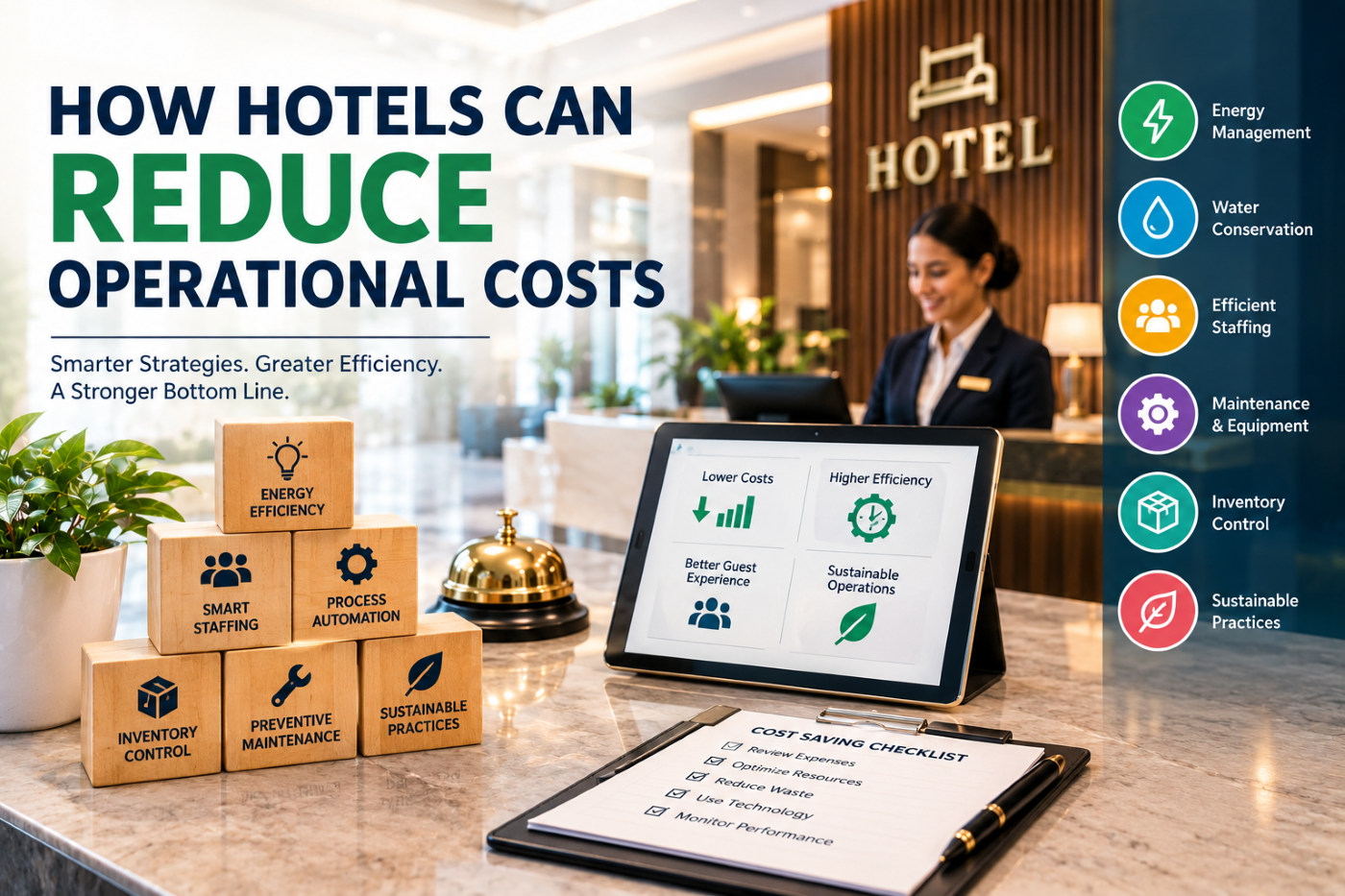
Running a hotel involves managing a wide range of expenses every day. From employee salaries and utilities to housekeeping supplies, food inventory, maintenance, technology, procurement, and marketing, operational costs can quickly add up. At the same time, hotels must maintain high service standards and deliver a comfortable experience to guests.
This makes cost management one of the most important responsibilities in modern hospitality management. Cutting operational costs does not mean cutting essential services or compromising guest satisfaction. Instead, it involves identifying unnecessary expenses, improving processes, using resources more efficiently, and making better decisions based on accurate data.
At BookSmart, we believe that hotels can achieve sustainable cost efficiency by combining thoughtful planning, technology, employee involvement, and continuous operational improvement.
Understanding Hotel Operational Costs
Hotel operational costs are the expenses involved in running a property on a daily basis. These costs can vary depending on the hotel’s size, location, category, occupancy levels, facilities, and business model.
Common hotel operating expenses include:
- Employee wages and benefits
- Electricity and water
- Housekeeping supplies
- Food and beverage inventory
- Maintenance
- Technology
- Laundry
- Procurement
- Marketing
- Insurance
- Administrative expenses
Some costs are relatively fixed, while others change according to occupancy and business activity. Understanding this difference helps hotel managers identify where cost optimization is possible.
The first step toward reducing costs is therefore not immediately cutting expenses, but understanding where money is being spent and why.
Analyze Expenses Regularly
Hotels should regularly review their operating expenses to identify unnecessary spending and changing cost patterns.
Monthly or quarterly financial reviews can reveal areas where expenses are increasing faster than revenue.
Management can compare current spending with:
- Previous periods
- Budget targets
- Occupancy levels
- Department performance
- Supplier prices
- Industry benchmarks
For example, if housekeeping costs increase significantly while occupancy remains stable, management can investigate whether the increase is related to staffing, supplies, laundry, overtime, or another factor.
Regular analysis allows hotels to address problems before they become larger financial challenges.
Improve Staff Scheduling
Labor is one of the largest operational expenses for many hotels. However, reducing staff indiscriminately can negatively affect service quality.
Instead, hotels can improve workforce scheduling by matching staffing levels with actual demand.
Occupancy forecasts, reservations, group bookings, events, seasonal trends, and historical data can help managers determine how many employees are required during different periods.
For example, staffing levels may need to be higher during peak check-in periods and lower during quieter hours.
Technology-based workforce scheduling tools can help managers create more efficient schedules while reducing unnecessary overtime and understaffing.
Cross-Train Employees
Cross-training employees can provide greater flexibility while supporting cost efficiency.
Employees who understand multiple functions can assist other departments when demand changes.
For example, an employee with experience in front office operations may be able to support reservations during busy periods. Similarly, employees can be trained to perform multiple related tasks within housekeeping or food and beverage operations.
Cross-training does not mean expecting employees to perform unlimited responsibilities. Instead, it creates a more adaptable workforce and reduces dependence on a single role or individual.
It can also provide employees with opportunities to develop new skills.
Reduce Energy Consumption
Energy is a significant expense for hotels because properties operate continuously.
Heating, cooling, lighting, hot water, kitchens, laundry, elevators, and other systems can consume large amounts of electricity and fuel.
Hotels can reduce energy costs through:
- Energy-efficient lighting
- Smart thermostats
- Occupancy sensors
- Efficient HVAC systems
- Building management systems
- Regular equipment maintenance
- Energy monitoring
- Employee awareness programs
Smart energy management can help hotels identify areas where consumption is unnecessarily high.
The objective should be to eliminate waste rather than reduce guest comfort.
Manage Water Consumption
Water management can also contribute to lower operating costs.
Hotels use water in guest rooms, kitchens, laundry facilities, swimming pools, landscaping, and cleaning operations.
Water-efficient fixtures, leak detection systems, efficient laundry practices, and responsible housekeeping procedures can reduce consumption.
Hotels should also monitor water usage regularly.
Unexpected increases in consumption may indicate leaks or equipment problems that require immediate attention.
Optimize Housekeeping Operations
Housekeeping directly affects both hotel quality and operating costs.
Hotels can improve housekeeping efficiency by coordinating room cleaning with occupancy, expected arrivals, departures, and guest preferences.
Digital housekeeping systems can provide real-time information about room status and maintenance requirements.
Better coordination can reduce unnecessary room inspections, communication delays, and repeated work.
Hotels can also review the use of cleaning supplies and establish appropriate inventory controls to prevent over-ordering and wastage.
Reduce Food Waste
Food and beverage operations can generate significant waste if inventory is not managed properly.
Hotels can use demand forecasting to estimate food requirements based on occupancy, events, restaurant reservations, and historical consumption.
Other strategies include:
- Monitoring portion sizes
- Improving inventory rotation
- Using appropriate storage methods
- Tracking expired products
- Reviewing buffet quantities
- Repurposing suitable ingredients responsibly
- Monitoring purchasing patterns
Reducing food waste can lower purchasing costs while supporting sustainability objectives.
Improve Procurement and Supplier Management
Procurement has a major impact on hotel profitability.
Hotels purchase everything from food and beverages to linens, cleaning supplies, furniture, maintenance equipment, and technology.
Businesses can improve procurement efficiency by consolidating suitable purchases, negotiating contracts, comparing suppliers, and establishing clear purchasing policies.
Supplier performance should also be reviewed regularly.
The lowest purchase price is not always the lowest overall cost. Quality, reliability, delivery times, warranty terms, and product lifespan should also be considered.
A cheaper product that requires frequent replacement may ultimately cost more.
Use Technology to Reduce Manual Work
Technology can help hotels reduce administrative costs by automating repetitive processes.
Examples include:
- Digital reservations
- Automated guest communication
- Electronic invoices
- Digital staff checklists
- Inventory management
- Automated reporting
- Online payments
- Digital maintenance requests
Automation can reduce repetitive administrative work and allow employees to focus on tasks that require human interaction and decision-making.
However, hotels should evaluate technology based on actual business needs. Investing in unnecessary software can create additional costs rather than reducing them.
Preventive Maintenance Saves Money
Unexpected equipment failures can be expensive.
A malfunctioning air-conditioning unit, refrigerator, boiler, elevator, washing machine, or kitchen appliance can disrupt operations and require urgent repairs.
Preventive maintenance helps hotels identify potential problems before they become major failures.
Maintenance schedules should cover critical equipment and building systems.
Hotels can also use digital maintenance platforms to track service history, inspections, repair costs, and upcoming maintenance requirements.
Preventive maintenance can reduce emergency repair expenses and extend equipment lifespan.
Reduce Laundry Costs
Laundry is an important operational expense, particularly for hotels with high occupancy.
Hotels can reduce laundry costs through efficient washing equipment, optimized laundry schedules, appropriate detergent usage, and water and energy management.
Guest linen-reuse programs can also reduce unnecessary washing.
Such programs should be communicated clearly and implemented in a way that gives guests control over their preferences.
Hotels should also monitor linen inventory to reduce losses and unnecessary replacement costs.
Control Inventory More Effectively
Excess inventory ties up money and can create storage and wastage problems.
Insufficient inventory, on the other hand, can lead to operational disturbances and emergency purchasing.
Hotels should establish appropriate stock levels based on actual usage.
Digital inventory management systems can help monitor:
- Current stock
- Usage rates
- Reorder points
- Supplier deliveries
- Expiry dates
- Inventory value
Regular inventory audits can identify discrepancies and reduce unnecessary purchasing.
Improve Digital and Marketing Efficiency
Marketing is essential for generating bookings, but hotels should monitor the return generated by different marketing activities.
Instead of spending equally across every channel, hotels can analyze which campaigns and distribution channels generate meaningful bookings.
Website performance, direct booking rates, online advertising, social media campaigns, email marketing, and travel distribution platforms can be evaluated based on their costs and results.
Improving direct bookings where appropriate can also help hotels reduce dependency on channels that charge commissions.
The objective is not simply to spend less on marketing but to spend more effectively.
Reduce Paper-Based Processes
Paper, printing, storage, and manual documentation may appear to be small expenses, but they can accumulate over time.
Hotels can digitize suitable processes such as:
- Guest communications
- Staff checklists
- Internal reports
- Maintenance requests
- Invoices
- Training records
- Inventory documentation
Digital processes can reduce material costs while also improving accessibility as well as operational efficiency.
Sensitive information should, however, be managed securely and according to applicable privacy requirements.
Use Data for Better Cost Decisions
Data analytics can help hotel managers understand where operational costs are coming from.
Management can track metrics such as:
- Cost per occupied room
- Energy cost per room
- Labor cost percentage
- Food cost percentage
- Maintenance expenses
- Inventory turnover
- Laundry cost per occupied room
These metrics provide a clearer picture of operational performance.
For example, if the cost per occupied room increases even though occupancy remains stable, managers can investigate the underlying reasons rather than making arbitrary budget cuts.
Avoid Cost Cutting That Hurts Guest Experience
One of the biggest risks in hotel cost management is reducing expenses without considering their effect on guests.
Removing important services, reducing cleanliness standards, understaffing critical departments, or lowering product quality can damage guest satisfaction.
Negative reviews and declining customer loyalty may ultimately cost more than the original savings.
Hotels should therefore focus on eliminating waste and improving efficiency rather than simply reducing spending.
The right question is not, “What can we cut?” but rather, “How can we deliver the same or better value using resources more effectively?”
Involve Employees in Cost Management
Employees often have important insights into operational inefficiencies because they experience hotel processes every day.
Management can encourage employees to identify:
- Repetitive tasks
- Unnecessary purchases
- Equipment problems
- Supply wastage
- Communication gaps
- Inefficient processes
Creating a culture where employees can suggest improvements can uncover cost-saving opportunities that management may not notice.
Employees should also understand that cost management is about responsible resource use rather than simply reducing budgets.
Create Department-Level Budgets
Instead of managing costs only at the property level, hotels can establish budgets for individual departments.
Departments such as housekeeping, food and beverage, maintenance, front office, and administration can track their own expenses.
Managers can compare actual spending against budgets and investigate significant differences.
Department-level accountability makes financial management more transparent and encourages teams to think carefully about resource use.
Build a Long-Term Cost Optimization Strategy
Cost management should be an ongoing process.
Hotels should regularly review their operations and identify opportunities for improvement.
A long-term strategy can include:
- Monitoring operational expenses.
- Improving workforce scheduling.
- Reducing energy and water waste.
- Optimizing procurement.
- Improving inventory management.
- Automating repetitive processes.
- Using preventive maintenance.
- Reducing food and laundry waste.
- Measuring departmental performance.
- Protecting guest experience while improving efficiency.
This approach creates sustainable cost management instead of temporary savings.
The Future of Hotel Cost Management
Technology will play an increasingly important role in controlling hotel operating costs.
Artificial Intelligence can support demand forecasting, workforce planning, procurement analysis, and energy optimization.
IoT devices can monitor equipment and building systems, while automation can reduce repetitive administrative work.
Cloud-based platforms can give hotel managers access to financial and operational information in real time.
However, technology alone will not solve cost challenges. Hotels still need effective processes, skilled employees, responsible management, and continuous evaluation.
Conclusion
Reducing hotel operational costs is not about making indiscriminate cuts. It is about improving the way resources are used while maintaining the quality of the guest experience.
Hotels can control costs by analyzing expenses, optimizing staff schedules, improving procurement, reducing energy and water consumption, managing inventory, preventing equipment failures, reducing food and laundry waste, and using technology strategically.
At BookSmart, we believe that competent cost management should create greater efficiency without compromising hospitality. When hotels combine financial discipline with smart technology, employee involvement, and data-informed decision-making, they can build stronger operations and improve long-term profitability.
The future of hospitality will require hotels to be both guest-focused and resource-conscious. Businesses that continuously look for smarter ways to operate will be better positioned to manage costs, respond to changing market conditions, and deliver consistent value to their guests.
Leave a Reply