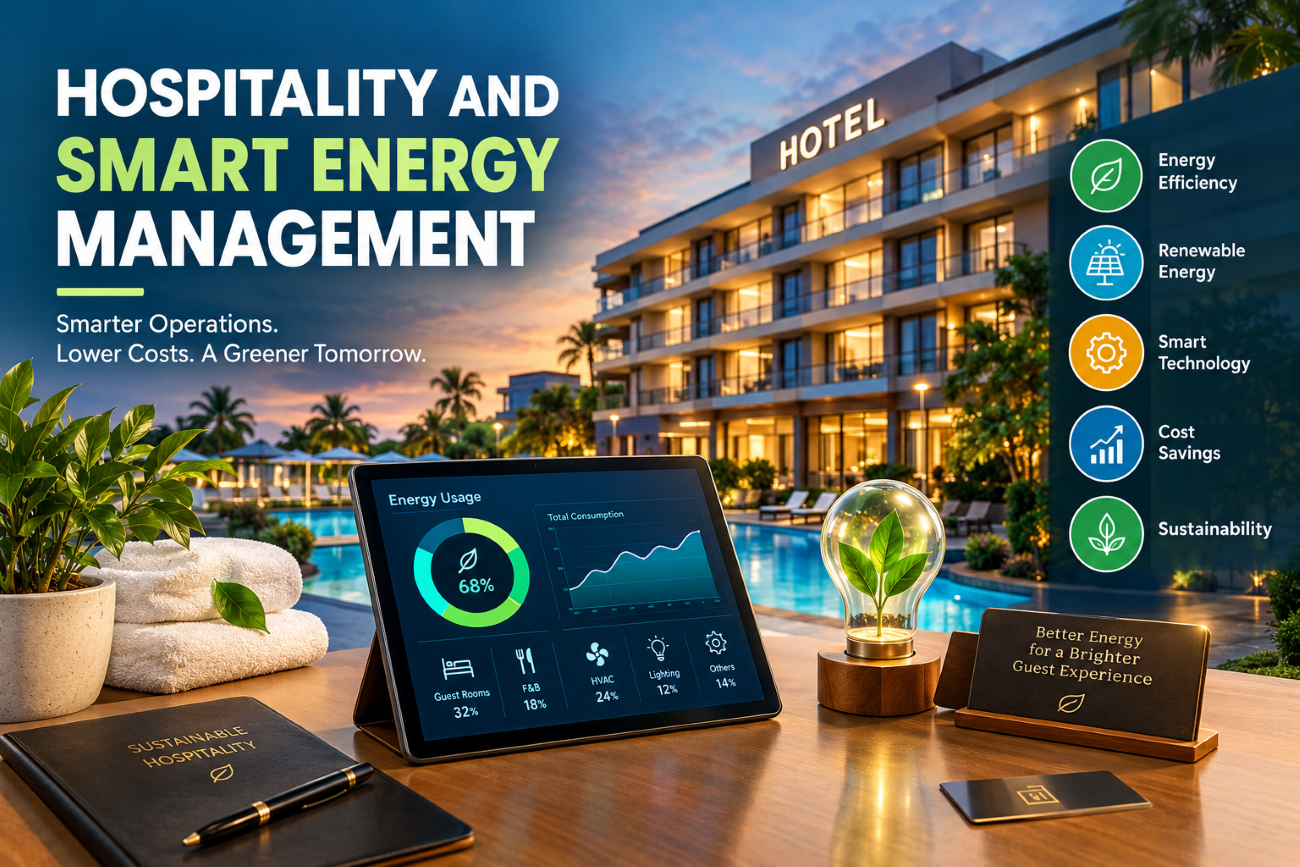
Energy is one of the most important resources in the hospitality industry. Hotels operate around the clock, with lighting, heating, cooling, hot water, kitchens, laundry facilities, elevators, electronic systems, and guest-room equipment consuming energy every day. As operating costs increase and sustainability becomes a greater priority, hotels are looking for smarter ways to manage their energy consumption without compromising guest comfort.
Smart energy management provides a practical approach to this challenge. By combining digital technology, automation, sensors, data analytics, and efficient equipment, hotels can monitor how energy is being used and identify opportunities to reduce unnecessary consumption. The objective is not simply to use less energy, but to use energy more intelligently.
At BookSmart, we believe smart energy management can help hospitality businesses improve operational efficiency, control costs, support sustainability initiatives, and create more responsible hotel operations.
What Is Smart Energy Management in Hospitality?
Smart energy management refers to the use of technology and data to monitor, control, and optimize energy consumption across a hotel. Traditional energy management often depends on fixed schedules or manual monitoring. Smart systems can respond dynamically to occupancy, room usage, weather conditions, equipment performance, and other operational factors.
A smart energy management system may connect lighting, heating, ventilation, air conditioning, water heating, building systems, and other equipment to a centralized platform. Hotel managers can then monitor consumption and identify unusual patterns or areas of waste.
For example, an empty guest room does not need to operate at exactly the same temperature as an occupied room. Smart controls can adjust energy use according to room occupancy while maintaining comfortable conditions when guests return.
Why Energy Management Matters for Hotels
Energy represents a significant operating expense for many hospitality businesses. Hotels require energy not only for guest rooms but also for kitchens, restaurants, laundry, offices, common areas, pools, conference facilities, and other amenities.
Poor energy management can result in unnecessary consumption and higher operating costs. At the same time, excessive energy use can increase a property’s environmental footprint.
Smart energy management can help hotels:
- Reduce unnecessary energy consumption
- Control operating costs
- Improve equipment efficiency
- Monitor energy performance
- Reduce environmental impact
- Support sustainability goals
- Identify equipment problems
- Improve operational decision-making
The benefits can extend beyond financial savings. Efficient energy management can become part of a hotel’s broader sustainability and guest-experience strategy.
Smart HVAC Systems
Heating, ventilation, and air conditioning systems are among the most important energy-consuming systems in hotels.
Smart HVAC technology can adjust temperature and airflow based on factors such as room occupancy, outdoor temperature, time of day, and guest preferences.
For example, when a room becomes vacant, the system can automatically adjust its temperature settings. When a guest is expected to arrive, the room can gradually return to a comfortable setting.
Hotels can also use smart HVAC controls in meeting rooms, restaurants, and other public areas.
Instead of operating every system at maximum capacity throughout the day, hotels can match energy consumption with actual demand.
Occupancy Sensors and Smart Rooms
Occupancy sensors can play an important role in hotel energy management.
Sensors can detect whether a guest room or public area is occupied and trigger appropriate changes in lighting, temperature, or other systems.
Smart room technology can also allow guests to control lighting and temperature through connected devices or room controls.
The key is to design these systems around convenience. Energy-saving features should operate naturally without making guests feel that comfort has been sacrificed.
When technology works in the background, hotels can improve energy efficiency while maintaining a positive guest experience.
Intelligent Lighting Management
Lighting is another area where hotels can achieve greater efficiency.
Traditional lighting systems may remain active even when areas are unoccupied. Smart lighting systems can use occupancy sensors, schedules, and daylight information to adjust lighting automatically.
Hotels can also use energy-efficient lighting technology throughout guest rooms, corridors, restaurants, conference areas, and outdoor spaces.
For example, corridor lighting can be adjusted based on occupancy and time of day rather than operating at the same level continuously.
Smart lighting can therefore reduce unnecessary energy use while maintaining appropriate visibility and ambiance.
Real-Time Energy Monitoring
One of the major advantages of smart energy management is visibility.
A hotel cannot effectively manage energy consumption without understanding where and when energy is being used.
Digital energy monitoring systems can provide information about consumption across different areas of a property.
Managers can monitor:
- Guest rooms
- HVAC systems
- Kitchens
- Laundry
- Swimming pools
- Restaurants
- Conference spaces
- Common areas
Real-time information can reveal unusual consumption patterns and help management identify areas requiring attention.
Instead of waiting for monthly utility bills, hotel teams can make decisions using current operational data.
Predictive Maintenance and Energy Efficiency
Equipment that is not operating properly may consume more energy than necessary.
A malfunctioning HVAC unit, refrigerator, boiler, pump, or other system can increase energy consumption while reducing performance.
Smart monitoring systems can identify unusual equipment behavior and alert maintenance teams.
Predictive maintenance can help hotels address potential problems before they become major failures.
This approach can improve equipment performance, reduce downtime, and potentially extend the useful life of important systems.
Smart Water Heating and Management
Hot water is essential in hospitality and can require substantial amounts of energy.
Hotels can improve efficiency by using smart water heating systems that monitor demand and adjust heating accordingly.
Efficient boilers, heat pumps, insulation, water-saving fixtures, and temperature controls can also reduce energy requirements.
Hotels should consider both water consumption and the energy required to heat and distribute that water.
Combining water and energy management can produce broader operational benefits.
Renewable Energy Integration
Smart energy management can also support the integration of renewable energy.
Hotels may use technologies such as solar photovoltaic systems to generate electricity on-site where suitable.
However, generating renewable energy is only one part of the equation. Hotels also need to understand when energy is being produced and when it is being consumed.
Smart energy platforms can help monitor generation and consumption, allowing businesses to make better use of available energy.
Battery storage and other technologies may also support energy management where appropriate and economically viable.
Energy Management in Hotel Kitchens
Hotel kitchens operate equipment such as ovens, refrigerators, freezers, dishwashers, exhaust systems, and cooking appliances for extended periods.
Poorly managed kitchen equipment can result in significant energy waste.
Hotels can improve kitchen energy efficiency by:
- Maintaining refrigeration equipment
- Turning off suitable equipment when not required
- Using energy-efficient appliances
- Monitoring cooking schedules
- Maintaining appropriate refrigerator temperatures
- Preventing unnecessary heat loss
- Training kitchen employees
Smart monitoring can help identify equipment that consumes unusually high amounts of energy.
Laundry and Energy Optimization
Laundry operations can be another major source of energy and water consumption.
Hotels process large quantities of towels, bedsheets, uniforms, and other linens.
Efficient washing machines, dryers, boilers, and water-heating systems can reduce resource consumption.
Hotels can also use data to optimize laundry schedules according to occupancy and demand.
Guest participation can contribute as well. Clear linen-reuse programs can reduce unnecessary washing while giving guests the opportunity to participate in sustainability initiatives.
Using Data Analytics for Energy Decisions
Data analytics can turn energy information into useful operational insights.
Hotels can compare energy consumption with occupancy levels, weather conditions, room usage, and other factors.
For example, management may discover that energy consumption remains unusually high even when occupancy is low. This could indicate inefficient equipment, poor scheduling, or systems operating unnecessarily.
Energy performance indicators can help management track progress over time.
Useful measurements may include energy consumption per occupied room or energy use by specific hotel departments.
Data-driven management makes energy improvement more measurable and easier to evaluate.
Employee Training and Energy Awareness
Technology is important, but employees remain essential to successful energy management.
Staff members influence energy consumption through everyday activities.
Housekeeping teams, kitchen employees, maintenance staff, front desk teams, and managers can all contribute to energy efficiency.
Hotels can provide training on:
- Turning off unused equipment
- Reporting equipment problems
- Using HVAC systems appropriately
- Managing lighting
- Operating kitchen equipment efficiently
- Following sustainability procedures
Employees should understand why energy management matters and how their actions contribute to hotel performance.
Guest Participation in Smart Energy Management
Guests can also contribute to responsible energy use.
Hotels can provide simple options that allow guests to participate without reducing comfort.
Examples include:
- Optional linen reuse
- Energy-efficient room controls
- Clear sustainability information
- Smart temperature controls
- Digital communication instead of unnecessary printed materials
Communication should be informative rather than demanding.
Guests are more likely to participate when sustainability initiatives are convenient and clearly explained.
Reducing Energy Costs Without Reducing Guest Comfort
A common concern is that energy-saving measures could negatively affect the guest experience.
However, smart energy management focuses on eliminating unnecessary consumption rather than reducing essential comfort.
For example, automatically adjusting an empty room’s temperature is different from making an occupied room uncomfortably warm or cold.
The best systems operate intelligently in the background.
Hotels should monitor guest feedback when introducing new energy technologies to ensure that efficiency improvements do not create unintended service problems.
Challenges in Implementing Smart Energy Management
Although smart energy systems offer many benefits, implementation requires planning.
Hotels may face challenges such as:
- Initial investment costs
- Integration with existing systems
- Employee training
- Technology maintenance
- Data management
- Cybersecurity concerns
- Compatibility between devices
Older properties may also have legacy infrastructure that makes modernization more complicated.
Hotels should therefore develop an implementation plan based on their property size, energy profile, budget, and operational priorities.
Starting with high-consumption areas can help demonstrate measurable results before expanding the program.
The Role of Hotel Management
Management plays an important role in creating an effective energy strategy.
Leaders should establish clear goals, monitor performance, allocate responsibilities, and ensure that employees understand the hotel’s energy objectives.
Energy management should not be treated as the responsibility of one department alone.
Housekeeping, engineering, food and beverage, front office, finance, and senior management can all contribute to better energy performance.
Cross-department collaboration makes it easier to identify opportunities and implement changes.
Smart Energy Management and Sustainability
Energy efficiency is closely connected to hotel sustainability.
Reducing unnecessary energy consumption can help hotels lower their environmental impact while controlling operating costs.
Energy management can also support broader sustainability initiatives involving carbon reduction, resource conservation, responsible operations, and environmental reporting.
For hotels working toward sustainability certifications, energy monitoring and efficiency measures may also form part of their broader environmental management efforts, depending on the certification requirements.
The Future of Smart Energy in Hospitality
The future of hotel energy management is likely to become increasingly automated and data-driven.
Artificial Intelligence can potentially analyze large amounts of energy data and identify patterns that may not be immediately visible to hotel managers.
IoT-connected devices can provide continuous information about building systems and equipment.
Smart buildings may increasingly adjust energy consumption automatically based on occupancy, weather, demand, and operational conditions.
As these technologies develop, hotels will have more opportunities to create flexible energy systems that respond to real-time conditions.
However, technology should always support clear business objectives. Hotels should evaluate whether a solution genuinely improves efficiency, reliability, guest experience, or sustainability before investing in it.
Conclusion
Smart energy management is becoming an important part of modern hotel operations. By combining sensors, automation, connected systems, data analytics, efficient equipment, and employee awareness, hotels can better understand and control how energy is consumed.
From smart HVAC systems and occupancy sensors to intelligent lighting, predictive maintenance, energy monitoring, renewable energy, and efficient hotel kitchens, there are many opportunities to improve energy performance.
At BookSmart, we believe that smart energy management should be viewed as a long-term operational strategy rather than a short-term cost-cutting exercise. The goal is to create hotels that use resources intelligently while maintaining the comfort and service guests expect.
As hospitality technology continues to advance, smart energy management can help hotels become more efficient, sustainable, and adaptable. By investing thoughtfully in technology and combining it with responsible human practices, hotels can build operations that are better prepared for the future of hospitality.
Leave a Reply