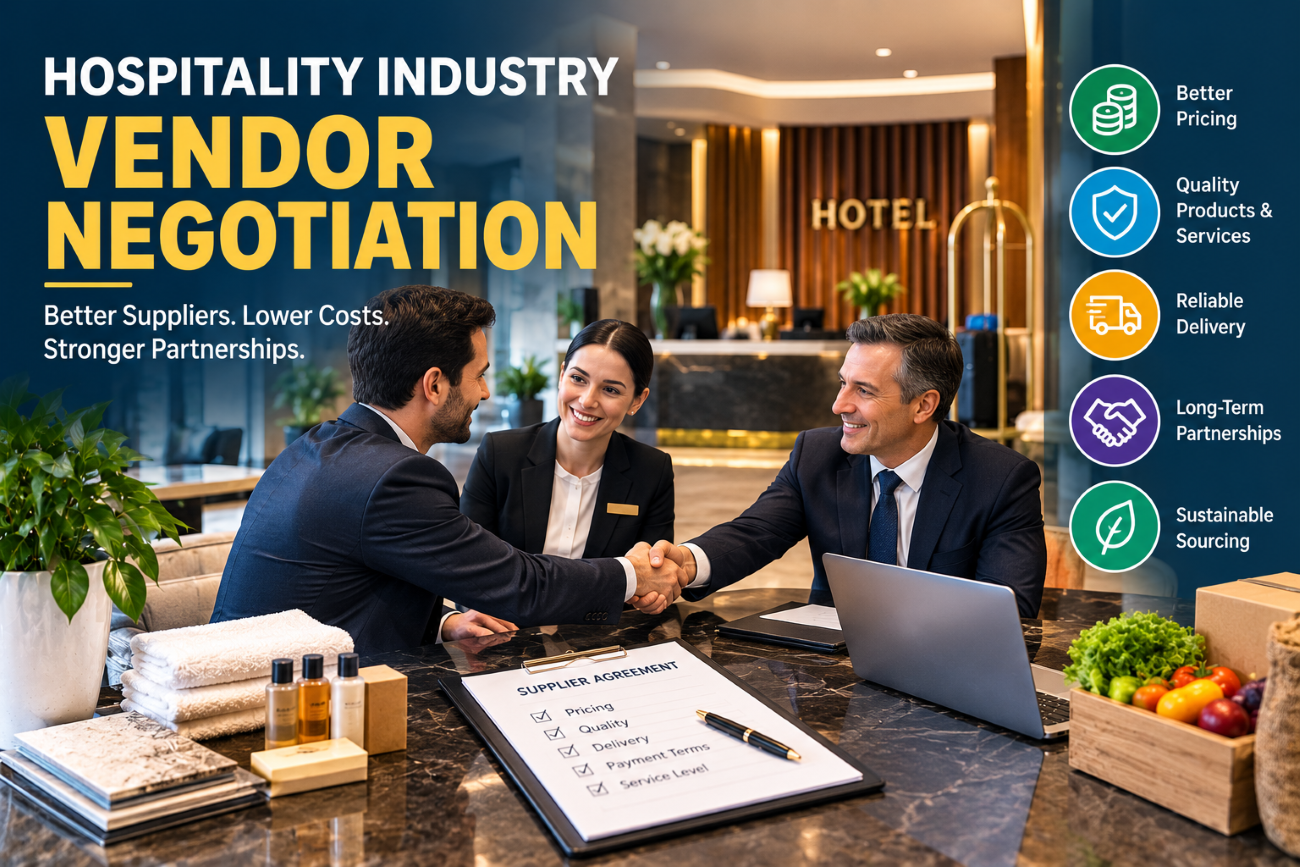
Hotels depend on a wide network of vendors and suppliers to keep their operations running smoothly. From food and beverages to linens, cleaning products, technology, maintenance equipment, furniture, amenities, and professional services, vendors play an important role in almost every area of hotel management.
Because hotels purchase such a wide variety of products and services, vendor negotiation has become an important part of hospitality business management. Effective negotiation can help hotels manage costs, maintain quality, improve delivery reliability, and establish stronger relationships with suppliers.
However, successful vendor negotiation is not simply about asking for the lowest possible price. A hotel that focuses only on price may end up compromising product quality, service reliability, delivery schedules, or long-term supplier relationships. A more effective approach considers the total value a vendor can provide.
At BookSmart, we believe that effective hospitality vendor negotiation should create a balance between cost, quality, reliability, flexibility, and long-term business value.
What Is Vendor Negotiation in the Hospitality Industry?
Hospitality vendor negotiation is the process through which hotels discuss and agree on pricing, product specifications, payment terms, delivery schedules, service levels, contracts, and other conditions with suppliers.
Hotels may negotiate with vendors for:
- Food and beverages
- Guest room amenities
- Cleaning supplies
- Linen and laundry products
- Furniture and fixtures
- Technology systems
- Maintenance services
- Security services
- Transportation
- Marketing services
- Office supplies
- Energy and utility-related services
The negotiation process can take place when selecting a new vendor, renewing an existing contract, expanding hotel operations, or responding to changing market conditions.
Why Vendor Negotiation Matters for Hotels
Vendor costs can have a direct impact on hotel profitability.
Even relatively small changes in purchasing costs can become significant when products are purchased in large quantities or on a regular basis.
Effective negotiation can help hotels:
- Control procurement costs
- Improve product quality
- Secure reliable delivery
- Reduce supply disruptions
- Obtain flexible payment terms
- Improve service agreements
- Manage inventory more effectively
- Build stronger supplier relationships
However, negotiation should not be treated as a one-time cost-cutting exercise. It should be part of a broader procurement strategy.
Understand Hotel Requirements Before Negotiating
Preparation is one of the most important parts of successful vendor negotiation.
Before contacting a supplier, hotels should understand exactly what they require.
This includes identifying:
- Product specifications
- Expected quantities
- Quality standards
- Delivery frequency
- Required service levels
- Budget limits
- Contract duration
- Payment preferences
For example, a hotel purchasing linens should define the required material, size, durability, washing requirements, color, and expected lifespan.
Clear specifications make it easier to compare vendors and negotiate meaningful terms.
Research the Vendor Market
Hotels should understand the supplier market before beginning negotiations.
Research can include comparing multiple vendors, reviewing product specifications, examining market prices, and evaluating supplier capabilities.
Hotels should also consider whether a vendor has experience working with hospitality businesses.
A supplier that understands hotel operations may be better prepared to handle urgent requirements, seasonal demand, and large-volume orders.
Market research gives hotels useful information and reduces dependence on a single supplier’s pricing assumptions.
Compare Vendors Beyond Price
Price is important, but it should not be the only factor used to evaluate vendors.
Hotels should consider the total value of a supplier, including:
- Product quality
- Delivery reliability
- Customer service
- Warranty
- Technical support
- Replacement policies
- Payment terms
- Scalability
- Sustainability practices
- Response time
A vendor offering a slightly higher price may provide better quality and fewer operational problems.
For example, purchasing low-quality maintenance equipment may appear economical initially but could result in frequent repairs and replacement costs.
Total cost of ownership is therefore often more useful than purchase price alone.
Negotiate Volume-Based Pricing
Hotels frequently purchase products in large quantities, which can create opportunities for volume-based pricing.
Suppliers may offer better rates when hotels commit to larger or recurring orders.
However, hotels should avoid purchasing excessive quantities simply to obtain a discount.
Large inventories can create storage costs, spoilage, product expiry, and cash-flow challenges.
Volume negotiations should therefore be based on realistic consumption patterns.
Historical purchasing data can help hotels determine appropriate quantities.
Discuss Payment Terms
Payment terms can have a significant effect on hotel cash flow.
Hotels may negotiate terms related to payment deadlines, deposits, installment structures, or early-payment discounts.
For example, a supplier may offer a discount for payment within a specific period, while another may provide longer payment terms.
Hotels should compare the overall financial impact rather than automatically choosing the lowest price.
Payment conditions should also be clearly documented in the final agreement.
Negotiate Delivery and Lead Times
Reliable delivery is essential in hospitality.
A delay in receiving food, linens, cleaning supplies, or maintenance materials can disrupt hotel operations.
Hotels should negotiate clear delivery expectations, including:
- Delivery schedules
- Lead times
- Emergency orders
- Minimum order quantities
- Shipping responsibilities
- Delivery charges
- Procedures for delayed shipments
For critical supplies, hotels may also consider backup suppliers to reduce dependence on a single vendor.
Establish Quality Standards
Quality expectations should be clearly defined before entering into a supplier agreement.
Hotels can specify product standards, inspection procedures, acceptable defect levels, replacement policies, and service requirements.
For example, food suppliers may need to meet specific quality, packaging, storage, and delivery requirements.
Clear quality standards reduce misunderstandings and provide a basis for addressing performance problems.
Negotiate Service-Level Agreements
For technology, maintenance, security, cleaning, and other service-based vendors, hotels should consider using Service-Level Agreements, commonly known as SLAs.
An SLA can define:
- Response times
- Resolution times
- Availability requirements
- Service standards
- Support hours
- Escalation procedures
- Performance measurements
For example, a hotel technology provider may be expected to respond to critical system failures within a defined period.
Clear service expectations help both parties understand their responsibilities.
Build Long-Term Vendor Relationships
Successful negotiation does not end when the contract is signed.
Hotels should maintain professional relationships with vendors throughout the partnership.
Long-term relationships can create advantages such as improved communication, better understanding of hotel requirements, faster issue resolution, and greater flexibility during unexpected situations.
Hotels should communicate their expectations clearly and provide vendors with appropriate feedback.
At the same time, suppliers should be evaluated objectively based on performance rather than personal relationships.
Use Data in Vendor Negotiations
Data can make hotel procurement negotiations more effective.
Hotels can analyze historical information such as:
- Purchase volumes
- Price changes
- Delivery performance
- Product defects
- Supplier response times
- Inventory usage
- Contract spending
This information allows procurement teams to negotiate from evidence rather than assumptions.
For example, if a hotel can demonstrate that it purchases a particular product consistently throughout the year, it may have a stronger basis for discussing volume-based pricing.
Data can also reveal which suppliers consistently meet expectations.
Centralize Procurement Where Appropriate
Large hotel groups may benefit from centralized procurement for commonly purchased products.
Centralization can increase purchasing volume and create stronger negotiating positions.
For example, multiple properties within the same group may negotiate together for standardized amenities, technology services, or cleaning supplies.
However, complete centralization is not always suitable.
Local suppliers may provide advantages in areas such as fresh food, local products, emergency delivery, and regional services.
A balanced procurement model can combine centralized purchasing with local sourcing where appropriate.
Avoid Overdependence on One Vendor
Strong vendor relationships are valuable, but excessive dependence on one supplier can create risks.
If a primary supplier experiences financial difficulties, production problems, transportation disruptions, or other challenges, the hotel may face shortages.
Hotels should identify critical suppliers and evaluate whether alternative sources are available.
Maintaining qualified backup vendors can improve business continuity.
This does not mean hotels must constantly switch suppliers. Instead, they should maintain enough flexibility to respond when circumstances change.
Include Sustainability in Vendor Selection
Sustainability is becoming increasingly relevant to hospitality procurement.
Hotels may evaluate suppliers based on:
- Sustainable materials
- Packaging practices
- Energy efficiency
- Waste reduction
- Ethical sourcing
- Environmental certifications
- Local sourcing
Sustainable procurement can support a hotel’s broader environmental objectives.
It can also influence brand perception among guests who value responsible business practices.
However, sustainability claims should be evaluated carefully, and hotels should request appropriate documentation when necessary.
Technology and Digital Vendor Management
Technology can simplify vendor management.
Modern procurement platforms can help hotels manage supplier information, purchase orders, invoices, contracts, approvals, and performance records.
Digital systems can also provide greater visibility into purchasing patterns.
Hotels can use this information to identify price changes, duplicate purchases, unusual spending, and opportunities for consolidation.
Automated workflows can also reduce manual paperwork and improve purchasing controls.
Vendor Performance Reviews
Negotiation should continue throughout the vendor relationship through regular performance reviews.
Hotels can evaluate suppliers using indicators such as:
- Delivery accuracy
- Product quality
- Pricing consistency
- Response time
- Service reliability
- Complaint resolution
- Contract compliance
Regular reviews allow hotels to identify problems early.
They also provide useful information when contracts are renewed or renegotiated.
Common Vendor Negotiation Mistakes
Hotels can face several challenges when negotiating with suppliers.
Common mistakes include:
- Focusing only on price
- Entering negotiations without preparation
- Failing to compare suppliers
- Ignoring delivery reliability
- Accepting unclear contract terms
- Overlooking hidden fees
- Failing to define quality standards
- Not reviewing vendor performance
- Depending too heavily on one supplier
Avoiding these mistakes can create stronger procurement outcomes.
Ethical and Transparent Negotiation
Vendor negotiation should be conducted professionally and ethically.
Hotels should maintain clear procurement policies and avoid conflicts of interest.
Supplier selection should be based on relevant business criteria such as quality, price, reliability, service, compliance, and value.
Transparent procurement processes can reduce operational and reputational risks.
Clear documentation is also important, particularly when dealing with large contracts or significant purchases.
Creating a Hospitality Vendor Negotiation Strategy
Hotels can create a structured approach to vendor negotiation by following several steps:
- Identify purchasing requirements.
- Analyze historical spending.
- Research available suppliers.
- Compare quality and pricing.
- Define negotiation objectives.
- Discuss pricing and volume.
- Negotiate payment and delivery terms.
- Establish quality and service standards.
- Document agreed conditions.
- Monitor vendor performance regularly.
This structured process makes procurement more consistent and measurable.
The Future of Hospitality Vendor Negotiation
Technology and data analytics will increasingly influence hotel procurement.
AI-powered systems may help identify pricing trends, forecast purchasing requirements, evaluate supplier performance, and detect unusual spending patterns.
Digital procurement platforms can also make vendor comparisons and contract management more efficient.
At the same time, relationships will remain important. Hospitality businesses will continue to depend on suppliers for reliable products and services, particularly during periods of high demand or disruption.
The future of vendor negotiation will therefore combine data-driven procurement with strong professional relationships.
Conclusion
Hospitality industry vendor negotiation is an important part of managing hotel costs, quality, and operational reliability. Hotels need suppliers that can provide the right products and services at appropriate prices while meeting expected standards for quality, delivery, and support.
Successful negotiation requires preparation, market research, data analysis, clear expectations, and effective communication. Hotels should evaluate suppliers based on overall value rather than focusing only on the lowest price.
At BookSmart, we believe that strong vendor relationships can become an important part of efficient hotel management. When hotels approach procurement strategically, they can improve cost control, strengthen supply reliability, and create partnerships that support long-term operational success.
As the hospitality industry becomes more technology-driven and competitive, vendor negotiation will continue to evolve. Hotels that combine smart procurement practices, digital tools, performance measurement, and ethical relationship management can build a more resilient and efficient supply network.
Leave a Reply