The relationship between a hotel and its guests does not begin when a guest walks through the front door. It starts much earlier, when a potential traveler first discovers a property, visits its website, reads reviews, compares prices, or makes an inquiry. Similarly, the relationship does not necessarily end at checkout. Post-stay communication, reviews, loyalty programs, and future booking opportunities can continue the relationship long after the guest has left.
This complete journey is known as the customer lifecycle. Hospitality customer lifecycle management focuses on understanding and managing every stage of this journey so hotels can provide relevant experiences, improve guest satisfaction, and build stronger long-term relationships.
At BookSmart, we believe that effective customer lifecycle management allows hotels to move beyond individual bookings and create meaningful guest relationships that can support repeat business and sustainable growth.
What Is Hospitality Customer Lifecycle Management?
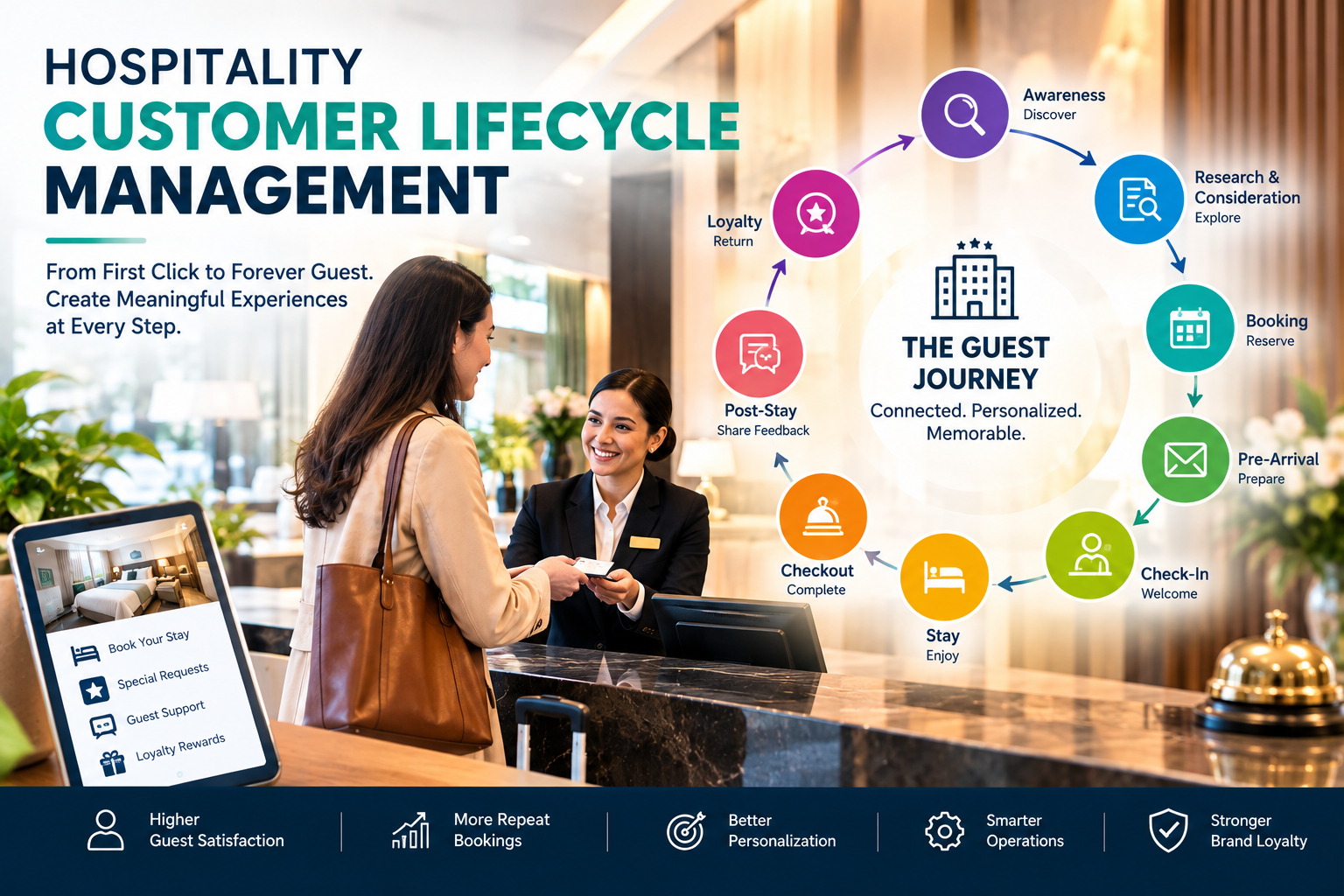
Hospitality customer lifecycle management is the process of managing a guest’s interactions with a hotel from the first point of awareness through booking, stay, checkout, and post-stay engagement.
A typical hotel customer lifecycle can include several stages:
- Awareness
- Research and consideration
- Booking
- Pre-arrival
- Check-in
- Stay
- Checkout
- Post-stay engagement
- Loyalty and repeat booking
Each stage provides an opportunity for hotels to understand guest expectations and deliver appropriate communication or services.
The objective is not to communicate with guests constantly. Instead, hotels should provide useful and timely interactions that make the guest journey easier and more personalized.
Why Customer Lifecycle Management Matters in Hospitality
Guests interact with hotels through multiple channels. They may discover a property through search engines, social media, travel platforms, recommendations, advertisements, or direct referrals.
Managing these interactions separately can create inconsistent experiences.
A customer lifecycle strategy helps hotels connect different touchpoints and develop a more complete understanding of guest needs.
Effective lifecycle management can help hotels:
- Improve guest satisfaction
- Increase direct bookings
- Encourage repeat stays
- Personalize communication
- Strengthen customer loyalty
- Improve marketing efficiency
- Identify guest preferences
- Increase the value of existing customers
It can also help hotels understand where potential guests are being lost during the booking journey.
Stage 1: Creating Awareness
The customer lifecycle begins when travelers become aware of a hotel.
Hotels can build awareness through websites, search engines, social media, travel platforms, online advertising, content marketing, reviews, and recommendations.
At this stage, potential guests may not yet be ready to make a booking. They are usually exploring destinations, comparing accommodation options, and forming their initial impressions.
Hotels should therefore focus on providing useful and accurate information rather than relying only on promotional messaging.
High-quality photographs, clear property information, location details, amenities, guest reviews, and useful destination content can help travelers understand what the hotel offers.
Stage 2: Research and Consideration
Once travelers become interested in a property, they usually begin comparing options.
They may compare:
- Room prices
- Location
- Amenities
- Reviews
- Cancellation policies
- Dining options
- Facilities
- Room types
- Guest experiences
This stage is particularly important because travelers can easily switch between competing properties.
Hotels can improve the consideration stage by providing clear information and making their websites easy to navigate.
Fast-loading pages, transparent pricing, detailed room descriptions, and simple booking processes can reduce uncertainty.
Guest reviews are also important because travelers often use the experiences of previous guests to assess a property.
Stage 3: Booking
The booking stage is where interest becomes a confirmed reservation.
A complicated booking process can cause potential guests to abandon their purchase.
Hotels should make booking as simple as possible across desktop and mobile devices.
A well-designed booking journey should provide:
- Clear room options
- Transparent pricing
- Available dates
- Relevant policies
- Secure payment options
- Confirmation details
Hotels can also use booking data to understand guest preferences and prepare for the next stage of the lifecycle.
Stage 4: Pre-Arrival Engagement
The customer relationship continues after the reservation is confirmed.
Pre-arrival communication can help guests prepare for their stay while giving hotels an opportunity to provide useful information.
Hotels may communicate information about:
- Check-in times
- Directions
- Parking
- Hotel facilities
- Dining options
- Local attractions
- Special requests
- Available upgrades
The goal should be to make the arrival experience easier.
Hotels should avoid sending excessive messages. Communication should be relevant to the guest’s reservation and preferences.
Stage 5: Check-In Experience
The arrival experience creates an important impression.
Guests may have traveled for several hours before reaching the hotel, so a smooth and welcoming check-in process can set the tone for their stay.
Technology can support this stage through digital registration, mobile communication, automated notifications, and other convenient options.
However, technology should complement human hospitality.
A friendly welcome, clear communication, and willingness to assist can be just as important as an efficient digital process.
Stage 6: Managing the Guest Stay
The stay stage is where hotels have the greatest opportunity to deliver their promised experience.
Every interaction can influence guest satisfaction.
This includes:
- Room cleanliness
- Front desk service
- Housekeeping
- Food and beverage
- Maintenance
- Concierge support
- Amenities
- Response to requests
- Problem resolution
Hotels can use customer relationship management systems and guest-service platforms to organize guest preferences and requests.
For example, if a guest has previously requested a particular room feature or service, relevant information can potentially be used to improve future interactions, subject to appropriate privacy practices.
Personalization During the Guest Journey
Personalization has become increasingly important in hospitality.
Guests may appreciate experiences that reflect their needs and preferences rather than generic communication.
Personalization can include:
- Relevant room recommendations
- Personalized offers
- Preferred communication channels
- Customized dining suggestions
- Special occasion recognition
- Relevant local recommendations
However, personalization should be useful rather than intrusive.
Hotels should use guest information responsibly and transparently, following applicable privacy and data-protection requirements.
Stage 7: Handling Guest Feedback and Service Recovery
Not every hotel stay will be perfect.
Guests may encounter problems involving rooms, service, billing, facilities, or other aspects of their experience.
Customer lifecycle management should therefore include a structured approach to feedback and service recovery.
Hotels should make it easy for guests to communicate concerns.
Once a problem is identified, employees should respond appropriately and attempt to resolve the issue as efficiently as possible.
A well-managed service recovery experience can influence how guests remember the overall stay.
Hotels should also analyze recurring complaints to identify operational problems rather than treating each complaint as an isolated incident.
Stage 8: Checkout
Checkout is another important lifecycle touchpoint.
Hotels should aim to make the process efficient and transparent.
Digital invoices, convenient payment options, and clear billing information can simplify departure.
Employees can also use the opportunity to thank guests and provide information about future communication or loyalty benefits where appropriate.
A positive final interaction can help create a strong overall impression.
Stage 9: Post-Stay Engagement
The relationship should not automatically end after checkout.
Hotels can follow up with guests through appropriate post-stay communication.
This may include:
- Thank-you messages
- Feedback requests
- Review invitations
- Relevant future offers
- Loyalty information
- Destination content
Post-stay communication should provide genuine value rather than simply sending repeated promotional messages.
Feedback can also help hotels identify opportunities for operational improvement.
Using CRM Systems for Customer Lifecycle Management
Customer Relationship Management systems can play an important role in managing the hospitality customer lifecycle.
A hotel CRM can help organize information related to guest interactions, preferences, bookings, communication, and loyalty.
When connected appropriately with other hotel systems, CRM technology can provide a more complete view of the guest relationship.
For example, marketing teams can use relevant booking information to create more targeted communication, while service teams can access appropriate guest information to support the stay.
The Role of Data Analytics
Data analytics can help hotels understand customer behavior across the lifecycle.
Hotels can analyze metrics such as:
- Website visits
- Booking conversion rates
- Cancellation rates
- Average booking value
- Guest satisfaction
- Repeat booking rates
- Loyalty participation
- Review scores
- Communication engagement
These insights can help management identify where improvements are needed.
For example, if many potential guests visit a booking page but do not complete reservations, the hotel may investigate pricing, website usability, booking complexity, or other factors.
Artificial Intelligence in Customer Lifecycle Management
Artificial Intelligence is creating new possibilities for hospitality customer lifecycle management.
AI-powered systems can analyze large amounts of guest and operational data to identify patterns and support personalization.
Potential applications include:
- Predictive guest preferences
- Personalized recommendations
- Automated customer support
- Demand forecasting
- Sentiment analysis
- Targeted communication
- Guest segmentation
AI can help hotels process information more efficiently, but human oversight remains important.
Guest communication should continue to feel natural and respectful rather than entirely automated.
Omnichannel Guest Communication
Modern guests may communicate with hotels through websites, email, mobile applications, messaging platforms, social media, phone calls, and online travel platforms.
An omnichannel approach aims to provide a consistent experience across these touchpoints.
For example, a guest who begins an inquiry through a website should not have to repeat all their information when continuing the conversation through another appropriate channel.
Connecting communication systems can make interactions more convenient for both guests and hotel employees.
Loyalty and Repeat Bookings
The final objective of effective customer lifecycle management is not simply completing one transaction.
Hotels can use lifecycle insights to encourage repeat relationships.
Loyalty programs may provide benefits such as:
- Member rates
- Exclusive offers
- Room-related benefits
- Personalized experiences
- Recognition
- Reward points
However, loyalty extends beyond formal programs.
Guests may return because they trust a hotel, appreciate its service, enjoy its location, or consistently receive a positive experience.
Consistent service quality is therefore one of the strongest foundations for long-term guest relationships.
Measuring Customer Lifecycle Performance
Hotels should measure the effectiveness of their lifecycle strategies.
Important metrics can include:
- Booking conversion rate
- Direct booking percentage
- Customer acquisition cost
- Average booking value
- Guest satisfaction
- Review performance
- Repeat booking rate
- Customer lifetime value
- Loyalty participation
- Post-stay engagement
These metrics can help hotels understand both marketing performance and the quality of the overall guest relationship.
Challenges in Customer Lifecycle Management
Implementing a lifecycle strategy can create several challenges.
Hotels may deal with fragmented systems, incomplete guest information, inconsistent communication, employee training requirements, and data privacy considerations.
Another challenge is avoiding excessive personalization or communication.
Hotels need to find the right balance between being helpful and overwhelming guests.
Successful lifecycle management requires coordination between marketing, reservations, front office, housekeeping, food and beverage, technology, and management teams.
The Future of Hospitality Customer Lifecycle Management
The future of customer lifecycle management will likely become increasingly connected and data-driven.
AI, CRM platforms, mobile technology, automation, predictive analytics, and integrated hotel systems can help properties understand guest journeys in greater detail.
Hotels may increasingly anticipate guest needs before they are expressed.
However, technology should support—not replace—the human side of hospitality.
Guests still value genuine communication, empathy, attention to detail, and responsive service.
Conclusion
Hospitality customer lifecycle management provides hotels with a structured way to understand and improve the complete guest journey. From initial discovery and booking to pre-arrival communication, the stay, checkout, feedback, and future bookings, every interaction can influence the guest relationship.
Technology, CRM systems, automation, analytics, and AI can help hotels connect these touchpoints and provide more relevant experiences. At the same time, successful lifecycle management depends on strong service, thoughtful communication, responsible data use, and employee engagement.
At BookSmart, we believe that every guest interaction is an opportunity to create value. Hotels that understand the customer lifecycle can move beyond managing individual bookings and build stronger, more consistent relationships that support guest satisfaction and long-term business growth.
Leave a Reply