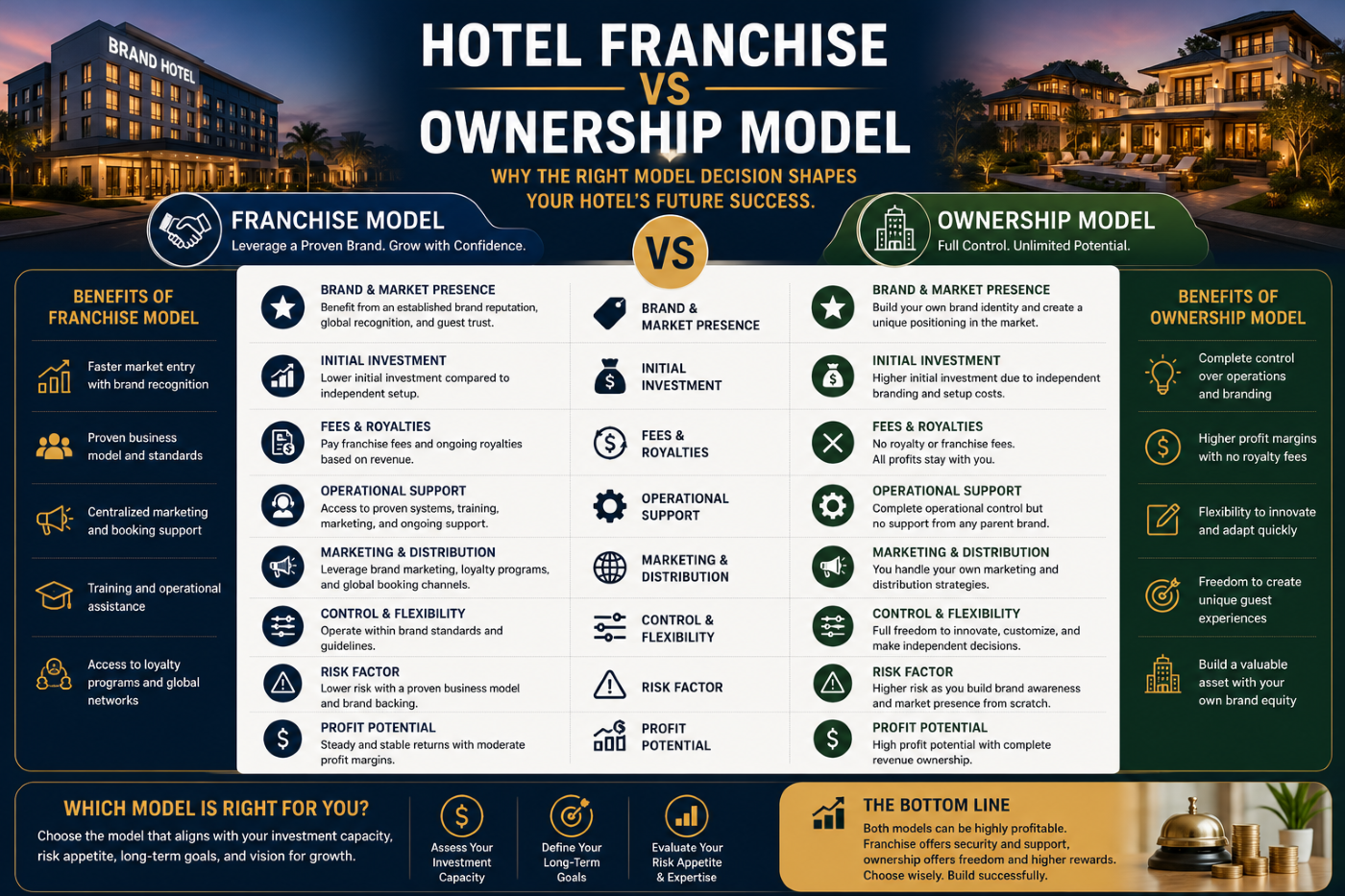
Entering the hotel industry is an exciting opportunity, but choosing the right business model can significantly influence long-term success. Entrepreneurs, investors, and hospitality professionals often face an important decision: should they own and operate an independent hotel, or should they join an established hotel franchise?
Both the hotel franchise and ownership models offer distinct advantages and challenges. A franchise provides access to an established brand, proven systems, operational support, and marketing resources. On the other hand, independent hotel ownership gives investors greater control over branding, operations, guest experiences, and strategic decisions.
There is no universal answer to which model is better. The right choice depends on an investor’s financial resources, business objectives, risk tolerance, hospitality experience, and long-term vision.
At BookSmart, we believe that understanding the differences between hotel franchising and independent ownership is essential for anyone planning to enter or expand within the hospitality industry.
What Is a Hotel Franchise Model?
A hotel franchise model allows an investor or business owner to operate a property under the established brand of a larger hospitality company.
The franchisee owns or leases the hotel property but receives permission to use the franchisor’s brand name, trademarks, operational systems, marketing resources, technology platforms, and business processes.
In exchange, the franchisee typically pays an initial franchise fee along with ongoing royalty, marketing, reservation, or technology fees.
The franchisor generally provides brand standards, staff training, operational guidance, reservation systems, marketing support, and other resources.
This model allows entrepreneurs to benefit from an established hospitality brand without building a reputation from scratch.
What Is an Independent Hotel Ownership Model?
Under the independent ownership model, the investor owns and operates the hotel without being affiliated with a major hotel franchise brand.
The owner has complete control over the hotel’s branding, pricing, services, interior design, guest experience, marketing strategy, and operational decisions.
Independent hotels can develop unique identities that reflect their location, culture, target audience, and hospitality philosophy.
Boutique hotels and lifestyle properties often choose this model because it provides greater creative freedom and flexibility.
However, independent owners are responsible for building brand awareness, developing distribution channels, managing technology, and creating effective marketing strategies.
Brand Recognition: Franchise Advantage
One of the biggest advantages of the franchise model is immediate brand recognition.
Travelers are often more comfortable booking hotels from brands they already know and trust.
Established hotel brands benefit from years of marketing, customer loyalty, and a recognizable reputation.
This familiarity can make it easier for franchise hotels to attract guests, particularly in competitive markets.
Independent hotels must build their reputation from the ground up, which can require significant time and investment.
However, an independent hotel with a strong concept and exceptional guest experience can eventually develop a highly loyal customer base.
Operational Control: Ownership Advantage
Independent ownership provides significantly greater control over hotel operations.
Owners can make decisions regarding room design, pricing, staffing, amenities, food and beverage services, marketing, and guest experience without needing approval from a franchisor.
This flexibility allows independent hotels to respond quickly to local market conditions and changing guest preferences.
Franchise properties, by contrast, must follow established brand standards and operational guidelines.
While these standards help maintain consistency, they can sometimes limit an owner’s ability to experiment with new ideas.
Marketing and Distribution
Franchise hotels benefit from established marketing systems and global distribution networks.
Franchisors often provide centralized marketing campaigns, loyalty programs, online booking platforms, reservation systems, and relationships with travel agencies.
These resources can significantly reduce the marketing burden on individual hotel owners.
Independent hotels must develop their own marketing strategies and distribution channels.
However, modern digital marketing, social media, search engine optimization, and online booking platforms have made it easier for independent properties to reach travelers directly.
Independent hotels can also create highly targeted campaigns that highlight their unique identity and local experiences.
Financial Considerations
Financial planning is a critical factor when choosing between the two models.
Franchise owners typically face several costs, including:
- Initial franchise fees
- Ongoing royalty fees
- Marketing fees
- Reservation system fees
- Technology fees
- Brand compliance expenses
These costs can reduce profit margins, but franchisees gain access to established systems and brand resources.
Independent hotel owners do not pay franchise fees, allowing them to retain greater control over their revenue.
However, they must independently invest in branding, technology, marketing, staff training, distribution, and operational infrastructure.
The financial advantage of either model depends on the hotel’s location, size, market segment, operating efficiency, and revenue performance.
Guest Loyalty and Customer Acquisition
Franchise hotels often have an advantage when attracting repeat customers through established loyalty programs.
Travelers who participate in a major hotel loyalty program may choose affiliated properties to earn or redeem rewards.
This can generate a consistent flow of bookings across different locations.
Independent hotels must create their own loyalty strategies.
However, independent properties can offer more personalized rewards and unique experiences that appeal to travelers seeking something different from standardized hotel brands.
In many cases, personalized service and memorable experiences can be just as effective as traditional loyalty programs.
Technology and Innovation
Technology plays a crucial role in modern hotel management.
Franchise properties often receive access to centralized technology platforms, including Property Management Systems (PMS), Customer Relationship Management (CRM) tools, booking engines, revenue management systems, and data analytics.
These technologies can improve operational efficiency and simplify management.
Independent owners must select and implement their own technology solutions.
Although this requires additional planning, it also provides greater flexibility.
Independent hotels can choose innovative technology providers that best match their operational needs without being restricted to franchisor-approved systems.
Training and Operational Support
Franchise models provide significant support for new and experienced hotel operators.
Franchisors typically offer employee training, operational manuals, quality standards, marketing guidance, and ongoing consulting.
This support can be especially valuable for investors who have limited hospitality experience.
Independent owners must develop their own training programs and operational procedures.
While this requires greater effort, it provides the opportunity to create a unique service culture based entirely on the hotel’s vision.
Risk and Business Stability
Franchising can reduce certain business risks because the hotel operates under an established brand with proven systems.
Guests may be more likely to book a recognized brand, helping reduce uncertainty during the early stages of operation.
However, franchisees are still responsible for property performance, financial obligations, staffing, and compliance with brand standards.
Independent hotels face greater challenges in establishing market recognition but can potentially respond more quickly to market changes.
Their ability to adapt their concept, pricing, and services can become a significant competitive advantage.
Flexibility and Creativity
Independent ownership clearly has an advantage when it comes to creativity.
Owners can design unique rooms, introduce innovative services, collaborate with local businesses, create distinctive dining concepts, and develop personalized guest experiences.
Franchise hotels must generally follow brand guidelines covering everything from room design and signage to service standards.
For investors who prioritize consistency and proven systems, franchising may be ideal.
For entrepreneurs who value creativity and independence, owning an independent hotel may be more attractive.
Franchise vs. Ownership: A Quick Comparison
| Factor | Hotel Franchise | Independent Ownership |
|---|---|---|
| Brand Recognition | High | Must be developed |
| Operational Control | Moderate | High |
| Marketing Support | Strong | Owner-managed |
| Franchise Fees | Required | None |
| Loyalty Program | Established | Self-developed |
| Technology | Often provided or standardized | Owner-selected |
| Creative Freedom | Limited by brand standards | Extensive |
| Training Support | Usually available | Owner-managed |
| Risk | Supported by established brand | Fully managed by owner |
| Flexibility | Moderate | High |
Which Model Is Better for New Investors?
For new investors with limited hospitality experience, the franchise model can provide valuable guidance and operational support.
An established brand can simplify the process of launching a hotel by providing systems, training, marketing, and technology.
However, investors must carefully evaluate franchise fees and contractual obligations before making a decision.
Independent ownership may be more suitable for experienced hospitality professionals who understand the market and have the resources to build their own brand.
It can also be attractive to entrepreneurs who want complete control over their property’s identity and operations.
Which Model Is Better for Boutique Hotels?
Boutique hotels often benefit from the independent ownership model because their competitive advantage lies in uniqueness and personalization.
Independent owners can create distinctive concepts based on local culture, architecture, food, art, and lifestyle.
However, some boutique properties may choose franchise affiliations that offer flexibility while still providing access to established distribution and marketing systems.
The ideal choice depends on whether the hotel’s primary competitive advantage is its unique identity or the strength of an established brand.
Key Factors to Consider Before Choosing
Before selecting a business model, investors should carefully evaluate several factors.
First, consider the target market and location. A recognizable franchise may perform well in a business district, airport area, or major tourist destination, while an independent boutique concept may thrive in a culturally rich or unique destination.
Second, evaluate financial resources. Investors should calculate startup costs, operating expenses, franchise fees, marketing budgets, technology investments, and expected returns.
Third, consider hospitality experience. Investors with limited experience may benefit from franchisor support, while experienced operators may prefer greater independence.
Finally, consider long-term goals. Those seeking standardized operations and brand recognition may prefer franchising, while entrepreneurs focused on creativity and complete control may choose independent ownership.
The Future of Hotel Business Models
The hospitality industry is becoming increasingly flexible, and the traditional distinction between franchise and independent hotels is evolving.
Technology allows independent hotels to access sophisticated booking platforms, revenue management tools, digital marketing systems, and customer relationship technologies that were once available primarily to large hotel groups.
At the same time, some franchise models are offering greater flexibility to property owners who want to maintain local character and personalized experiences.
This evolution gives investors more options than ever before.
The future of hotel ownership will likely involve a combination of strong technology, personalized service, unique guest experiences, and flexible business models.
Conclusion
The choice between a hotel franchise and an independent ownership model is one of the most important decisions an investor can make when entering the hospitality industry.
A franchise offers brand recognition, established systems, marketing support, technology, and operational guidance. These advantages can reduce certain risks and provide valuable support, particularly for new investors.
Independent ownership, on the other hand, provides greater control, creative freedom, and flexibility. Owners can build unique brands, personalize guest experiences, and respond quickly to market trends without following strict franchise standards.
Ultimately, the best model depends on the investor’s financial capacity, hospitality expertise, risk tolerance, target market, and long-term business objectives.
At BookSmart, we believe that success in hospitality is not determined solely by whether a hotel chooses franchising or independent ownership. The real key lies in understanding guests, delivering consistent service, embracing technology, and creating experiences that inspire travelers to return. Whether operating under a globally recognized brand or building an independent hospitality concept, hotels that remain focused on guest satisfaction and operational excellence will be best positioned for sustainable growth in the future.
Leave a Reply