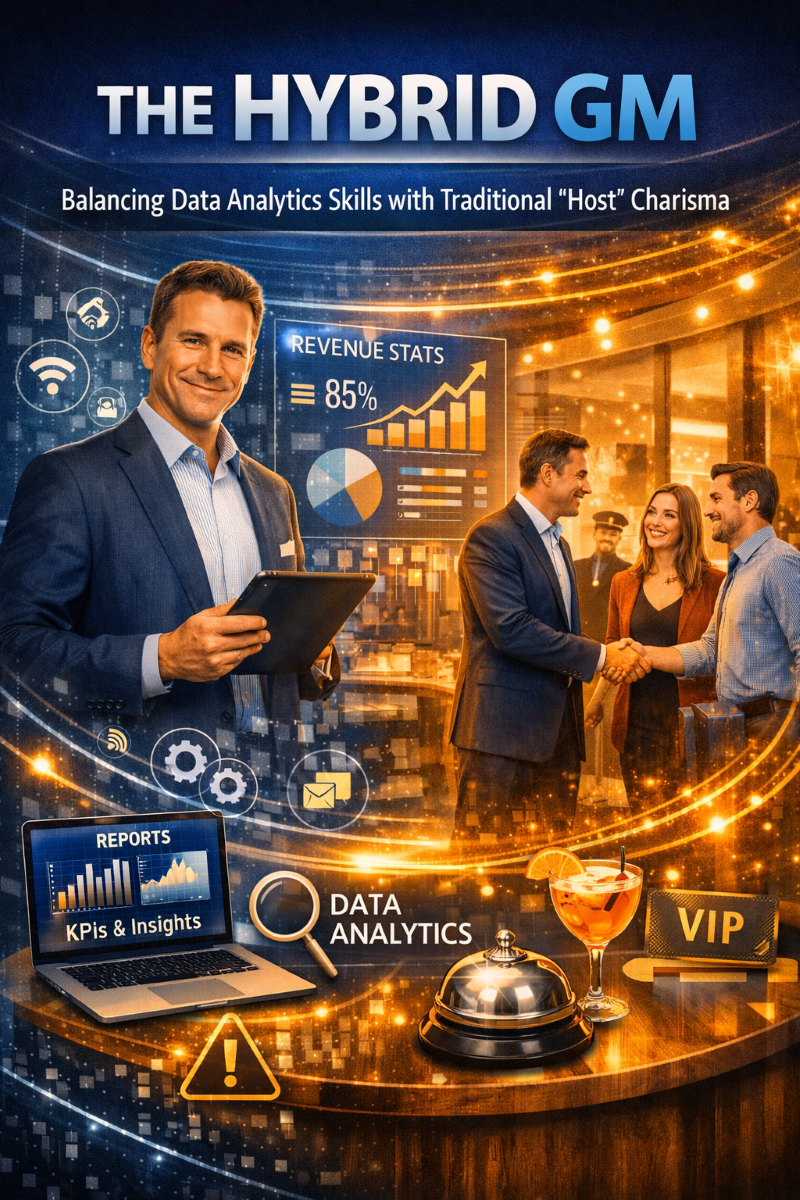
The role of the hotel General Manager (GM) has always been one of the most dynamic positions in hospitality. Traditionally, a great GM was defined by their presence — a visible leader who greeted guests, inspired teams, solved problems in real time, and embodied the spirit of hospitality.
Today, however, the expectations of a GM are rapidly evolving.
Modern hotels operate in a data-rich, technology-driven environment where decisions are guided by analytics, forecasting models, and performance dashboards. At the same time, hospitality remains a deeply human industry built on emotion, connection, and experience.
This dual demand has given rise to a new leadership archetype: the Hybrid GM — a professional who combines analytical intelligence with authentic human charisma.
Success in today’s hospitality landscape depends on mastering both.
The Evolution of the General Manager Role
Historically, GMs focused on:
- Guest relations
- Staff management
- Operational oversight
- Revenue performance
While these responsibilities remain relevant, the modern GM must now also navigate:
- Data analytics platforms
- Digital marketing insights
- Revenue optimization tools
- Guest behavior tracking
- Technology integrations
The role has expanded from operational leadership to strategic, data-informed decision-making.
Why Data Skills Are Now Essential
Hotels generate vast amounts of data daily — from booking patterns and pricing trends to guest preferences and online reviews.
A modern GM must understand how to interpret and act on this information.
Revenue Optimization
Analytics help GMs adjust pricing dynamically based on demand, seasonality, and competitor activity.
Understanding key metrics such as:
- RevPAR (Revenue per Available Room)
- ADR (Average Daily Rate)
- Occupancy trends
enables smarter financial decisions.
Guest Experience Insights
Data reveals patterns in guest satisfaction, including:
- Common complaints
- Preferred amenities
- Service gaps
GMs can use this information to proactively improve operations.
Operational Efficiency
Analytics identify inefficiencies across departments such as:
- Housekeeping productivity
- Energy consumption
- Staff allocation
This leads to better resource management.
The Risk of Becoming “Too Data-Driven”
While data is powerful, over-reliance on numbers can create a disconnect from the human essence of hospitality.
A GM who focuses solely on dashboards may:
- Miss emotional cues from guests
- Overlook team morale
- Prioritize efficiency over experience
Hospitality is not just a science — it is also an art.
Data informs decisions, but human intuition completes them.
The Enduring Power of Host Charisma
At its core, hospitality is about making people feel welcome, valued, and cared for.
The best GMs are still exceptional hosts.
Visible Leadership
Guests appreciate seeing leadership presence in the lobby, restaurants, and public spaces.
A simple greeting or conversation can significantly enhance guest perception.
Emotional Intelligence
Understanding guest emotions and staff dynamics is critical.
Charismatic GMs can:
- Diffuse tense situations
- Build strong relationships
- Create memorable guest interactions
Culture Building
Team morale directly impacts service quality.
A GM who connects with employees fosters:
- Higher engagement
- Better performance
- Lower staff turnover
Human connection drives operational success.
The Hybrid Skillset: Where Data Meets Hospitality
The Hybrid GM integrates analytical thinking with interpersonal excellence.
This balance creates a powerful leadership model.
Data-Informed Decisions, Human-Centered Execution
Example:
Data shows guests prefer faster check-in.
A purely analytical approach might automate everything.
A Hybrid GM ensures:
- Technology speeds up the process
- Staff remain available for personalized welcome
Efficiency and warmth coexist.
Personalization at Scale
Analytics identify guest preferences.
Charisma delivers those preferences meaningfully.
For instance:
A returning guest’s data shows a preference for quiet rooms.
The GM ensures the room is assigned accordingly — and personally welcomes the guest with a note acknowledging their preference.
Data enables insight; charisma delivers impact.
Proactive Problem Solving
Data may reveal recurring complaints about slow service.
A Hybrid GM doesn’t just adjust staffing levels.
They:
- Observe service interactions
- Engage with staff
- Understand underlying issues
Solutions become more holistic.
Technology as a Leadership Tool
Modern GMs must embrace technology not as a replacement for leadership, but as an enhancement.
Key tools include:
- Business intelligence dashboards
- Guest feedback platforms
- Revenue management systems
- CRM (Customer Relationship Management) tools
These tools provide clarity — but leadership determines action.
Training the Next Generation of Hybrid Leaders
Hospitality education and training programs must evolve to develop Hybrid GMs.
Key focus areas include:
Analytical Skills
- Data interpretation
- Financial literacy
- Technology familiarity
Soft Skills
- Communication
- Empathy
- Conflict resolution
Strategic Thinking
- Long-term planning
- Market positioning
- Brand development
Future leaders must be both data-savvy and people-focused.
Challenges of Balancing Both Worlds
Becoming a Hybrid GM is not without challenges.
Time Management
Balancing data analysis with on-the-floor presence can be demanding.
Skill Gaps
Many experienced hospitality professionals may lack formal data training, while tech-savvy leaders may lack interpersonal depth.
Organizational Resistance
Some teams may resist data-driven changes or new technologies.
Strong leadership is required to align all stakeholders.
The Competitive Advantage of Hybrid Leadership
Hotels led by Hybrid GMs benefit from:
- Better financial performance
- Higher guest satisfaction
- Stronger team culture
- Faster adaptation to market changes
This leadership style creates a well-rounded, resilient organization.
Real-World Application Scenario
Consider a hotel experiencing declining guest satisfaction scores.
A traditional GM might rely on intuition.
A data-driven GM might analyze surveys.
A Hybrid GM does both:
- Reviews guest feedback data
- Observes guest interactions
- Speaks directly with staff
- Identifies emotional and operational gaps
The resulting solution is both analytical and empathetic.
The Future of Hospitality Leadership
As technology continues to evolve, the importance of Hybrid GMs will only increase.
Future leaders will need to:
- Interpret AI-generated insights
- Manage digital ecosystems
- Deliver hyper-personalized experiences
- Maintain authentic human connections
Automation will handle routine tasks.
Leadership will focus on meaning, culture, and experience.
Conclusion
The modern General Manager must be more than an operator or a data analyst. They must be a bridge between technology and humanity.
The Hybrid GM represents the future of hospitality leadership — combining the precision of data with the warmth of genuine human connection.
Hotels that cultivate this balance will not only operate more efficiently but also create deeper, more memorable guest experiences.
Because in the end, data may guide decisions — but it is human connection that defines hospitality.
Leave a Reply