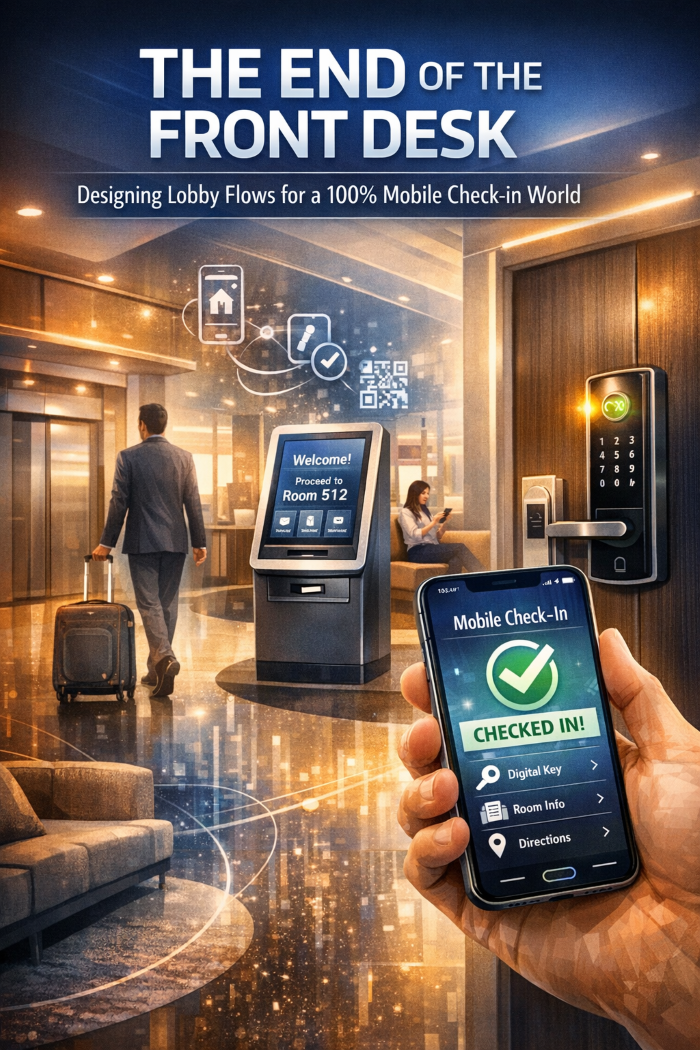
For over a century, the front desk has been the symbolic and operational heart of a hotel. It was the first point of contact, the control center for check-ins, and the anchor of lobby design. Guests queued, presented identification, signed forms, collected keys, and interacted with staff before beginning their stay.
Today, that model is rapidly changing.
With the rise of mobile check-in, digital keys, and contactless technology, hotels are reimagining the very purpose of the lobby. The traditional front desk is no longer a necessity — it is becoming optional.
In a world moving toward 100% mobile check-in, the lobby is transforming from a transactional space into an experiential, fluid environment designed for movement, comfort, and personalization.
This shift requires not just new technology, but entirely new design thinking.
Why the Front Desk Is Becoming Obsolete
Several forces are driving the decline of the traditional reception desk.
1. Guest Expectations for Speed and Convenience
Modern travelers expect frictionless experiences. Waiting in line after a long journey feels outdated in an era of instant digital access.
Mobile check-in allows guests to:
- Complete registration before arrival
- Access rooms using digital keys
- Skip queues entirely
- Customize preferences in advance
The expectation is clear: arrival should be seamless, not procedural.
2. The Rise of Contactless Technology
Health and safety concerns accelerated adoption of contactless services. Guests now prefer minimal physical interaction for routine processes.
Mobile-first journeys reduce:
- Physical touchpoints
- Paper usage
- Waiting time
- Operational bottlenecks
This has permanently shifted guest behavior.
3. Operational Efficiency
Front desks require staffing, training, and physical space. By reducing reliance on traditional check-in counters, hotels can:
- Lower labor costs
- Reallocate staff to guest experience roles
- Optimize lobby real estate
- Increase operational flexibility
The front desk evolves from necessity to optional support function.
Redefining the Lobby: From Queue to Flow
In a mobile check-in world, the lobby is no longer a waiting area.
It becomes a flow-based environment designed to guide guests effortlessly from arrival to destination.
Key design principles include:
- Eliminating bottlenecks
- Encouraging natural movement
- Providing intuitive navigation
- Supporting multiple guest journeys simultaneously
The goal is to create a space where guests move through, not wait within.
Designing Frictionless Arrival Experiences
Smart Entry Points
Arrival begins before the guest enters the building.
Hotels can integrate:
- License plate recognition for parking access
- Mobile-triggered door entry
- Digital welcome notifications
Guests transition from outside to inside without interruption.
Wayfinding and Spatial Clarity
Without a central desk, guests must easily understand where to go.
Effective design includes:
- Clear signage
- Digital directories
- Mobile app navigation
- Visual cues through lighting and layout
Navigation should feel intuitive, even for first-time visitors.
Decentralized Welcome Zones
Instead of one large reception desk, hotels can create multiple smaller interaction points.
Examples include:
- Concierge pods
- Guest assistance kiosks
- Lounge-based staff stations
Staff become mobile hosts rather than desk-bound agents.
The Role of Mobile Technology
Mobile devices become the primary interface between guests and the hotel.
Key capabilities include:
- Digital check-in and ID verification
- Mobile room keys
- In-app messaging with staff
- Service requests and bookings
- Real-time notifications
The smartphone replaces the front desk as the central control hub.
Designing for Different Guest Types
Not all guests have identical preferences.
A successful mobile-first lobby must accommodate diverse needs.
Tech-Savvy Guests
These guests prefer full autonomy.
They move directly to their rooms using mobile keys with no assistance.
Assisted Digital Users
Some guests may need minimal support.
Staff equipped with tablets can assist them anywhere in the lobby.
Traditional Guests
A small percentage may still prefer human interaction.
Hotels can provide optional service desks or hybrid check-in counters without making them the focal point.
Flexibility ensures inclusivity.
Transforming Staff Roles
As the front desk fades, staff responsibilities evolve.
Employees transition from transactional roles to experience-driven roles.
Instead of processing check-ins, staff focus on:
- Greeting guests personally
- Providing local recommendations
- Solving problems proactively
- Enhancing overall experience
This shift elevates hospitality from process to personalization.
Lobby as a Social and Experiential Space
Freed from the dominance of the front desk, lobbies can be redesigned as vibrant, multifunctional environments.
Possible elements include:
- Lounge seating areas
- Co-working spaces
- Café and bar concepts
- Art installations
- Retail corners
The lobby becomes a destination in itself rather than a transitional checkpoint.
Data-Driven Personalization
Mobile check-in systems collect valuable guest data before arrival.
Hotels can use this information to:
- Customize room settings
- Personalize greetings
- Recommend services
- Anticipate guest needs
For example:
A returning guest may receive a notification:
“Your preferred room temperature is set. Welcome back.”
Personalization enhances guest satisfaction without requiring manual interaction.
Security and Privacy Considerations
Eliminating the front desk introduces new security challenges.
Hotels must ensure:
- Secure identity verification
- Encrypted mobile key systems
- Controlled access to floors and rooms
- Data privacy compliance
Balancing convenience with security is critical.
Guests must trust digital systems as much as traditional processes.
Operational Challenges to Address
Transitioning to a front desk–free model requires careful planning.
Technology Reliability
System failures can disrupt the entire guest journey.
Backup systems and manual overrides are essential.
Guest Education
Guests must understand how to use mobile check-in features.
Clear pre-arrival communication is necessary.
Staff Adaptation
Employees must be trained for new roles focused on mobility and guest engagement.
The Business Benefits
Hotels adopting mobile-first lobby design gain several advantages:
- Faster guest throughput
- Reduced operational costs
- Improved space utilization
- Higher guest satisfaction
- Increased perception of innovation
The lobby becomes more efficient and more valuable simultaneously.
The Future of Lobby Design
The next generation of hotel lobbies will be:
- Fully digital yet highly human-centered
- Flexible and multi-functional
- Personalized through data
- Integrated with smart building systems
We may even see:
- Facial recognition check-ins
- AI-powered concierge services
- Autonomous luggage handling
- Predictive guest flow management
The front desk will not disappear entirely — but it will no longer define the lobby.
Conclusion
The end of the traditional front desk marks a major evolution in hospitality design. As mobile check-in becomes the norm, hotels must rethink how guests move through and experience arrival spaces.
By focusing on flow, flexibility, and personalization, hotels can transform lobbies into dynamic environments that prioritize convenience and connection over procedure.
The future lobby is not a place where guests wait.
It is a place where guests arrive, move, and begin their experience instantly.
Because in modern hospitality, the best check-in is the one that doesn’t feel like check-in at all.
Leave a Reply