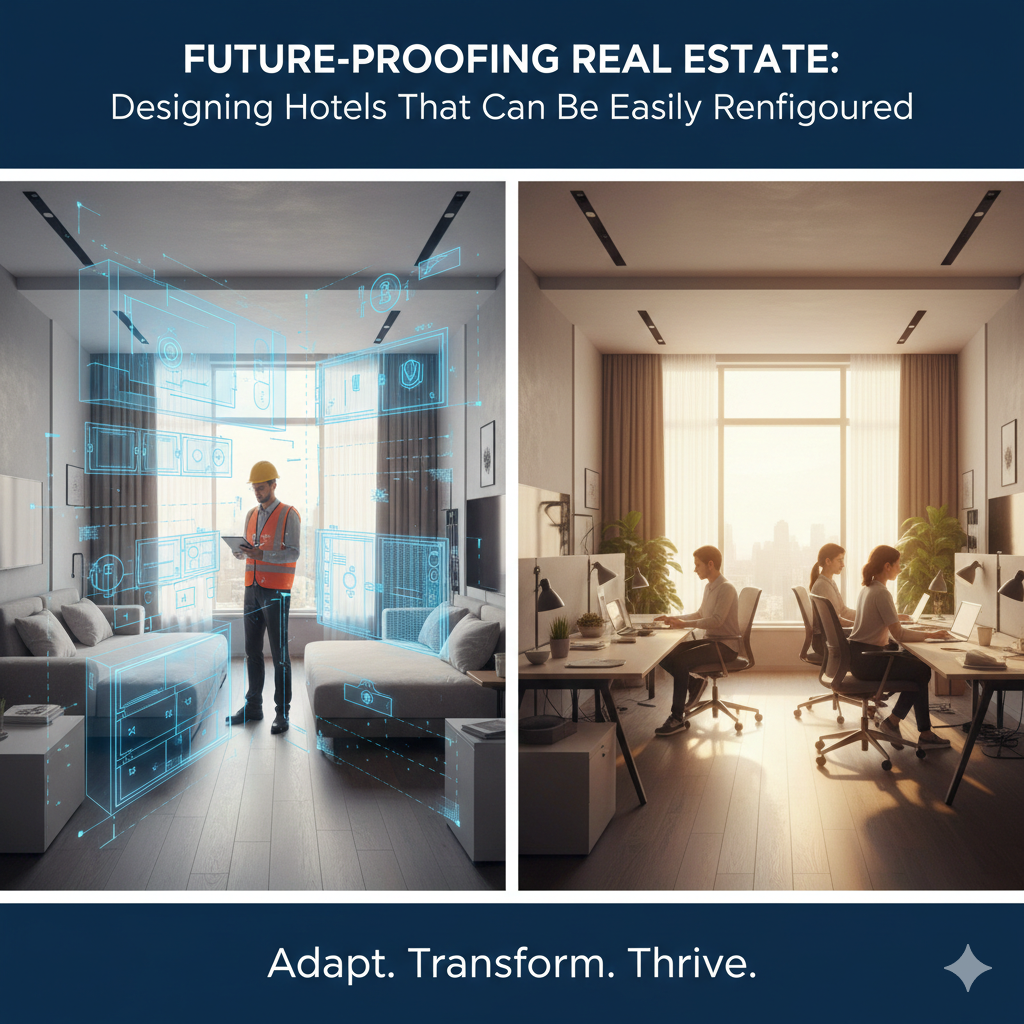
The hospitality industry has learned a hard truth over the past decade: change is no longer occasional—it’s constant. Market demands shift, guest preferences evolve, technology advances, and global disruptions reshape travel patterns overnight. Hotels designed for a single, rigid purpose risk becoming outdated faster than ever.
Future-proofing hotel real estate is no longer a luxury—it is a strategic necessity. The new frontier lies in designing hotels that can be easily reconfigured, allowing owners and operators to adapt layouts, functions, and revenue models without costly structural overhauls.
At Booksmart, we believe flexibility is the most valuable amenity a hotel can build into its foundation.
Why Traditional Hotel Design Falls Short
Historically, hotels were built with fixed assumptions:
- Standardized room layouts
- Permanent meeting spaces
- Rigid food and beverage configurations
- Static back-of-house systems
While this approach optimized efficiency for stable demand patterns, it struggles in today’s unpredictable landscape.
Consider how quickly the market has shifted:
- Rise of remote work and bleisure travel
- Demand for extended stays
- Growth of co-working and hybrid meetings
- Increased wellness and experiential focus
Buildings designed without adaptability often require expensive renovations to keep pace.
What Does “Future-Proofing” Really Mean?
Future-proofing does not mean predicting the future perfectly. It means designing spaces that can adapt to multiple potential futures.
In practical terms, this involves:
- Modular construction
- Flexible floor plans
- Movable partitions
- Convertible guest rooms
- Multi-use public areas
- Infrastructure designed for technology upgrades
Adaptability becomes embedded in the building’s DNA.
The Business Case for Reconfigurable Hotels
1. Revenue Resilience
Flexible spaces allow hotels to pivot revenue streams quickly.
For example:
- Converting meeting rooms into co-working spaces
- Transforming underused restaurants into event venues
- Reconfiguring guest rooms into suites or extended-stay units
This agility protects profitability during market shifts.
2. Lower Renovation Costs
Traditional renovations involve:
- Structural demolition
- Utility rerouting
- Significant downtime
Reconfigurable design reduces disruption by enabling layout changes without major reconstruction.
3. Increased Asset Lifespan
Properties that adapt easily remain competitive longer, extending their lifecycle and protecting investment value.
Designing Flexible Guest Rooms
Guest rooms represent a large percentage of hotel space—and opportunity.
Modular Furniture Systems
Movable walls, foldable desks, and convertible beds allow rooms to shift between:
- Standard accommodation
- Family suites
- Extended-stay units
- Hybrid workspaces
Flexibility enhances both occupancy and ADR potential.
Plug-and-Play Infrastructure
Electrical, plumbing, and HVAC systems designed with modularity in mind make reconfiguration faster and more cost-effective.
Raised floors and accessible ceiling systems simplify future upgrades.
Transformable Public Spaces
Lobbies, lounges, and meeting areas are increasingly multi-functional.
Open-Plan Concepts with Movable Dividers
Spaces can transition from:
- Morning co-working hubs
- Afternoon café environments
- Evening social lounges
- Private event venues
This maximizes utilization across dayparts.
Technology-Ready Meeting Spaces
Hybrid events are here to stay. Future-proof meeting rooms include:
- Built-in streaming capabilities
- Flexible seating layouts
- Scalable AV infrastructure
Adaptable design ensures relevance in evolving event markets.
Back-of-House Flexibility
Operational adaptability is just as important as guest-facing design.
Future-ready back-of-house areas include:
- Modular kitchens
- Flexible storage layouts
- Expandable service corridors
This enables shifts in F&B concepts or service models without major structural work.
Mixed-Use and Adaptive Reuse Potential
Hotels increasingly operate within mixed-use developments.
Flexible design allows properties to:
- Integrate retail or wellness components
- Convert floors into residential or serviced apartments
- Accommodate healthcare or corporate housing during demand shifts
Adaptability enhances long-term asset resilience.
Sustainability Through Flexibility
Future-proofing aligns closely with sustainable design.
Reconfigurable hotels:
- Reduce demolition waste
- Minimize renovation materials
- Extend building lifespan
- Lower embodied carbon impact
Sustainable design is not just about energy efficiency—it’s about longevity.
Technology as a Foundation for Adaptability
Smart building systems support flexible real estate.
Digital infrastructure enables:
- Space utilization tracking
- Predictive maintenance
- Remote configuration of environmental controls
- Scalable connectivity upgrades
Technology readiness ensures buildings evolve with digital trends.
Designing for Changing Guest Demographics
Guest demographics are shifting rapidly.
Hotels must accommodate:
- Solo digital nomads
- Multi-generational families
- Long-stay corporate travelers
- Wellness-focused guests
Flexible room layouts and amenity configurations allow properties to serve multiple segments simultaneously.
Financial Considerations and ROI
Future-proof design may involve higher upfront investment, but it delivers long-term returns through:
- Reduced renovation frequency
- Lower downtime costs
- Greater revenue diversification
- Enhanced property valuation
Investors increasingly favor assets with adaptable infrastructure.
Case Scenarios: Flexibility in Action
Imagine a city hotel that:
- Converts conference space into co-working suites during low event demand
- Transforms standard rooms into mini-apartments for extended stays
- Adjusts lobby configurations for pop-up retail or local partnerships
Each adaptation generates incremental revenue without structural overhaul.
Overcoming Barriers to Reconfigurable Design
Higher Initial Costs
While modular systems may cost more upfront, lifecycle savings often outweigh initial investment.
Design Complexity
Collaboration between architects, engineers, and operators is essential from the outset.
Brand Standards
Brands must evolve to allow flexibility within standardized frameworks.
Early alignment prevents costly redesigns later.
The Role of Developers and Investors
Developers must think beyond immediate ROI and consider:
- Long-term adaptability
- Market volatility
- Regulatory shifts
- Technological change
Hotels that can pivot quickly will outperform rigid assets in uncertain markets.
Preparing for the Unknown
The most important benefit of reconfigurable design is preparedness for uncertainty.
Future disruptions—economic, technological, or social—will continue to reshape travel patterns. Hotels designed for adaptability can respond confidently rather than react desperately.
Conclusion
Future-proofing hotel real estate is about designing for change rather than resisting it. By building reconfigurable spaces, modular systems, and adaptable infrastructure, hotels can extend asset value, protect revenue streams, and remain competitive in an unpredictable world.
At Booksmart, we believe the future of hospitality belongs to properties that embrace flexibility as a core design principle. The hotels that thrive tomorrow will not be those built for a single purpose—but those built for possibility.
Leave a Reply