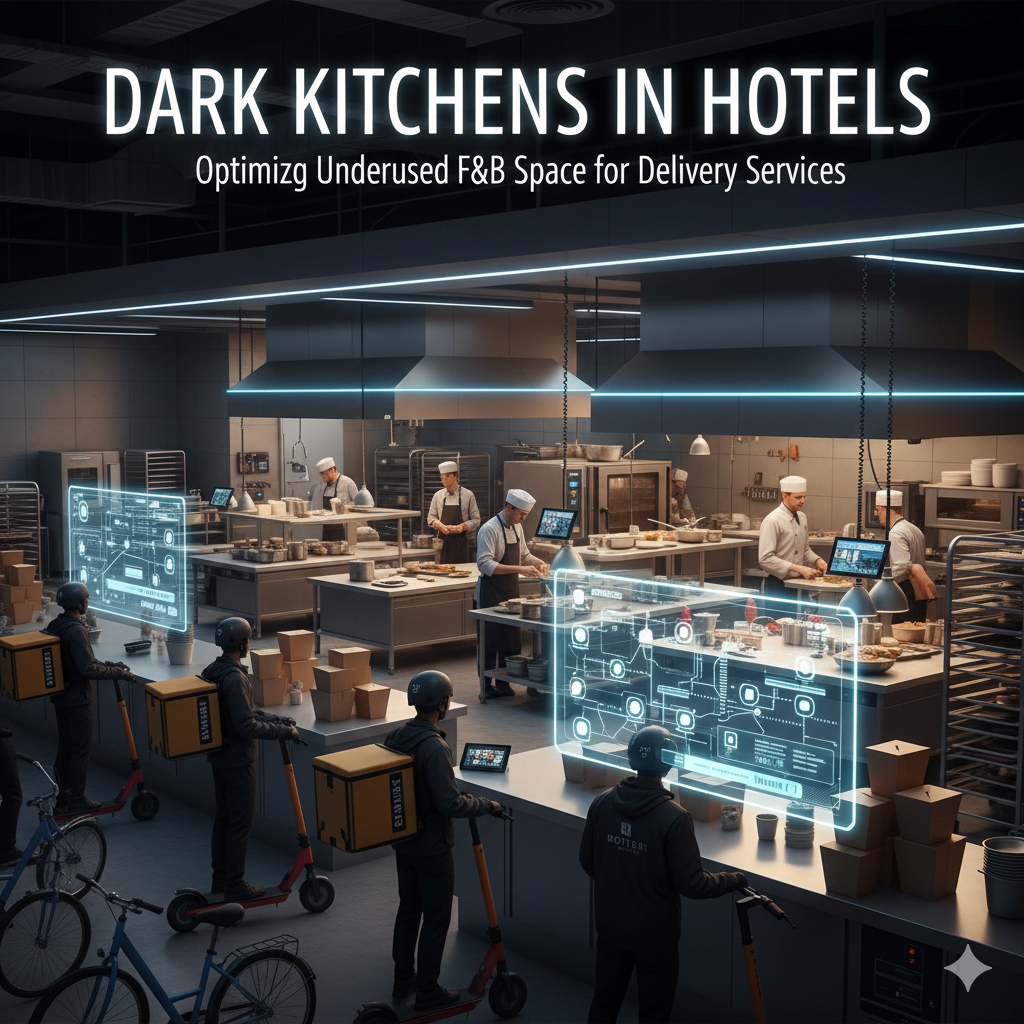
The hospitality industry has always been about maximizing space, experience, and revenue. Yet across hotels worldwide, a familiar challenge persists: underused food and beverage (F&B) spaces. From half-empty kitchens during off-peak hours to restaurants that struggle to achieve consistent footfall, many hotels are sitting on untapped culinary potential.
Enter dark kitchens, also known as ghost kitchens or virtual kitchens—a model that has reshaped the food service industry and is now gaining momentum in hospitality. By repurposing existing kitchen infrastructure to serve delivery-only brands, hotels can unlock new revenue streams, increase asset utilization, and stay competitive in a delivery-driven dining economy.
This article explores how dark kitchens fit into hotel operations, the benefits and challenges of adoption, and why this model represents a smart evolution for hotel F&B strategy.
What Are Dark Kitchens?
Dark kitchens are professional food preparation facilities designed exclusively for delivery and takeaway orders. They do not offer dine-in service and rely heavily on digital ordering platforms.
In the hotel context, dark kitchens typically operate:
- From existing hotel kitchens
- During off-peak hours
- As standalone virtual brands or co-branded concepts
This model allows hotels to monetize kitchen capacity without disrupting traditional guest dining experiences.
Why Dark Kitchens Make Sense for Hotels
Hotel kitchens are uniquely positioned to support delivery operations.
Built-In Infrastructure
Hotels already have:
- Commercial-grade kitchens
- Trained culinary staff
- Food safety and hygiene compliance
- Storage and procurement systems
This significantly reduces the cost and complexity of launching a dark kitchen.
Underutilized Capacity
Many hotel restaurants experience:
- Low occupancy during weekdays
- Reduced late-night demand
- Seasonal fluctuations
Dark kitchens turn idle capacity into consistent revenue.
The Rise of Food Delivery and Changing Consumer Behavior
Food delivery has become a permanent part of urban lifestyles. Guests and local residents increasingly expect:
- Fast delivery
- Diverse cuisines
- Reliable quality
Hotels, once limited to in-house dining, can now extend their culinary reach beyond their walls—serving neighborhoods, offices, and residential communities.
Key Benefits of Dark Kitchens for Hotels
1. New Revenue Streams
Dark kitchens allow hotels to generate income without additional real estate investment. Revenue comes from:
- Delivery-only menus
- Virtual restaurant brands
- Partnerships with food aggregators
This diversification reduces reliance on room occupancy alone.
2. Improved F&B Profitability
Traditional hotel restaurants often struggle with high overheads and inconsistent demand. Dark kitchens:
- Lower front-of-house costs
- Reduce service staffing needs
- Focus purely on food production efficiency
Margins can be significantly improved with the right execution.
3. Better Utilization of Staff and Assets
Culinary teams can be scheduled more efficiently, especially during slow periods. Equipment, storage, and utilities are used more productively.
4. Brand Experimentation with Lower Risk
Dark kitchens allow hotels to:
- Test new cuisines
- Launch niche food brands
- Adapt menus quickly based on demand
Failures are less visible and less costly than traditional restaurant launches.
Operational Models for Hotel Dark Kitchens
Hotels can adopt dark kitchens in several ways.
In-House Virtual Brands
Hotels create their own delivery-only brands using internal culinary expertise.
Advantages:
- Full control over quality and branding
- Higher margins
- Seamless integration with hotel operations
Partnership with Delivery Platforms
Hotels collaborate with third-party aggregators or dark kitchen operators.
Advantages:
- Faster market entry
- Access to platform marketing
- Reduced operational complexity
Hybrid Models
Some hotels operate multiple virtual brands from the same kitchen—both in-house and partner-driven.
This maximizes menu diversity and revenue potential.
Technology as the Backbone of Dark Kitchens
Digital tools are essential for success.
Key technology components include:
- Online ordering systems
- POS integration
- Delivery aggregator APIs
- Kitchen display systems (KDS)
- Data analytics dashboards
Seamless tech integration ensures accuracy, speed, and scalability.
Menu Design for Delivery Success
Not all dishes travel well. Successful hotel dark kitchens focus on:
- Items with high delivery stability
- Fast preparation times
- Strong visual appeal
- Consistent portioning
Menus should be optimized specifically for delivery, not copied directly from dine-in offerings.
Maintaining Hotel Brand Integrity
One concern hotels often have is brand dilution.
Clear Brand Separation
Virtual brands should be clearly positioned as:
- Independent delivery concepts, or
- “Powered by” the hotel’s culinary expertise
This protects the hotel’s core brand identity.
Quality Control
Delivery customers may become future hotel guests. Maintaining consistent quality is critical to brand reputation.
Challenges in Implementing Dark Kitchens
While promising, dark kitchens come with challenges.
Operational Complexity
Running multiple brands from one kitchen requires:
- Precise workflow management
- Strong leadership
- Clear SOPs
Without structure, efficiency can suffer.
Staff Training and Motivation
Kitchen teams must adapt to:
- Faster turnaround times
- Delivery-focused workflows
- Technology-driven operations
Training and engagement are essential.
Regulatory and Compliance Issues
Hotels must ensure:
- Local licensing compliance
- Clear separation of hotel and delivery food records
- Transparent tax reporting
Regulatory clarity prevents future complications.
Financial Considerations and ROI
Dark kitchens are relatively low-risk but still require planning.
Key cost considerations include:
- Packaging
- Platform commissions
- Marketing spend
- Additional staff hours
However, compared to launching a new restaurant, the ROI timeline is significantly shorter.
Dark Kitchens as a Hedge Against Market Volatility
The hospitality industry is vulnerable to external shocks—economic downturns, travel disruptions, and seasonal demand changes.
Dark kitchens provide:
- Stable local revenue
- Reduced dependence on travelers
- Greater business resilience
They act as a financial buffer during uncertain times.
Sustainability and Waste Reduction
With better demand forecasting and digital tracking, dark kitchens can:
- Reduce food waste
- Optimize inventory
- Improve sustainability metrics
Efficiency and responsibility can go hand in hand.
The Future of Hotel F&B Is Hybrid
The line between dine-in, delivery, and experience-based dining is blurring.
Future hotel kitchens will:
- Serve in-house guests
- Power multiple virtual brands
- Support events and catering
- Adapt menus dynamically
Dark kitchens are not a replacement—they are an extension of modern hospitality.
Conclusion
Dark kitchens represent a strategic opportunity for hotels to rethink food and beverage operations. By optimizing underused kitchen space for delivery services, hotels can unlock new revenue, improve operational efficiency, and stay relevant in a rapidly evolving food economy.
At Booksmart, we believe the future of hospitality lies in smart utilization of assets and flexible business models. Dark kitchens empower hotels to transform hidden capacity into visible growth—turning kitchens into profit centers that operate far beyond the dining room.
Leave a Reply