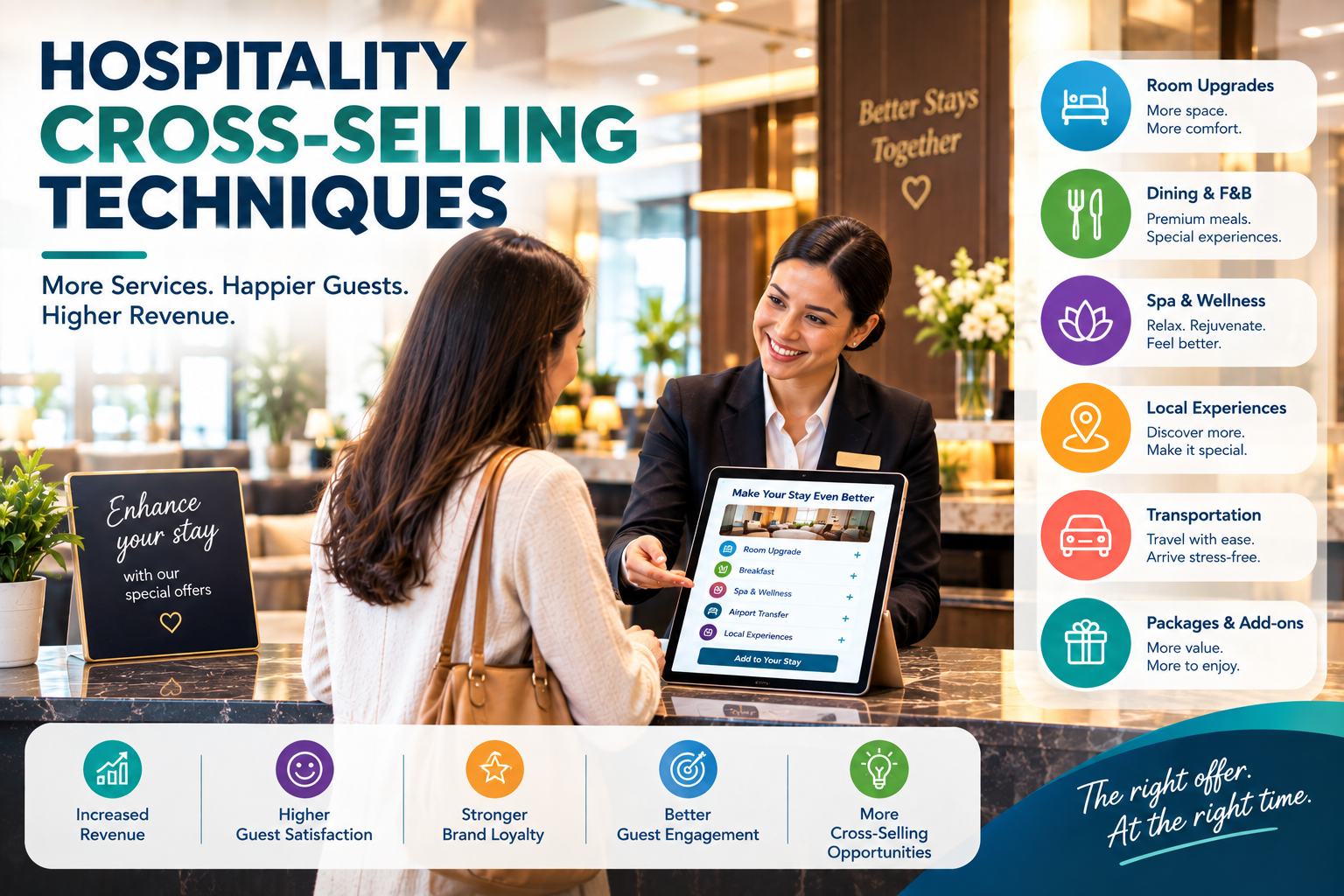
The hospitality industry offers much more than accommodation. A hotel may provide restaurants, room service, spa facilities, transportation, meeting spaces, recreational activities, laundry, local experiences, and many other services. While guests may initially book a room, their overall stay can include several additional purchases.
This creates an important opportunity for hotels through cross-selling. Hospitality cross-selling involves recommending complementary products or services that can add value to a guest’s existing purchase. Unlike upselling, which encourages a guest to choose a higher-value version of a product, cross-selling focuses on related services that complement what the guest has already selected.
For example, a guest booking a hotel room may also be interested in breakfast, airport transportation, a spa treatment, parking, a restaurant reservation, or a local sightseeing experience. When these suggestions are relevant and presented appropriately, cross-selling can benefit both the guest and the hotel.
At BookSmart, we believe successful hospitality cross-selling should be based on understanding guest needs rather than simply trying to increase the size of every transaction. The right recommendation can make a stay more convenient while creating additional revenue opportunities for the hotel.
What Is Cross-Selling in Hospitality?
Hospitality cross-selling is the practice of offering guests additional products or services that complement their primary purchase.
For a hotel, the primary purchase may be accommodation. Complementary services can include:
- Breakfast
- Airport transfers
- Parking
- Restaurant reservations
- Spa treatments
- Room service
- Laundry
- Local tours
- Event tickets
- Meeting facilities
- Recreational activities
The goal is to make relevant services easier for guests to discover and purchase.
For example, a guest traveling for business may benefit from airport transportation and meeting-room facilities, while a family on vacation may be more interested in dining, activities, or local attractions.
Cross-Selling vs. Upselling
Cross-selling and upselling are closely related but serve different purposes.
Upselling encourages a guest to purchase a higher-value version of an existing product. For example, a hotel may offer a guest an upgrade from a standard room to a suite.
Cross-selling encourages the guest to purchase a complementary product or service. For example, the same guest may be offered breakfast or airport transportation.
Both strategies can increase revenue, but cross-selling focuses on expanding the guest’s use of different hotel services.
Understanding the difference helps hotels design more focused sales and guest-experience strategies.
Why Cross-Selling Matters for Hotels
Hotels have many revenue opportunities beyond room bookings.
A guest who books accommodation may spend additional money on food and beverages, wellness services, transportation, activities, events, and other facilities.
Effective cross-selling can help hotels:
- Increase ancillary revenue
- Improve revenue per guest
- Promote underused facilities
- Improve guest convenience
- Increase awareness of hotel services
- Strengthen guest engagement
- Create more complete guest experiences
However, cross-selling should not become excessive. Guests should receive relevant recommendations that genuinely match their needs.
Start With Understanding Guest Needs
The foundation of effective cross-selling is understanding the guest.
Hotels can consider information such as:
- Travel purpose
- Length of stay
- Booking dates
- Number of guests
- Previous purchases
- Stated preferences
- Loyalty status
- Available hotel services
For example, a guest staying for one night may have different needs from a guest staying for a week.
Similarly, a business traveler may be interested in workspace and transportation, while a leisure traveler may prefer dining and recreational experiences.
The better the hotel understands the context of the stay, the more relevant its recommendations can become.
Cross-Selling During the Booking Process
The booking process provides one of the earliest opportunities for cross-selling.
Once guests select their accommodation, hotels can present relevant additional services.
These may include:
- Breakfast packages
- Airport transfers
- Parking
- Dining reservations
- Spa appointments
- Special occasion arrangements
The options should be presented clearly without making the booking process complicated.
Hotels should also make prices and conditions transparent so guests understand exactly what they are purchasing.
Pre-Arrival Cross-Selling
The period between booking and arrival can be particularly useful for cross-selling.
After confirming a reservation, hotels can provide guests with an opportunity to customize their stay.
A pre-arrival message may include information about available services and allow guests to make arrangements before reaching the property.
For example, a guest arriving late at night may appreciate the option to arrange transportation from the airport.
Another guest celebrating a special occasion may be interested in dining arrangements or other appropriate services.
Pre-arrival cross-selling works best when recommendations are based on the actual context of the reservation.
Food and Beverage Cross-Selling
Food and beverage services are among the most natural cross-selling opportunities in hospitality.
Hotels can introduce guests to:
- Breakfast
- Restaurants
- Cafés
- Room service
- Special dining experiences
- Banquet services
- Local cuisine experiences
For example, a guest booking a room without breakfast may be shown a convenient breakfast option.
During the stay, restaurant staff can also make relevant recommendations based on the guest’s dining preferences.
The emphasis should be on helping guests discover available options rather than pressuring them to spend more.
Spa and Wellness Services
Hotels with wellness facilities can use cross-selling to introduce guests to spa and fitness services.
Potential offerings include:
- Massages
- Facial treatments
- Wellness packages
- Fitness sessions
- Sauna or relaxation facilities
- Beauty services
These services can be promoted during booking, through pre-arrival communication, mobile applications, or appropriate in-person interactions.
Hotels should clearly communicate appointment availability, pricing, duration, and booking requirements.
Transportation Cross-Selling
Transportation is another practical cross-selling opportunity.
Hotels can offer services such as:
- Airport transfers
- Shuttle services
- Local transportation
- Car rental assistance
- Private transfers
Transportation can be particularly relevant for guests unfamiliar with the destination.
Offering the service before arrival can also make the guest journey more convenient because transportation arrangements are handled in advance.
Local Experiences and Activities
Hotels can expand their cross-selling strategy beyond their own facilities by helping guests discover relevant local experiences.
Depending on the destination, hotels may provide information about:
- Guided tours
- Cultural attractions
- Museums
- Adventure activities
- Culinary experiences
- Local events
- Shopping areas
Where appropriate, hotels can work with trusted local partners to provide guests with additional experiences.
The hotel should clearly communicate whether the service is provided directly by the property or by an external provider.
Cross-Selling for Business Travelers
Business travelers can have specific needs that create several cross-selling opportunities.
Hotels can offer:
- Meeting rooms
- Business centers
- Printing services
- Airport transfers
- Breakfast
- Workspace facilities
- Catering
- Laundry services
Corporate guests may also require meeting or event services during their stay.
Understanding the purpose of the trip can therefore help hotels identify relevant services without relying on generic offers.
Cross-Selling for Families
Families may have different priorities from individual travelers.
Hotels can promote relevant services such as:
- Family dining options
- Connecting rooms
- Child-friendly activities
- Recreational facilities
- Transportation
- Special meal arrangements
- Local family attractions
The objective should be to make the family stay easier and more enjoyable.
Hotels should avoid assuming that every family wants the same services. Guest preferences and stated requirements should remain the primary guide.
Using CRM Systems for Cross-Selling
Customer Relationship Management systems can support hotel cross-selling by organizing relevant guest information.
A CRM can help hotels understand previous bookings, service usage, preferences, loyalty activity, and interactions.
For example, if a returning guest has previously booked a spa treatment, the hotel may be able to provide information about relevant wellness services during a future stay, where appropriate.
CRM systems should be managed responsibly, with appropriate privacy and access controls.
Technology-Enabled Cross-Selling
Digital hotel platforms can make cross-selling easier.
Hotels can use:
- Booking engines
- Mobile applications
- Guest messaging platforms
- CRM systems
- Digital concierge tools
- Email communication
- In-room technology
These platforms can present services at appropriate stages of the guest journey.
Technology can also reduce the workload for employees by automating basic information and allowing guests to explore services independently.
Artificial Intelligence and Cross-Selling
Artificial Intelligence can help hotels analyze guest behavior and identify potential cross-selling opportunities.
AI-powered systems can analyze factors such as booking history, length of stay, preferences, service usage, and other relevant information.
Potential applications include:
- Personalized recommendations
- Automated offer selection
- Guest segmentation
- Predictive purchase analysis
- Recommendation engines
- Timing optimization
For example, an AI system may identify that certain guest segments frequently purchase breakfast or transportation services and help the hotel determine when relevant information could be presented.
AI should support hotel teams rather than operate without appropriate human oversight.
Timing Is Critical
A relevant offer can become ineffective if it is presented at the wrong time.
For example, transportation may be most useful before arrival, while restaurant recommendations may be more relevant during the stay.
Hotels can map cross-selling opportunities across the customer journey:
Booking: Breakfast, parking, transfers, room-related services
Pre-arrival: Transportation, dining, spa, experiences
Check-in: Facilities, dining, activities
During stay: Restaurants, wellness, room service, local experiences
Before checkout: Additional services, future booking information, loyalty opportunities
Timing should always consider the guest’s needs and communication preferences.
Personalized Cross-Selling
Generic offers may have limited effectiveness because different guests have different needs.
Personalization allows hotels to provide more relevant recommendations.
For example:
A business traveler may receive information about meeting facilities.
A family may receive information about suitable dining and activities.
A couple may be interested in a dining or wellness experience.
A long-stay guest may value laundry or transportation services.
Personalization should be useful rather than intrusive.
Using Data Analytics to Improve Cross-Selling
Data analytics can help hotels understand which cross-selling strategies are working.
Hotels can monitor:
- Offer conversion rate
- Ancillary revenue
- Revenue per guest
- Service usage
- Offer performance by guest segment
- Booking-stage performance
- Mobile offer engagement
- Repeat purchases
These insights can help hotels improve their recommendations.
If a particular service receives very little interest, management can investigate whether the issue is related to pricing, presentation, timing, availability, or guest demand.
Training Employees for Cross-Selling
Employees play an important role in successful cross-selling.
Training should focus on helping employees understand guest needs rather than simply encouraging them to sell more.
Employees should learn how to:
- Ask appropriate questions
- Recognize genuine opportunities
- Explain services clearly
- Communicate prices transparently
- Respect guest decisions
- Avoid aggressive sales behavior
- Use hotel technology
A recommendation should feel like helpful hospitality, not a sales script.
Common Cross-Selling Mistakes
Hotels can reduce negative guest reactions by avoiding common mistakes such as:
- Offering irrelevant services
- Making too many recommendations
- Hiding additional charges
- Repeating declined offers
- Using aggressive language
- Making assumptions about guests
- Providing unclear service information
Transparency and relevance are essential.
Guests should always know what they are being offered, what it costs, and whether there are any additional conditions.
Measuring Cross-Selling Performance
Hotels should establish clear performance indicators.
Important metrics can include:
- Cross-sell conversion rate
- Ancillary revenue per guest
- Average transaction value
- Service utilization
- Offer acceptance rate
- Revenue by guest segment
- Revenue by communication channel
- Guest satisfaction
- Repeat purchase behavior
- Return on cross-selling campaigns
Revenue should not be the only measure of success. Hotels should also evaluate whether cross-selling contributes positively to the guest experience.
The Future of Hospitality Cross-Selling
The future of hospitality cross-selling will likely become increasingly personalized and technology-driven.
AI, CRM systems, mobile applications, predictive analytics, and integrated hotel platforms can help properties understand guest needs and present relevant services at appropriate moments.
Cross-selling may increasingly become part of the overall guest experience rather than a separate sales activity.
Hotels will be able to recommend services based on context, availability, guest preferences, and previous interactions.
However, human hospitality will remain essential. Technology can identify opportunities, but employees still play an important role in understanding emotions, answering questions, and providing genuine recommendations.
Conclusion
Hospitality cross-selling techniques provide hotels with opportunities to increase ancillary revenue while helping guests discover services that can improve their stay. From breakfast and transportation to dining, spa services, local experiences, and business facilities, hotels can create additional value beyond accommodation.
Successful cross-selling depends on relevance, timing, personalization, transparency, and employee training. Technology and data analytics can make the process more efficient, while CRM systems and AI can help hotels understand guest preferences and identify appropriate opportunities.
At BookSmart, we believe that effective cross-selling should never be about simply selling more. It should be about understanding what guests may genuinely need and making those services easy to discover and access.
When hotels combine thoughtful hospitality with smart technology and responsible data use, cross-selling can become a natural part of the guest journey—creating additional revenue for the property while delivering greater convenience and value to guests.
Leave a Reply