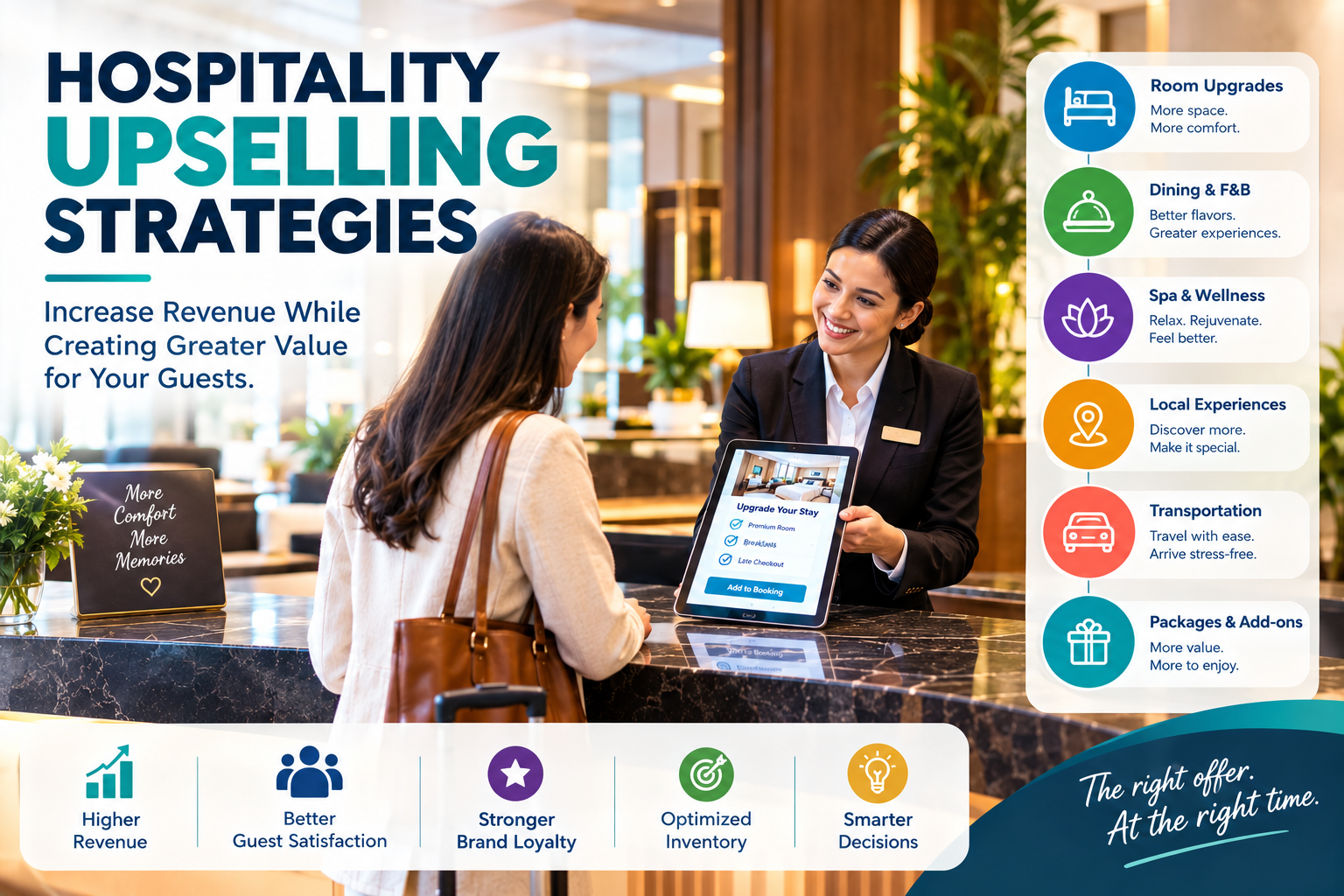
In the hospitality industry, increasing revenue does not always require attracting more guests. Hotels can also generate additional revenue by offering relevant products, services, and experiences to guests who have already chosen to stay with them. This approach is known as upselling.
Hospitality upselling involves encouraging guests to consider a higher-value room, additional service, premium facility, dining option, or experience that may better suit their needs. When done thoughtfully, upselling can benefit both the hotel and the guest. The hotel increases its revenue, while the guest receives an opportunity to enhance their stay.
However, successful hotel upselling is not simply about selling more. Guests are more likely to respond positively when an offer is relevant, clearly explained, convenient, and presented at the right time. At BookSmart, we believe that effective hospitality upselling should focus on creating additional value rather than putting unnecessary pressure on guests.
What Is Hospitality Upselling?
Hospitality upselling is a sales strategy in which hotels encourage guests to purchase a higher-value version of an existing product or add relevant services to their booking.
Examples include upgrading from a standard room to a premium room, adding breakfast to a reservation, booking a spa treatment, selecting airport transportation, or choosing a package with additional benefits.
Upselling can happen at different stages of the guest journey, including:
- During the initial booking
- Before arrival
- During online check-in
- At the front desk
- Through mobile applications
- During the guest’s stay
- Before checkout
The most effective strategy depends on the guest, the service being offered, and the timing of the communication.
Why Upselling Matters in Hospitality
Hotels have multiple opportunities to increase the value of each guest relationship.
A guest who books a room may also need breakfast, transportation, dining, laundry, parking, spa services, meeting facilities, or local experiences.
If these services are presented appropriately, guests may appreciate the convenience of arranging everything through the hotel.
Upselling can help hotels:
- Increase average revenue per guest
- Improve ancillary revenue
- Promote premium services
- Utilize available inventory
- Improve guest convenience
- Create personalized experiences
- Strengthen the overall value of a booking
The objective should be to identify services that genuinely match guest requirements.
Room Upgrade Strategies
Room upgrades are among the most common hotel upselling opportunities.
A guest who books a standard room may be interested in a larger room, better view, additional amenities, suite, or premium category.
Hotels can present upgrades through their booking engine, confirmation emails, pre-arrival communication, mobile applications, or front-desk interactions.
The offer should clearly explain what the guest receives in exchange for the additional cost.
For example, instead of simply saying “Upgrade your room,” a hotel can explain the relevant benefits, such as additional space, a better view, lounge access, or other included amenities.
Upselling During the Booking Process
The booking stage is an important opportunity for upselling because guests are already making purchasing decisions.
Hotels can offer relevant additions alongside the selected room.
These may include:
- Breakfast
- Airport transfers
- Parking
- Room upgrades
- Dining packages
- Spa appointments
- Early check-in
- Late checkout
- Special occasion arrangements
The booking process should remain simple. Too many options can overwhelm guests and make the booking experience more complicated.
Pre-Arrival Upselling
The period between booking and arrival provides another opportunity for hotels to offer relevant services.
After receiving a reservation, the hotel may send a pre-arrival communication that allows guests to customize their stay.
Guests may be offered options such as:
- Room upgrades
- Breakfast packages
- Transportation
- Special meals
- Spa services
- Local experiences
- Celebration arrangements
Pre-arrival upselling can be particularly useful because guests have time to consider additional services before reaching the property.
Front Desk Upselling
Front-desk employees often have direct interaction with guests and may identify suitable upselling opportunities.
For example, if a guest is traveling for a special occasion, the employee may explain relevant room or dining options.
However, front-desk upselling should be handled carefully.
Employees should avoid making assumptions or creating pressure. The conversation should focus on available options and their benefits.
Effective staff training can help employees recognize appropriate opportunities while maintaining a welcoming guest experience.
Personalized Upselling
Personalization can make upselling more relevant.
Hotels can use appropriate guest information to understand preferences and travel patterns.
For example, a returning guest who previously booked breakfast may be interested in adding breakfast again. A guest traveling for a celebration may be interested in relevant dining or room options.
Personalization should be based on useful information and handled in accordance with applicable privacy requirements.
The objective is to make relevant suggestions rather than make guests feel that their personal information is being used excessively.
Using Technology for Upselling
Technology has made hotel upselling more efficient.
Hotels can use booking engines, CRM platforms, mobile applications, guest messaging systems, and property management systems to present relevant offers.
Automated systems can display offers based on factors such as:
- Room type
- Length of stay
- Booking date
- Guest preferences
- Travel purpose
- Availability
- Previous purchases
Technology can also help employees track whether an offer has already been presented, reducing unnecessary repetition.
AI-Powered Upselling
Artificial Intelligence can provide additional opportunities for hotel upselling.
AI systems can analyze booking patterns, guest behavior, demand, and available services to identify potential opportunities.
Possible applications include:
- Personalized room recommendations
- Offer recommendations
- Guest segmentation
- Predictive purchasing analysis
- Automated messaging
- Dynamic offer selection
For example, an AI system could identify guests whose booking patterns indicate an interest in premium room categories.
AI should be used as a decision-support tool, with appropriate human oversight and responsible data practices.
Upselling Through Mobile Apps
Hotel mobile applications can provide guests with convenient ways to explore additional services.
A guest may use an app to request:
- Room service
- Spa appointments
- Restaurant reservations
- Late checkout
- Additional amenities
- Transportation
- Room upgrades
Because the guest initiates the interaction, mobile upselling can feel more convenient than unsolicited sales communication.
Hotels should make sure the interface clearly explains prices and benefits before guests confirm a purchase.
Food and Beverage Upselling
Food and beverage operations provide significant opportunities for upselling.
Restaurants can suggest premium dishes, beverages, desserts, meal packages, or special dining experiences.
Room-service menus can also present complementary options.
For example, a guest ordering a meal may be shown relevant side dishes or dessert options.
Staff should be trained to make recommendations naturally rather than mechanically pushing the highest-priced items.
Spa and Wellness Upselling
Hotels with wellness facilities can use upselling to introduce guests to spa and wellness services.
Possible offers include:
- Massage treatments
- Facial treatments
- Wellness packages
- Fitness sessions
- Couples treatments
- Relaxation packages
These services can be promoted during booking, pre-arrival communication, or the guest’s stay.
The offer should clearly communicate availability, duration, pricing, and any booking requirements.
Experience-Based Upselling
Modern travelers increasingly value experiences in addition to accommodation.
Hotels can offer relevant local experiences such as:
- Guided tours
- Cultural activities
- Culinary experiences
- Adventure activities
- Local transportation
- Special events
Experience-based upselling can also help hotels differentiate their guest offering.
The key is to ensure that recommendations are relevant to the destination and the guest’s interests.
Upselling Through Packages
Packages can combine multiple services into a single offering.
For example, a hotel might create a weekend package that includes accommodation, breakfast, dining benefits, and a selected experience.
Packages can simplify the purchasing process because guests do not need to arrange every component separately.
Hotels should clearly communicate what is included, the total price, applicable conditions, and any limitations.
Seasonal Upselling Strategies
Upselling opportunities can change throughout the year.
Hotels can create relevant offers around:
- Holidays
- Festivals
- School vacations
- Business events
- Local attractions
- Seasonal activities
For example, a resort may promote relevant leisure experiences during a peak holiday period, while a city hotel may promote business-oriented services during major conferences.
Seasonal upselling should be based on actual guest demand and available inventory.
Loyalty-Based Upselling
Loyalty members can receive relevant opportunities based on their relationship with the hotel.
Hotels may offer members access to premium services, room upgrades, experiences, or personalized packages.
However, loyalty-based offers should provide genuine value rather than simply encouraging additional spending.
A strong loyalty strategy focuses on the overall guest relationship.
Using Data to Improve Upselling
Data analytics can help hotels understand which offers perform well.
Hotels can measure:
- Offer acceptance rate
- Average upsell value
- Revenue per guest
- Conversion rate
- Most popular upgrades
- Most popular services
- Revenue by guest segment
- Offer performance by channel
This information can help management refine its upselling strategy.
For example, if guests consistently ignore a particular offer, the hotel can investigate whether the pricing, timing, presentation, or service itself needs adjustment.
Training Employees for Effective Upselling
Employees are an important part of successful hotel upselling.
Training should focus on understanding guest needs rather than simply memorizing sales scripts.
Employees should learn how to:
- Identify appropriate opportunities
- Explain benefits clearly
- Communicate pricing transparently
- Avoid pressure
- Handle guest questions
- Respect guest decisions
- Use hotel technology effectively
The best upselling conversations feel like helpful recommendations rather than aggressive sales pitches.
Avoiding Common Upselling Mistakes
Hotels can reduce negative guest reactions by avoiding several common mistakes.
These include:
- Offering irrelevant services
- Making too many offers
- Hiding additional costs
- Using aggressive sales language
- Repeating declined offers
- Making assumptions about guests
- Complicating the booking process
Transparency is especially important.
Guests should always understand the price and conditions associated with an additional service before purchasing it.
Measuring the Success of Hotel Upselling
Hotels should establish clear KPIs to evaluate their upselling activities.
Useful metrics include:
- Upsell conversion rate
- Average upsell revenue
- Revenue per available guest
- Room upgrade conversion
- Ancillary revenue
- Offer acceptance rate
- Revenue by sales channel
- Guest satisfaction after upselling
- Repeat purchase behavior
- Cancellation or complaint patterns
Revenue should not be the only measurement. Hotels should also consider whether upselling improves or negatively affects the guest experience.
The Future of Hospitality Upselling
The future of hotel upselling will likely become increasingly personalized and technology-driven.
AI, CRM platforms, mobile applications, predictive analytics, and integrated booking systems can help hotels identify opportunities at different stages of the guest journey.
Instead of showing the same offer to everyone, hotels may increasingly provide recommendations based on context, availability, preferences, and booking behavior.
At the same time, human interaction will remain important. Guests still appreciate genuine recommendations and personal assistance.
Conclusion
Hospitality upselling strategies can help hotels increase revenue while giving guests opportunities to enhance their stay. From room upgrades and breakfast packages to spa treatments, dining, transportation, and local experiences, hotels have many ways to provide additional value.
Successful upselling depends on relevance, timing, transparency, personalization, and service quality. Technology can help hotels identify and present opportunities, while trained employees can ensure that recommendations remain natural and guest-focused.
At BookSmart, we believe that the best hospitality upselling strategy is not about selling the most expensive option. It is about understanding what the guest may genuinely find useful and presenting that option at the right moment.
When hotels combine thoughtful service with data, technology, and responsible personalization, upselling can become more than a revenue-generation technique. It can become a way to create more convenient, memorable, and valuable guest experiences while supporting sustainable hotel growth.
Leave a Reply