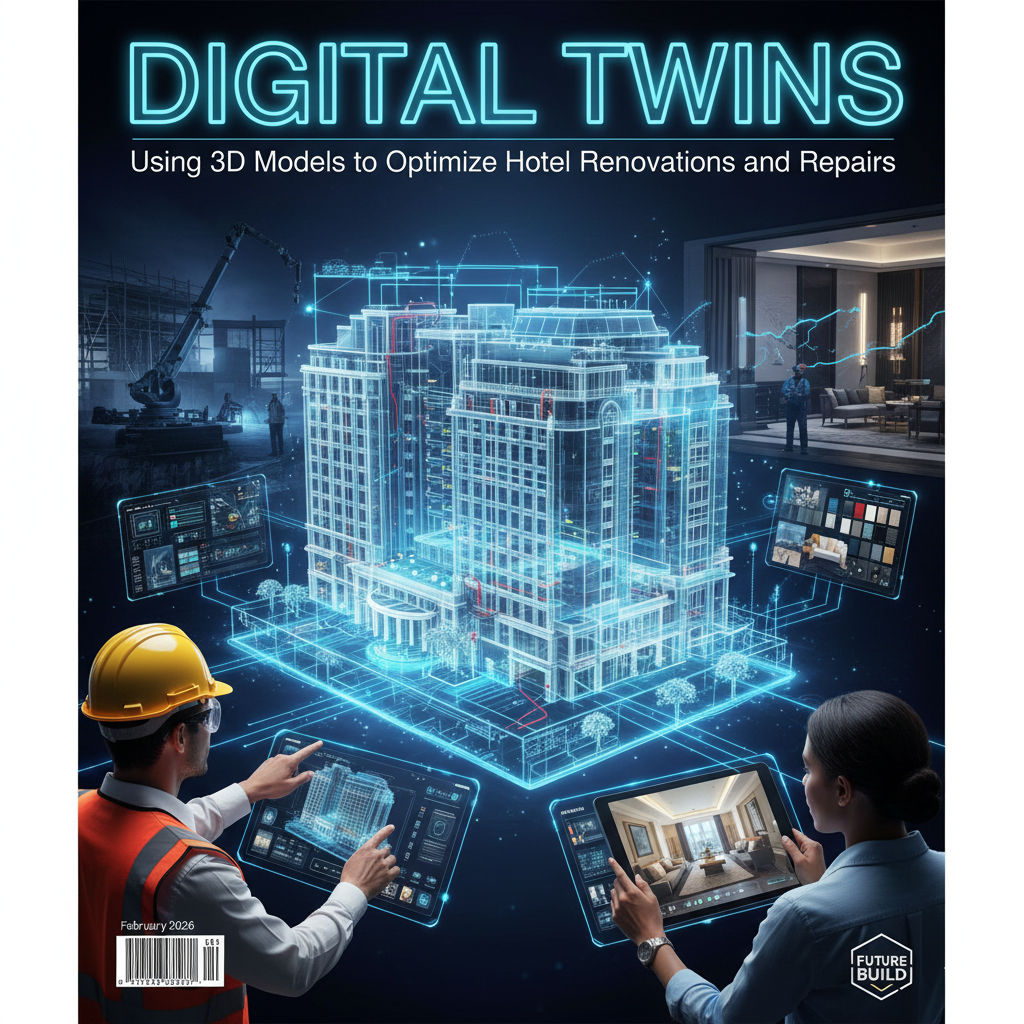
Renovations and repairs are inevitable in hospitality. Guest expectations evolve, brand standards change, and buildings age. Yet for hotels, renovation projects often come with familiar pain points—budget overruns, operational disruptions, miscommunication between teams, and unexpected downtime that impacts revenue.
In an industry where every closed room represents lost income, inefficiency is costly. This is where digital twins are quietly transforming how hotels plan, execute, and optimize renovations and maintenance.
By using intelligent 3D digital replicas of physical hotel assets, digital twins allow hotel owners, operators, and engineers to move from reactive fixes to predictive, data-driven decision-making.
What Is a Digital Twin in Hospitality?
A digital twin is a dynamic, virtual 3D model of a physical asset—such as a hotel building, guest room, HVAC system, or entire property—that is continuously updated with real-world data.
Unlike static blueprints or CAD drawings, digital twins:
- Reflect current conditions
- Integrate operational data
- Simulate future scenarios
- Enable real-time monitoring
In hospitality, digital twins serve as a single source of truth for design, engineering, maintenance, and renovation planning.
Why Traditional Renovation Planning Falls Short
Hotel renovations are uniquely complex. They must balance:
- Guest experience continuity
- Brand compliance
- Budget control
- Operational efficiency
Traditional approaches rely heavily on:
- Outdated drawings
- Manual inspections
- Disconnected contractors
- Reactive problem-solving
This often leads to unexpected structural issues, extended closures, and escalating costs. Digital twins address these gaps by making the invisible visible.
How Digital Twins Transform Hotel Renovations
1. Accurate Visualization Before Construction Begins
Digital twins allow stakeholders to explore renovations in a virtual environment before any physical work starts.
Hotels can:
- Visualize layout changes
- Test design alternatives
- Identify spatial conflicts
- Validate guest flow and accessibility
This reduces costly design revisions during construction.
2. Predictive Maintenance and Repair Planning
By integrating sensor data, digital twins can predict when assets are likely to fail.
For example:
- HVAC systems showing efficiency decline
- Plumbing components nearing end-of-life
- Electrical loads exceeding safe thresholds
This allows hotels to schedule repairs proactively, minimizing guest disruption and emergency costs.
3. Minimizing Operational Disruption
Digital twins help hotels plan renovations in phases that align with occupancy patterns.
Using simulations, teams can:
- Identify which rooms to close and when
- Optimize construction sequencing
- Maintain safety and service standards
This ensures revenue continuity during renovation cycles.
Digital Twins as a Collaboration Platform
Renovations involve multiple stakeholders—owners, operators, designers, contractors, and brand teams.
Digital twins provide a shared visual language that:
- Reduces misinterpretation
- Improves coordination
- Accelerates approvals
Everyone works from the same, up-to-date model rather than conflicting documents.
Optimizing Cost Control and Budget Accuracy
Budget overruns are a major risk in hotel renovations.
Digital twins help control costs by:
- Identifying clashes before construction
- Reducing rework
- Improving quantity take-offs
- Simulating cost-impact scenarios
Predictive insights enable smarter capital allocation and fewer surprises.
Enhancing Lifecycle Asset Management
Renovations should not be viewed as one-time events. Digital twins support long-term asset management.
Hotels can:
- Track asset age and condition
- Plan refurbishment cycles
- Extend asset lifespan
- Optimize total cost of ownership
This shifts capital planning from reactive to strategic.
Use Cases Across Hotel Operations
Guest Rooms
Digital twins model wear-and-tear patterns, helping prioritize renovations based on actual usage rather than fixed timelines.
Mechanical and Electrical Systems
Engineers can test upgrades virtually before implementing them on-site.
Public Spaces
Traffic flow simulations help redesign lobbies, restaurants, and meeting spaces for improved guest experience.
Back-of-House Areas
Maintenance efficiency improves through better space planning and system visibility.
Integrating Digital Twins with Smart Hotel Technology
Digital twins become even more powerful when connected to smart building systems.
Integration enables:
- Real-time energy monitoring
- Predictive fault detection
- Automated alerts
- Sustainability optimization
This creates a living model that evolves with the property.
Sustainability and Waste Reduction Benefits
Renovations generate significant material waste and carbon emissions.
Digital twins support sustainable practices by:
- Reducing over-ordering of materials
- Optimizing reuse of existing structures
- Improving energy efficiency planning
- Minimizing demolition waste
Circular renovation strategies become easier to implement.
Improving Safety and Compliance
Safety is critical during renovations in operational hotels.
Digital twins help by:
- Mapping emergency exits and hazards
- Simulating evacuation scenarios
- Ensuring regulatory compliance
- Enhancing contractor safety planning
This reduces risk for guests, staff, and workers.
Data-Driven Decision Making for Owners and Brands
For hotel owners and asset managers, digital twins provide clarity.
They enable:
- Objective evaluation of renovation ROI
- Better alignment with brand standards
- Scenario testing for different investment levels
Decisions become evidence-based rather than intuition-driven.
Overcoming Barriers to Adoption
Despite their benefits, digital twins face adoption challenges.
Perceived Complexity
Modern platforms are increasingly user-friendly and designed for non-technical users.
Initial Investment
While setup costs exist, ROI is often realized through reduced rework, downtime, and energy costs.
Data Integration
Successful implementation requires integration with existing systems—but this is improving rapidly.
Early adopters gain a significant competitive edge.
The Role of AI and Automation
When combined with AI, digital twins evolve from visualization tools into intelligent advisors.
AI-powered twins can:
- Recommend optimal renovation schedules
- Predict system failures
- Optimize energy consumption
- Suggest design improvements
This represents the future of intelligent hotel asset management.
Training and Knowledge Retention
Digital twins also serve as training tools.
New staff can:
- Understand building systems visually
- Learn maintenance procedures safely
- Reduce dependency on institutional memory
Knowledge stays with the property—even as staff changes.
Digital Twins and Brand Consistency
For multi-property brands, digital twins support consistency across locations.
They allow:
- Standardized renovation templates
- Benchmarking across assets
- Faster brand refresh rollouts
Scalability becomes more manageable and predictable.
The Future of Hotel Renovations
As hotels become more complex and guest expectations rise, renovation strategies must evolve.
Digital twins will:
- Replace static drawings
- Enable continuous optimization
- Support resilient operations
- Reduce renovation risk
They are not just tools—they are strategic infrastructure.
Conclusion
Digital twins represent a paradigm shift in how hotels approach renovations and repairs. By creating intelligent 3D models that mirror real-world conditions, hotels can plan smarter, spend wiser, and operate more efficiently—without compromising guest experience.
At Booksmart, we believe the future of hospitality asset management lies in visibility, predictability, and data-driven precision. Digital twins empower hotels to renovate not just faster—but better.
Leave a Reply