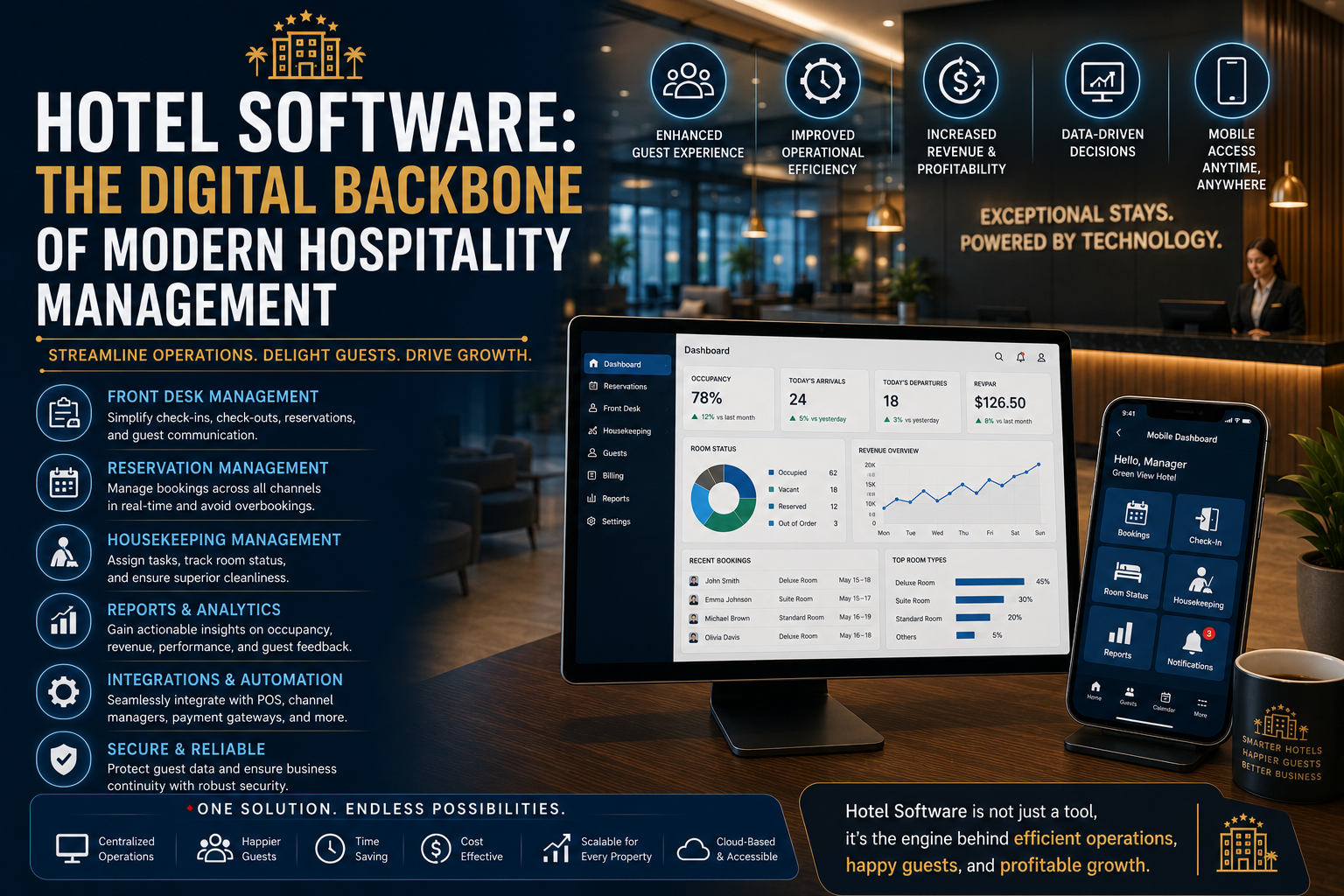
The hospitality industry has undergone a significant digital transformation over the past decade. As guest expectations continue to evolve and competition intensifies, hotels are increasingly relying on technology to streamline operations, enhance guest experiences, and improve profitability. Whether it’s managing reservations, coordinating housekeeping, optimizing room pricing, or building stronger guest relationships, hotel software has become the foundation of efficient hospitality management.
Today’s travelers expect seamless online booking, fast check-ins, personalized services, mobile accessibility, and instant communication. At the same time, hotel managers must oversee multiple departments, control operational costs, manage staff, and make data-driven decisions. Hotel software brings these functions together into a centralized platform, enabling hotels to deliver exceptional service while improving efficiency and business performance.
At BookSmart, we believe that investing in the right hotel software is no longer a luxury—it’s a necessity. Modern software solutions empower hospitality businesses to automate routine tasks, improve collaboration across departments, and create memorable guest experiences that drive long-term success.
What Is Hotel Software?
Hotel software is a collection of digital applications designed to manage and automate various aspects of hotel operations. Instead of relying on manual processes or disconnected systems, hotel software integrates multiple functions into a single, centralized platform.
Depending on the size and needs of the property, hotel software may include tools for reservations, property management, housekeeping, customer relationship management (CRM), billing, revenue management, inventory tracking, maintenance, staff scheduling, reporting, and guest communication.
These systems work together to improve operational efficiency while providing management with real-time visibility into hotel performance.
Cloud-based hotel software has become increasingly popular because it offers remote access, automatic updates, enhanced security, and greater scalability compared to traditional on-premise systems.
Why Hotel Software Is Essential
Managing a hotel involves coordinating numerous departments simultaneously. Front desk operations, housekeeping, maintenance, food and beverage services, accounting, marketing, and customer support must work together efficiently to deliver outstanding guest experiences.
Without integrated software, these departments often rely on manual communication, spreadsheets, or separate systems that create inefficiencies and increase the risk of errors.
Hotel software simplifies daily operations by automating repetitive tasks, reducing paperwork, improving communication, and providing accurate real-time information.
The result is faster service, better decision-making, lower operational costs, and improved guest satisfaction.
Property Management Systems (PMS)
The Property Management System (PMS) is the core component of most hotel software platforms.
A PMS manages essential front-office operations, including reservations, room assignments, guest check-ins and check-outs, billing, housekeeping coordination, and room availability.
The system provides employees with instant access to guest information, booking history, payment status, and room occupancy.
Modern PMS platforms integrate with numerous other hotel technologies, creating a unified operational environment.
By centralizing information, a PMS improves efficiency while reducing administrative workload and human error.
Online Reservation and Booking Management
An efficient reservation system is critical for maximizing occupancy and providing a smooth booking experience.
Hotel software allows guests to check availability, compare room options, make reservations, and receive instant confirmations through the hotel’s website or mobile application.
Integrated booking engines synchronize availability across online travel agencies (OTAs), global distribution systems (GDS), and direct booking channels.
Real-time synchronization helps prevent overbookings while ensuring accurate room inventory across all platforms.
Advanced booking systems also support promotional offers, package deals, and personalized recommendations.
Revenue Management Software
Revenue optimization is a major priority for hospitality businesses.
Revenue management software analyzes occupancy rates, booking trends, seasonal demand, competitor pricing, local events, and historical performance to recommend optimal room rates.
Dynamic pricing enables hotels to adjust rates automatically based on changing market conditions.
Instead of relying on manual pricing decisions, managers can use data-driven insights to maximize occupancy while increasing profitability.
Revenue management software also improves forecasting and supports long-term financial planning.
Customer Relationship Management (CRM)
Customer Relationship Management (CRM) software helps hotels build stronger relationships with guests by storing and analyzing customer information.
The system records booking history, room preferences, dining choices, loyalty program activity, communication preferences, and guest feedback.
Hotels use this information to personalize services, recommend relevant offers, and strengthen guest loyalty.
CRM software also supports targeted marketing campaigns, automated communication, and customer retention initiatives.
By understanding guest preferences, hotels create more memorable experiences that encourage repeat visits.
Housekeeping Management Software
Housekeeping operations become significantly more efficient with specialized software solutions.
Digital housekeeping systems provide real-time room status updates, cleaning schedules, maintenance notifications, and task assignments.
Staff members receive instant updates through mobile devices, reducing communication delays and improving coordination.
Supervisors can monitor cleaning progress, prioritize urgent requests, and ensure rooms are prepared efficiently for arriving guests.
Automated housekeeping management improves productivity while maintaining high cleanliness standards.
Maintenance Management Systems
Hotel facilities require continuous maintenance to ensure guest comfort and operational reliability.
Maintenance software tracks equipment performance, schedules preventive maintenance, records repair histories, and manages work orders.
Employees can report maintenance issues digitally, allowing technicians to respond quickly.
Some advanced systems integrate with Internet of Things (IoT) sensors that detect equipment problems before failures occur.
Preventive maintenance reduces downtime, lowers repair costs, and extends equipment lifespan.
Point of Sale (POS) Systems
Hotels often operate restaurants, bars, cafés, spas, gift shops, and recreational facilities.
A Point of Sale (POS) system manages transactions across these departments while integrating with the hotel’s billing and accounting systems.
Guests can conveniently charge purchases directly to their room accounts, simplifying payment processes.
POS software also tracks inventory, monitors sales performance, and generates financial reports that support operational planning.
Integrated POS systems improve both customer convenience and financial accuracy.
Inventory and Procurement Management
Managing inventory efficiently is essential for controlling costs and ensuring uninterrupted operations.
Hotel software tracks stock levels for food, beverages, housekeeping supplies, linens, maintenance equipment, and guest amenities.
Automated inventory systems generate purchase recommendations based on consumption patterns and occupancy forecasts.
Procurement software also helps manage supplier relationships, purchase orders, deliveries, and contract compliance.
Improved inventory management reduces waste, prevents shortages, and optimizes purchasing decisions.
Financial Management and Reporting
Accurate financial management is essential for long-term business success.
Hotel software automates billing, invoicing, expense tracking, payroll integration, tax calculations, and financial reporting.
Managers gain access to real-time dashboards displaying revenue, occupancy, operational costs, profit margins, and cash flow performance.
Automated reporting improves financial transparency while supporting faster and more informed decision-making.
Integrated accounting systems also simplify audits and regulatory compliance.
Guest Communication Tools
Modern hotel software includes communication platforms that improve guest engagement throughout the customer journey.
Automated messaging systems send booking confirmations, pre-arrival instructions, check-in reminders, promotional offers, satisfaction surveys, and post-stay follow-ups.
Guests can communicate with hotel staff through mobile applications, live chat, messaging platforms, or AI-powered virtual assistants.
Effective communication enhances guest satisfaction while reducing front desk workload.
Personalized messaging also strengthens customer relationships and loyalty.
Data Analytics and Business Intelligence
Hotel software generates valuable operational data that supports strategic decision-making.
Business intelligence dashboards provide insights into occupancy rates, guest demographics, booking channels, marketing performance, labor costs, housekeeping productivity, and financial performance.
Managers use analytics to identify trends, evaluate operational efficiency, forecast demand, and optimize pricing strategies.
Predictive analytics also supports resource planning and long-term business development.
Data-driven management enables hotels to respond quickly to changing market conditions.
Cloud-Based Hotel Software
Cloud technology has revolutionized hotel management by making software more flexible and accessible.
Cloud-based systems allow authorized employees to access hotel information securely from any location using internet-connected devices.
Automatic software updates eliminate the need for complex installations while reducing IT maintenance costs.
Cloud platforms also improve data backup, disaster recovery, and cybersecurity capabilities.
Scalable cloud solutions are particularly beneficial for hotel groups managing multiple properties across different locations.
Benefits of Hotel Software
The adoption of modern hotel software offers numerous advantages.
Hotels benefit from improved operational efficiency, reduced administrative workload, enhanced guest experiences, stronger financial management, better communication, higher occupancy rates, and increased profitability.
Automation minimizes human error while allowing employees to focus on personalized guest service.
Integrated systems improve collaboration across departments, ensuring consistent service delivery throughout the guest journey.
Technology also provides valuable business insights that support continuous improvement and innovation.
Challenges of Implementing Hotel Software
Although hotel software delivers significant benefits, implementation requires careful planning and organizational commitment.
Hotels must evaluate software compatibility, integration requirements, cybersecurity measures, employee training, and long-term support.
Staff adoption is critical for maximizing software effectiveness.
Organizations should choose scalable solutions that can adapt to future growth and evolving guest expectations.
Successful implementation also requires ongoing monitoring, updates, and continuous employee education.
The Future of Hotel Software
The future of hotel software will be shaped by Artificial Intelligence, automation, machine learning, Internet of Things (IoT), blockchain, and predictive analytics.
AI-powered platforms will automate guest communication, optimize pricing, personalize recommendations, and improve operational forecasting.
Smart hotel ecosystems will connect guest rooms, maintenance systems, housekeeping, security, and energy management into unified digital platforms.
As technology continues to evolve, hotel software will become even more intelligent, helping hospitality businesses deliver faster, more personalized, and more sustainable services.
Hotels that invest in digital transformation today will be well positioned for future growth and industry leadership.
Conclusion
Hotel software has become the digital backbone of modern hospitality management. By integrating reservations, property management, customer relationships, housekeeping, maintenance, financial reporting, and analytics into a centralized system, hotels can operate more efficiently while delivering exceptional guest experiences.
Beyond improving daily operations, hotel software supports data-driven decision-making, enhances collaboration across departments, and enables hotels to adapt to changing market demands. Whether managing a boutique hotel or a large international resort, the right software solution provides the flexibility and intelligence needed to remain competitive in today’s hospitality landscape.
At BookSmart, we believe that technology should empower hospitality professionals rather than replace them. Hotels that combine advanced software with outstanding customer service will create memorable guest experiences, improve operational performance, and build sustainable success in an increasingly digital world.
Leave a Reply