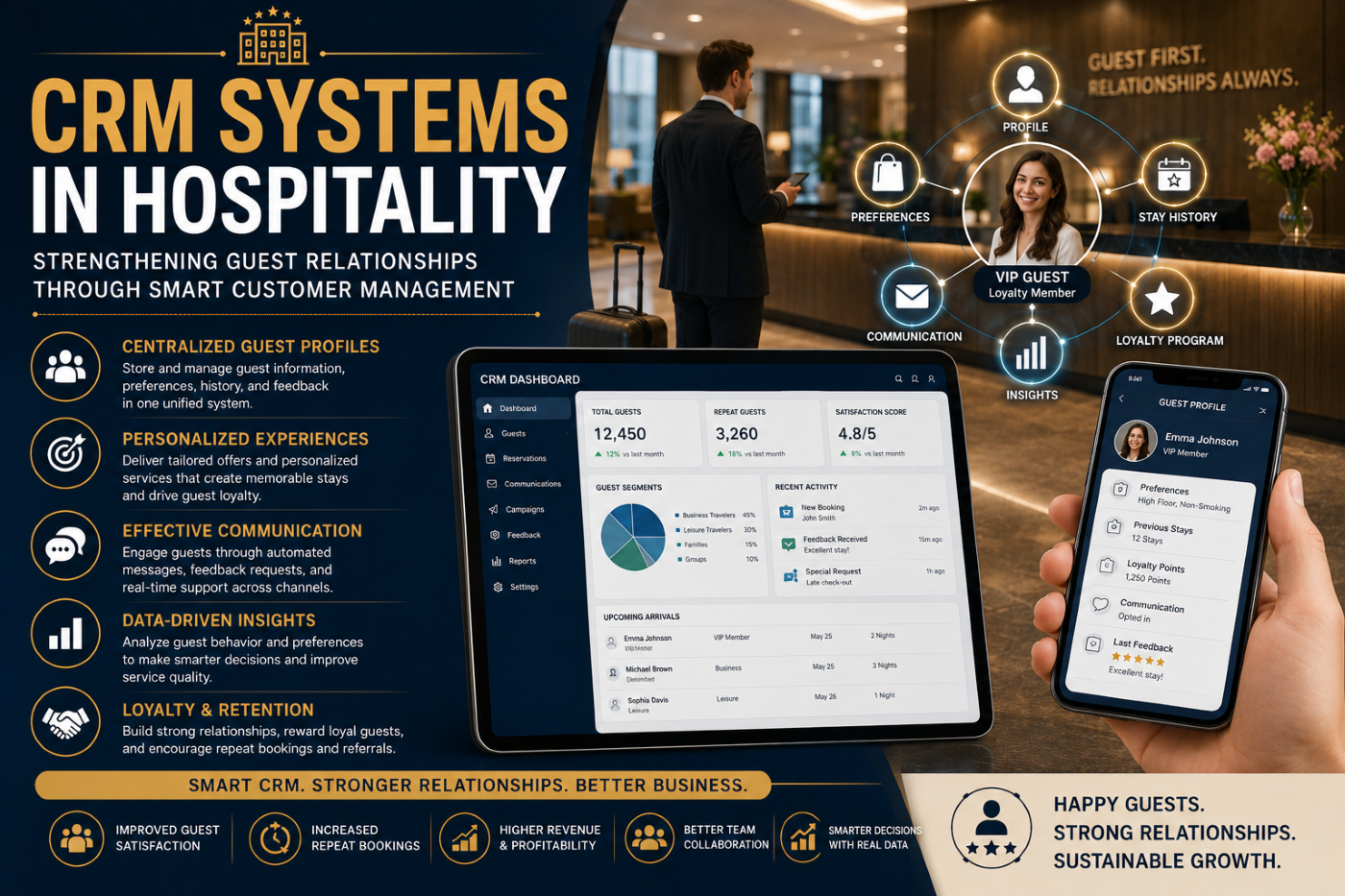
In today’s highly competitive hospitality industry, delivering exceptional guest experiences is no longer enough to guarantee long-term success. Hotels, resorts, restaurants, and hospitality businesses must build lasting relationships with guests by understanding their preferences, anticipating their needs, and providing personalized services throughout every stage of the customer journey. This is where Customer Relationship Management (CRM) systems have become an essential tool for modern hospitality businesses.
A CRM system helps hotels collect, organize, and analyze guest information to improve communication, personalize services, enhance loyalty, and increase revenue. Rather than storing customer data in separate systems, a hospitality CRM creates a centralized platform that enables every department to deliver a consistent and memorable guest experience.
As guest expectations continue to evolve, CRM technology has become a strategic investment rather than just a software solution. At BookSmart, we believe that an effective CRM system enables hospitality businesses to strengthen guest relationships, improve operational efficiency, and achieve sustainable business growth.
What Is a Hospitality CRM System?
A Customer Relationship Management (CRM) system is a software platform designed to manage interactions between a business and its customers. In the hospitality industry, CRM systems collect guest information from multiple touchpoints, including online bookings, hotel stays, restaurant visits, customer feedback, loyalty programs, websites, mobile applications, and social media.
The system creates a comprehensive guest profile containing information such as booking history, room preferences, dining choices, communication preferences, special requests, and past interactions.
By providing employees with easy access to this information, CRM systems help hotels deliver highly personalized service that enhances guest satisfaction and encourages repeat visits.
Modern hospitality CRMs often integrate with Property Management Systems (PMS), booking engines, revenue management software, marketing platforms, and payment systems to create a seamless operational ecosystem.
Why CRM Systems Matter in Hospitality
The hospitality industry depends heavily on customer loyalty and positive guest experiences. Acquiring new guests often costs significantly more than retaining existing ones, making relationship management a critical business priority.
CRM systems enable hotels to better understand guest behavior, anticipate expectations, and create personalized experiences that build trust and loyalty.
Instead of treating every guest the same, hotels can recognize returning visitors, remember their preferences, and provide customized services that make each stay feel unique.
A well-implemented CRM also improves communication across departments, ensuring that guest information is shared efficiently between reservations, front office, housekeeping, food and beverage, and customer service teams.
This coordinated approach creates a smoother and more consistent guest experience.
Building Comprehensive Guest Profiles
One of the greatest strengths of a CRM system is its ability to create detailed guest profiles.
Each interaction adds valuable information to the guest’s record, including preferred room type, check-in preferences, dietary requirements, favorite amenities, travel purpose, loyalty status, and previous service requests.
For example, if a guest consistently requests a high-floor room, vegetarian meals, and late check-out, the hotel can automatically prepare these preferences during future visits.
Personalized attention helps guests feel recognized and valued, significantly improving satisfaction and encouraging repeat business.
The more complete the guest profile becomes, the more meaningful and relevant the hotel experience can be.
Enhancing Guest Communication
Effective communication is essential throughout the guest journey, and CRM systems make it easier for hotels to stay connected before, during, and after each stay.
Before arrival, hotels can send personalized booking confirmations, pre-arrival information, upgrade offers, transportation options, and special promotions.
During the stay, guests can receive notifications about hotel events, dining offers, spa services, or local attractions based on their interests.
After departure, CRM systems support follow-up emails, satisfaction surveys, thank-you messages, loyalty rewards, and future promotional campaigns.
Consistent communication strengthens relationships while keeping guests engaged with the hotel’s brand.
Personalizing the Guest Experience
Modern travelers increasingly expect personalized experiences rather than standardized services.
CRM systems allow hotels to tailor every aspect of the guest journey by using historical data and behavioral insights.
Returning guests may automatically receive their preferred pillow type, room location, welcome beverage, or dining recommendations.
Business travelers can be offered meeting room packages, while families may receive information about children’s activities and nearby attractions.
Personalization extends beyond room preferences to include customized marketing, targeted offers, and individualized service recommendations.
These thoughtful details create memorable experiences that differentiate hotels from competitors.
Strengthening Loyalty Programs
Customer loyalty programs become significantly more effective when supported by CRM technology.
The CRM tracks guest activity, spending patterns, visit frequency, and engagement with promotional campaigns.
Hotels can reward loyal guests with personalized discounts, complimentary upgrades, exclusive experiences, birthday offers, and early access to special promotions.
Rather than offering identical rewards to every customer, CRM systems enable hotels to create targeted loyalty strategies based on individual preferences and behavior.
This personalized approach increases guest retention while encouraging repeat bookings.
Improving Marketing Performance
CRM systems transform hospitality marketing by replacing broad campaigns with highly targeted communication.
Hotels can segment guests based on travel purpose, demographics, booking history, spending habits, geographic location, or preferred amenities.
For example, leisure travelers may receive vacation package promotions, while business travelers receive conference and meeting offers.
Artificial Intelligence integrated into CRM platforms can also recommend the most effective marketing messages, communication channels, and promotional timing.
Targeted marketing improves campaign performance while reducing unnecessary advertising expenses.
It also increases conversion rates by delivering relevant offers to the right audience.
Increasing Revenue Opportunities
Hospitality CRM systems contribute directly to revenue growth by identifying opportunities for upselling and cross-selling.
Based on guest preferences and previous purchases, hotels can recommend premium rooms, spa treatments, dining experiences, airport transfers, late check-outs, or special event packages.
CRM analytics also help identify high-value guests who may be interested in exclusive services or luxury experiences.
Personalized recommendations are generally more effective than generic promotions because they align with individual guest interests.
As a result, hotels increase average guest spending while enhancing the overall customer experience.
Supporting Better Customer Service
Excellent customer service depends on having access to accurate and timely information.
CRM systems allow hotel employees to view guest history instantly, enabling faster responses and more informed decision-making.
If a guest previously reported a maintenance issue or requested a specific service, staff members can proactively address these needs during future visits.
Front desk teams, housekeeping, restaurants, and concierge services all benefit from shared access to guest information.
This coordinated approach improves efficiency while ensuring consistent service quality across every department.
Managing Guest Feedback
Guest feedback provides valuable insights into service quality and operational performance.
CRM systems collect reviews, surveys, online ratings, and customer comments from multiple channels.
Hotels can analyze this feedback to identify recurring issues, recognize service strengths, and implement continuous improvements.
Artificial Intelligence can categorize feedback by sentiment, allowing management to prioritize urgent concerns and respond more effectively.
Actively listening to guest feedback demonstrates commitment to service excellence while strengthening customer trust.
Data Analytics and Business Intelligence
Modern CRM platforms offer advanced analytics that help hotels make data-driven decisions.
Managers can monitor booking trends, guest demographics, customer lifetime value, campaign effectiveness, occupancy patterns, and loyalty program performance.
Predictive analytics identify future demand, estimate guest behavior, and support revenue forecasting.
Business intelligence dashboards provide real-time insights into customer engagement and operational performance.
These analytics enable hospitality organizations to improve strategic planning and resource allocation.
Integration with Hotel Systems
The full value of a CRM system is realized when it integrates with other hotel technologies.
Hospitality CRMs commonly connect with Property Management Systems (PMS), Central Reservation Systems (CRS), Revenue Management Systems (RMS), Point of Sale (POS) platforms, housekeeping software, mobile applications, and payment systems.
Integrated systems eliminate duplicate data entry, improve operational efficiency, and create a unified view of each guest.
Automation between systems also reduces administrative workload while improving data accuracy.
Seamless integration enables hotels to deliver more personalized and efficient service throughout the guest journey.
Challenges of CRM Implementation
Although CRM systems provide significant benefits, successful implementation requires careful planning.
Hotels must ensure high-quality data collection, staff training, system integration, and ongoing maintenance.
Employee adoption is particularly important, as even the most advanced CRM will provide limited value if staff members do not use it effectively.
Hotels must also protect guest information by implementing strong cybersecurity measures and complying with applicable data privacy regulations.
Maintaining guest trust requires responsible handling of personal data and transparent communication about how information is used.
The Future of CRM in Hospitality
The future of hospitality CRM will be driven by Artificial Intelligence, machine learning, predictive analytics, and automation.
AI-powered CRM platforms will deliver even more personalized guest experiences by anticipating preferences before guests make requests.
Voice assistants, mobile applications, smart hotel rooms, and loyalty platforms will become increasingly integrated into CRM ecosystems.
Real-time personalization, automated guest engagement, and predictive customer service will become standard features across the hospitality industry.
Hotels that invest in intelligent CRM solutions today will be well positioned to meet future guest expectations while strengthening long-term business performance.
Conclusion
Customer Relationship Management systems have become an indispensable part of modern hospitality. By centralizing guest information, improving communication, personalizing services, strengthening loyalty programs, and supporting data-driven decision-making, CRM technology helps hotels create exceptional guest experiences while improving operational efficiency.
Beyond managing customer information, CRM systems enable hospitality businesses to build meaningful relationships that encourage repeat visits, positive reviews, and long-term brand loyalty.
At BookSmart, we believe that successful hospitality is built on understanding guests as individuals rather than simply processing reservations. Hotels that embrace CRM technology while maintaining genuine human connections will create memorable experiences, strengthen customer loyalty, and achieve sustainable success in an increasingly competitive hospitality industry.
Leave a Reply