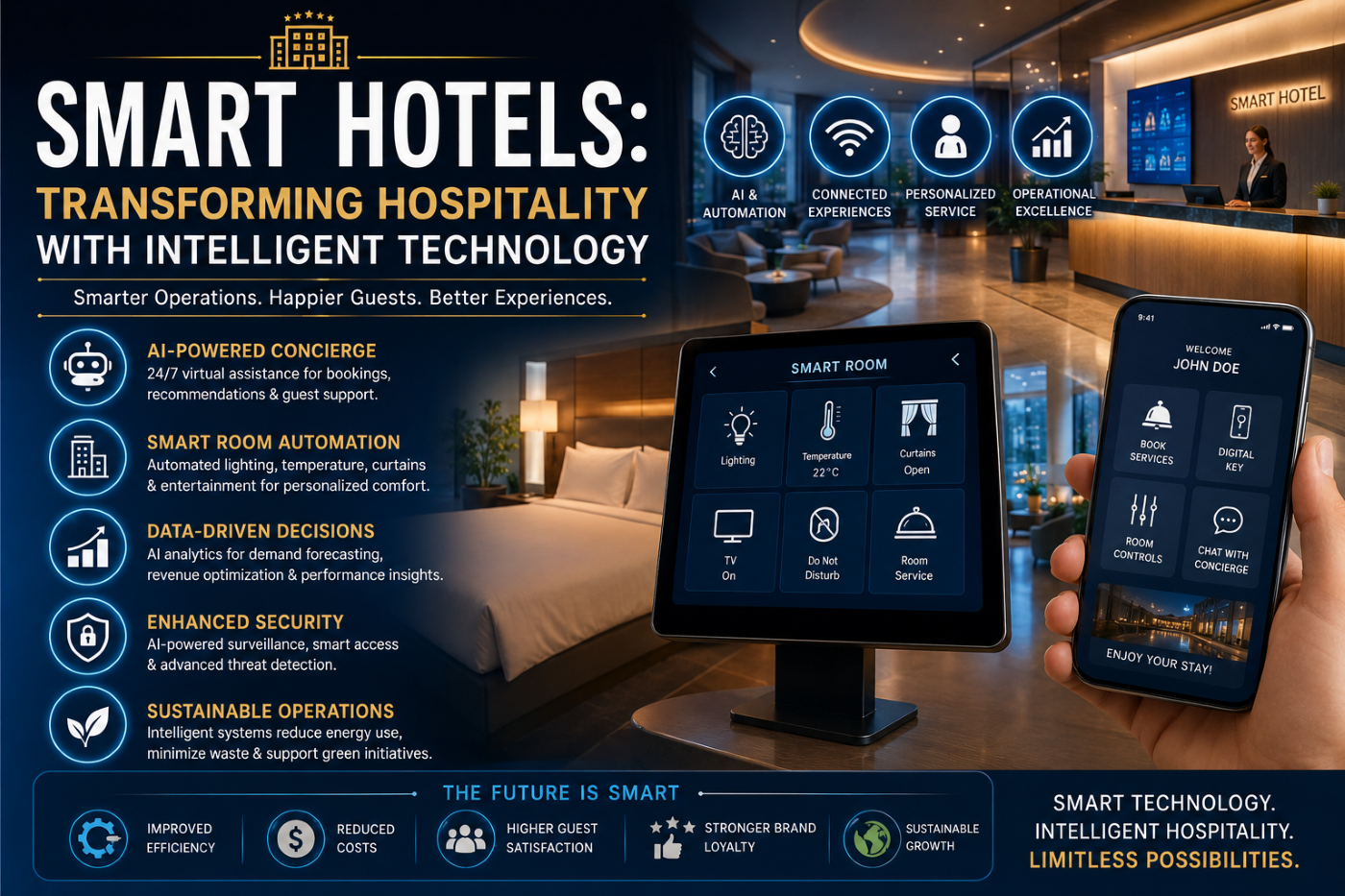
The hospitality industry is evolving rapidly as technology reshapes the way hotels operate and serve their guests. Modern travelers expect more than comfortable rooms and quality service—they seek convenience, personalization, seamless digital experiences, and innovative amenities that make their stay enjoyable and hassle-free. To meet these growing expectations, hotels around the world are embracing smart technologies that enhance operational efficiency while delivering exceptional guest experiences.
A smart hotel integrates advanced technologies such as the Internet of Things (IoT), Artificial Intelligence (AI), cloud computing, mobile applications, smart sensors, automation, and data analytics into its daily operations. These technologies work together to streamline processes, reduce operational costs, improve sustainability, and provide guests with a highly personalized experience. From mobile check-ins and voice-controlled rooms to AI-powered concierge services and energy-efficient systems, smart hotels represent the future of hospitality.
At BookSmart, we believe that smart hotels are redefining industry standards by combining innovative technology with outstanding customer service. Hotels that invest in intelligent solutions today are better prepared to meet evolving guest expectations and remain competitive in an increasingly digital marketplace.
What Is a Smart Hotel?
A smart hotel is a hospitality property that uses interconnected digital technologies to automate operations, improve efficiency, and enhance the guest experience. Unlike traditional hotels, smart hotels leverage real-time data and intelligent systems to manage everything from room settings and security to housekeeping and energy consumption.
Guests can often control various aspects of their stay using smartphones, tablets, voice assistants, or in-room touch panels. They may adjust room temperature, lighting, entertainment systems, curtains, and service requests without needing to contact the front desk.
For hotel management, smart technologies provide greater visibility into operations, enabling faster decision-making, predictive maintenance, optimized staffing, and improved resource management.
The result is a more efficient hotel that delivers higher levels of guest satisfaction while reducing operational complexity.
Why Smart Hotels Are Becoming Essential
The hospitality industry has become increasingly competitive, and guest expectations continue to rise. Travelers today value speed, convenience, personalization, and contactless services.
Smart hotels address these demands by providing seamless digital experiences throughout the guest journey. Automated processes reduce waiting times, improve communication, and eliminate many of the inconveniences traditionally associated with hotel stays.
In addition to improving customer satisfaction, smart technologies help hotels reduce labor costs, optimize energy usage, minimize waste, and improve operational efficiency.
As technology becomes more accessible and affordable, smart hotel features are no longer limited to luxury properties. Mid-scale and boutique hotels are also adopting intelligent solutions to enhance guest experiences and strengthen their competitive position.
Contactless Check-In and Check-Out
One of the most popular smart hotel features is contactless check-in and check-out.
Instead of waiting in line at the reception desk, guests can complete registration through mobile applications, self-service kiosks, or digital identity verification systems. Digital room keys are then delivered directly to their smartphones.
This process reduces waiting times, improves convenience, and allows hotel staff to focus on personalized guest interactions rather than administrative tasks.
Contactless services also improve operational efficiency while supporting guest preferences for convenience and flexibility.
Smart Guest Rooms
Smart guest rooms are one of the defining features of modern hospitality.
Using mobile applications, voice assistants, or in-room control panels, guests can personalize room settings according to their preferences.
They can control lighting, air conditioning, television, curtains, music, and room service requests from a single interface.
Some hotels automatically remember guest preferences from previous visits, creating a personalized experience every time they return.
Smart rooms increase comfort while providing guests with greater control over their environment.
Artificial Intelligence in Smart Hotels
Artificial Intelligence plays a central role in smart hotel operations.
AI-powered chatbots provide instant customer support by answering questions about reservations, hotel amenities, dining options, transportation, and local attractions at any time of the day.
AI also helps personalize guest experiences by analyzing booking history, travel preferences, and loyalty program data.
Hotels use AI for revenue management, demand forecasting, dynamic pricing, predictive maintenance, and customer feedback analysis.
These intelligent systems enable hotels to make faster and more informed business decisions while improving guest satisfaction.
Internet of Things (IoT) Integration
The Internet of Things connects devices and systems throughout the hotel, enabling real-time communication and automation.
Smart sensors monitor occupancy, lighting, temperature, water consumption, and equipment performance.
When a guest leaves the room, the system can automatically adjust lighting and climate settings to conserve energy.
IoT also supports predictive maintenance by identifying equipment issues before they result in failures.
These connected technologies improve operational efficiency while reducing utility costs and environmental impact.
Personalized Guest Experiences
Personalization has become a key competitive advantage in modern hospitality.
Smart hotel systems collect and analyze guest preferences to deliver customized recommendations and services.
Returning guests may automatically receive their preferred room type, pillow selection, dining suggestions, or wellness packages.
Hotels can also recommend local attractions, transportation services, and exclusive offers based on individual interests.
Personalized experiences increase guest satisfaction, strengthen loyalty, and encourage repeat visits.
Smart Housekeeping Operations
Technology is transforming housekeeping management through automation and real-time communication.
Housekeeping staff receive digital updates regarding room occupancy, guest requests, maintenance issues, and cleaning priorities.
Rather than following fixed schedules, cleaning activities can be optimized based on actual room usage.
This approach improves efficiency while ensuring rooms are ready for new arrivals as quickly as possible.
Digital task management also improves coordination between housekeeping, maintenance, and front office departments.
Energy Management and Sustainability
Smart hotels contribute significantly to environmental sustainability through intelligent energy management systems.
Automated lighting, climate control, occupancy sensors, and water monitoring systems reduce unnecessary resource consumption without compromising guest comfort.
Energy-efficient operations lower utility expenses while supporting sustainability initiatives and reducing carbon emissions.
Hotels can also monitor waste generation, optimize water usage, and integrate renewable energy sources into their operations.
Many environmentally conscious travelers actively seek accommodations that demonstrate strong sustainability practices.
Smart technologies help hotels achieve both environmental and financial objectives.
Enhanced Hotel Security
Security remains a top priority for both guests and hotel operators.
Smart hotels utilize advanced surveillance systems, digital access controls, biometric authentication, and intelligent monitoring technologies to improve safety.
Mobile room keys reduce the risk of lost key cards, while AI-powered surveillance systems can detect unusual activity in real time.
Cybersecurity also plays an increasingly important role as hotels protect guest data and digital infrastructure.
Comprehensive security systems help build guest trust and protect hotel operations.
Data-Driven Decision Making
Smart hotels generate valuable operational data that supports better business decisions.
Managers can monitor occupancy rates, guest satisfaction scores, maintenance performance, energy usage, staffing efficiency, and financial performance through centralized dashboards.
Data analytics helps identify operational trends, predict future demand, and optimize pricing strategies.
Hotels can also evaluate marketing performance and personalize promotional campaigns based on guest behavior.
Access to accurate real-time information enables more effective planning and continuous improvement.
Smart Food and Beverage Services
Restaurants within smart hotels are also benefiting from digital innovation.
Guests can browse menus, place orders, and request room service through mobile applications or QR codes.
AI analyzes ordering patterns to improve inventory management and reduce food waste.
Digital payment systems simplify transactions while enhancing convenience.
Smart kitchen management systems improve coordination between chefs, servers, and delivery staff, resulting in faster service and improved guest satisfaction.
Benefits of Smart Hotels
The adoption of smart technologies provides numerous advantages for both guests and hotel operators.
For guests, benefits include faster check-ins, personalized experiences, enhanced comfort, greater convenience, improved security, and seamless digital services.
For hotels, smart systems reduce operational costs, improve employee productivity, optimize resource utilization, strengthen sustainability efforts, increase revenue opportunities, and support better decision-making.
These combined benefits make smart hotels increasingly attractive in today’s competitive hospitality landscape.
Challenges in Implementing Smart Hotel Technologies
Although smart hotels offer many advantages, implementation requires careful planning and investment.
Hotels may face challenges related to technology costs, system integration, employee training, cybersecurity, data privacy, and ongoing maintenance.
Staff members must understand how to use new technologies effectively while continuing to deliver personalized hospitality.
Hotels must also ensure that digital innovations enhance rather than replace meaningful human interactions.
A balanced approach between automation and genuine customer service remains essential.
The Future of Smart Hotels
The future of hospitality will be increasingly shaped by intelligent technologies.
Artificial Intelligence, robotics, voice recognition, augmented reality, predictive analytics, and advanced IoT systems will continue transforming hotel operations.
Guests may soon experience fully personalized rooms that automatically adjust settings before arrival based on previous stays and individual preferences.
Sustainability technologies will further reduce environmental impact through smarter resource management and carbon reduction initiatives.
As technology continues to evolve, smart hotels will become the standard rather than the exception.
Organizations that embrace innovation today will be better prepared to meet tomorrow’s guest expectations.
Conclusion
Smart hotels represent the next generation of hospitality, combining advanced technology with exceptional guest service to create more efficient, personalized, and sustainable hotel experiences.
By integrating Artificial Intelligence, IoT, automation, mobile technology, and data analytics, hotels can streamline operations, reduce costs, improve sustainability, and exceed guest expectations. While technology continues to reshape the industry, the essence of hospitality remains unchanged—creating memorable experiences through outstanding service.
At BookSmart, we believe that the future belongs to hotels that successfully blend intelligent technology with genuine human care. By embracing smart innovations while maintaining a guest-first approach, hospitality businesses can strengthen their competitive advantage, improve operational performance, and build lasting relationships with travelers in an increasingly digital world.
Leave a Reply