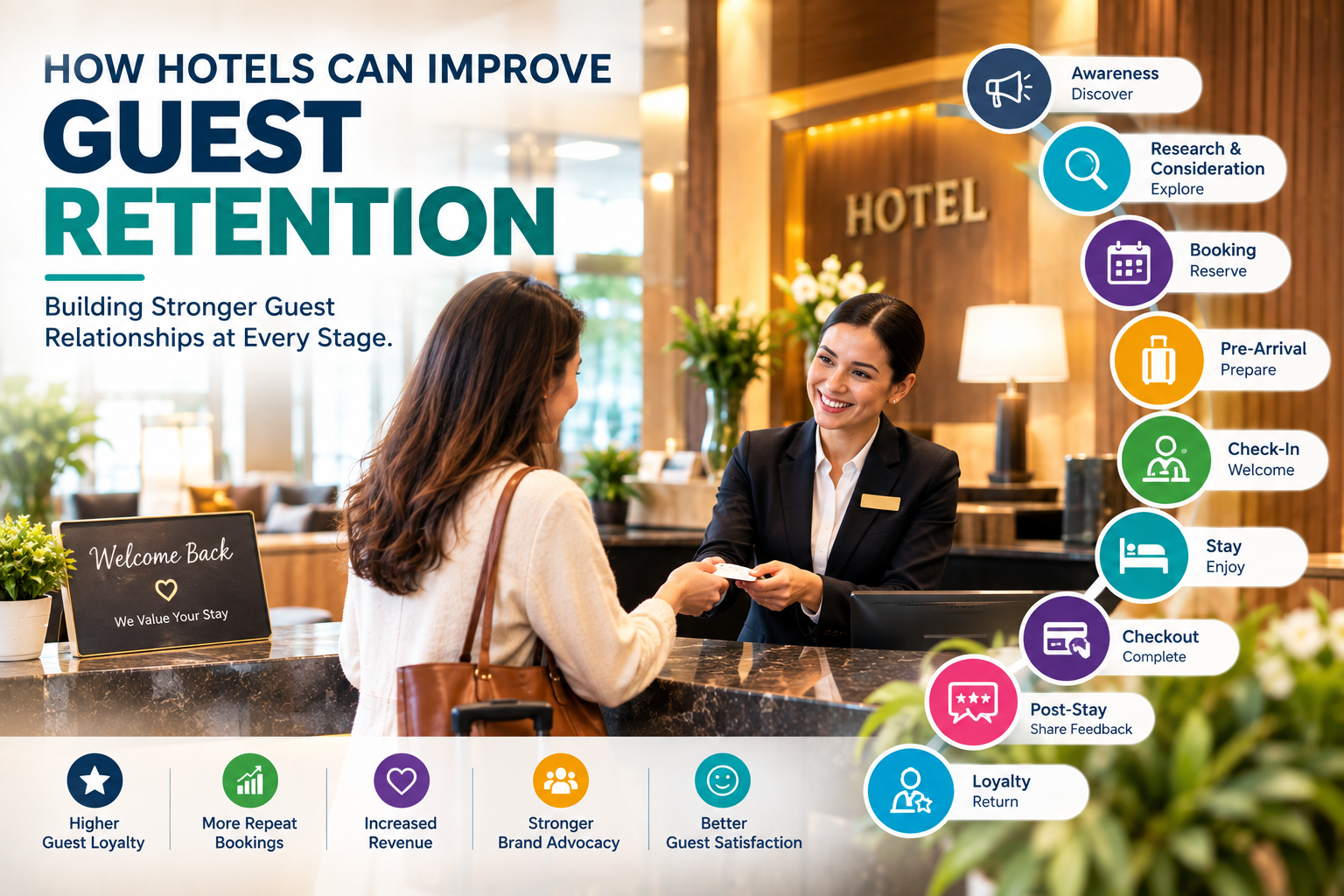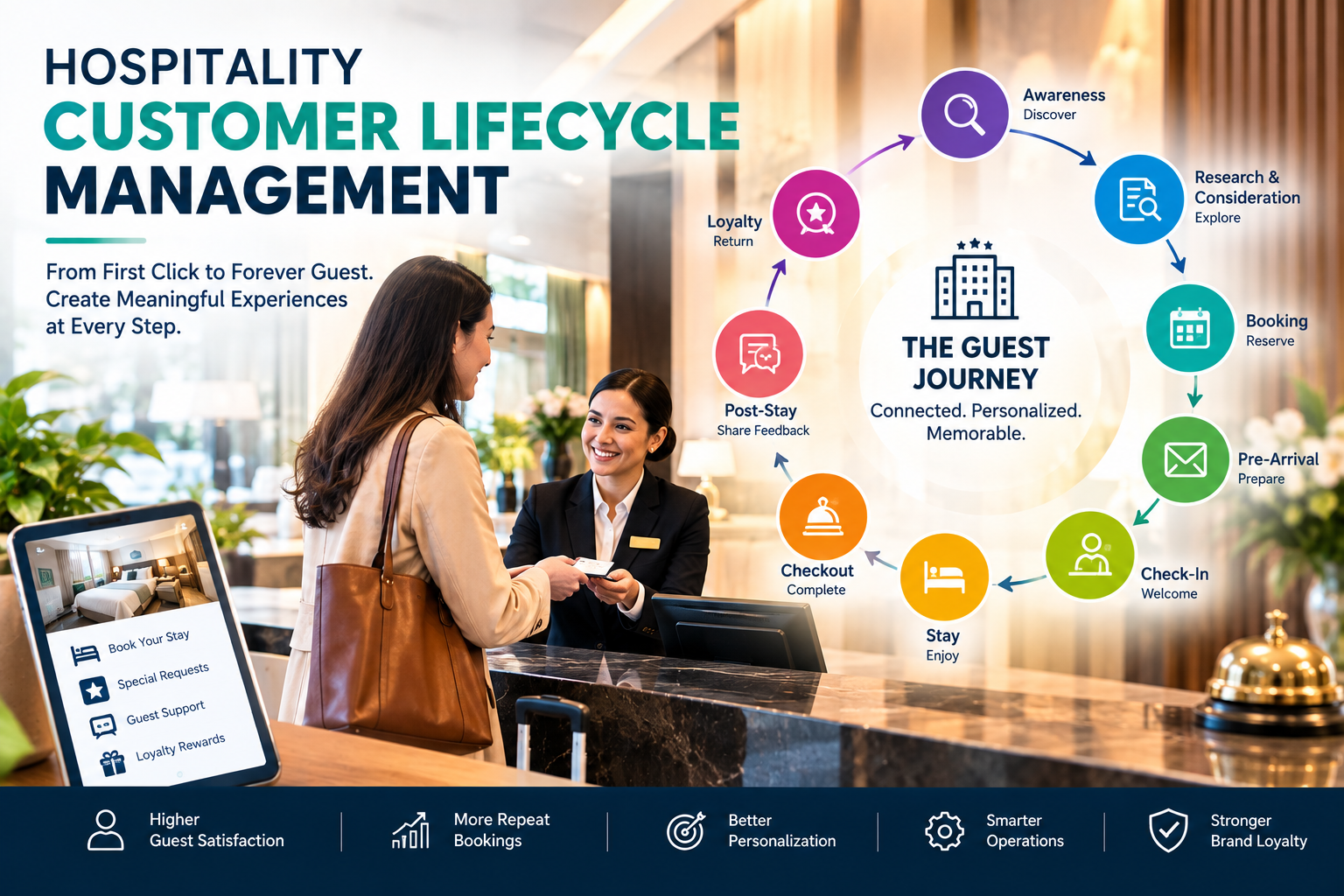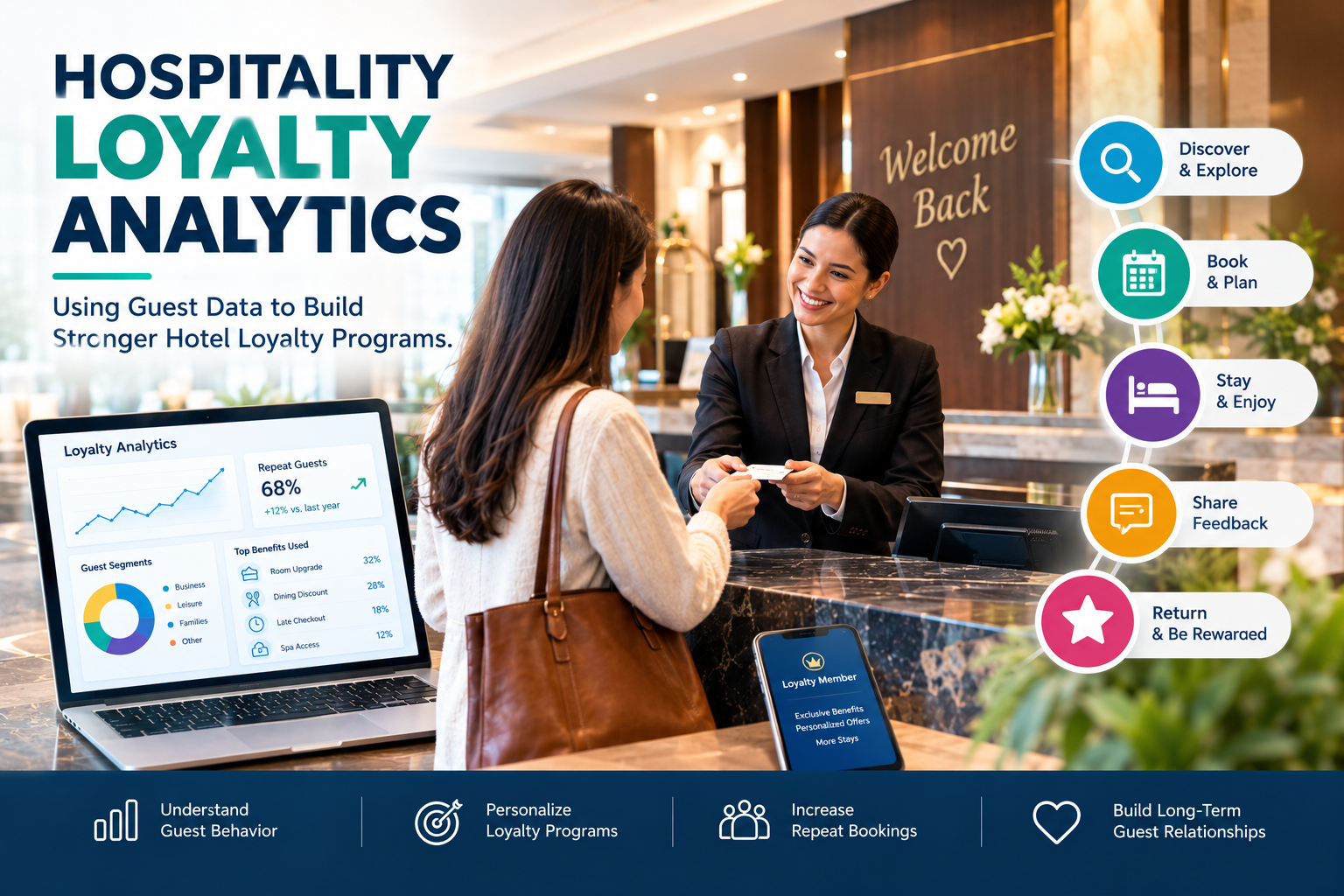
Guest loyalty has always been an important part of the hospitality industry. Hotels want guests to return, recommend their property to others, and develop a long-term relationship with the brand. However, modern loyalty programs are no longer based only on collecting points or offering occasional discounts. Hotels now have access to large amounts of guest and booking data that can help them understand what motivates guests to return. This is where hospitality loyalty analytics becomes increasingly valuable.
Hospitality loyalty analytics refers to the use of data, reporting, and analytical tools to understand guest loyalty behavior and measure the performance of hotel loyalty programs. By analyzing booking patterns, spending habits, preferences, engagement, feedback, and repeat stays, hotels can develop more relevant loyalty strategies and make better business decisions.
At BookSmart, we believe that effective loyalty management begins with understanding guests. When hotels use data responsibly, loyalty analytics can help transform a basic rewards program into a more meaningful and personalized guest relationship strategy.
What Is Hospitality Loyalty Analytics?
Hospitality loyalty analytics is the process of collecting and analyzing guest information to understand loyalty behavior and improve customer retention.
Hotels can analyze data from various sources, including:
- Hotel bookings
- Property Management Systems
- Customer Relationship Management platforms
- Loyalty programs
- Direct booking channels
- Guest feedback
- Online reviews
- Food and beverage purchases
- Spa and recreational services
- Website interactions
- Mobile applications
By combining relevant information, hotels can develop a clearer picture of how guests interact with the property before, during, and after their stay.
Why Loyalty Analytics Matters for Hotels
A loyalty program may have thousands of members, but membership numbers alone do not indicate whether the program is successful.
Hotels need to understand questions such as:
- How frequently do loyalty members return?
- Which benefits do guests actually use?
- Which guest segments generate the most value?
- What causes members to become inactive?
- Which offers encourage repeat bookings?
- Do loyalty members prefer direct booking channels?
- How does loyalty participation affect overall guest spending?
Loyalty analytics can help answer these questions using measurable data.
This allows hotels to move from simply operating a loyalty program to actively managing and improving it.
Understanding Guest Behavior
Every guest has different travel habits.
A business traveler may stay at hotels frequently throughout the year, while a leisure traveler may only book once or twice annually. Some guests may spend heavily on food and beverages, while others may primarily use room-related services.
Analytics can identify these behavioral patterns.
For example, hotels can segment guests according to booking frequency, average spending, length of stay, travel purpose, booking channel, or preferred services.
Understanding these differences allows hotels to create more relevant loyalty experiences.
Guest Segmentation Through Loyalty Analytics
Guest segmentation is one of the most useful applications of loyalty analytics.
Instead of treating every loyalty member identically, hotels can create meaningful segments based on behavior and preferences.
Possible segments include:
- Frequent business travelers
- Occasional leisure guests
- High-spending guests
- Long-stay guests
- New loyalty members
- Highly engaged members
- Inactive members
- Guests who primarily book directly
Each group may respond differently to loyalty benefits.
For example, a frequent business traveler may value flexibility and convenience, while a leisure guest may prefer experiences, dining benefits, or family-oriented packages.
Measuring Repeat Booking Behavior
Repeat bookings are an important indicator of guest loyalty.
Hotels can use analytics to determine how often loyalty members return compared with other guests.
They can also examine the time between stays.
For example, if a particular group of guests typically returns every six months, the hotel can plan appropriate communication around that period.
This does not mean sending constant promotional messages. Instead, the hotel can use behavioral information to provide relevant communication when it is most useful.
Analyzing Customer Lifetime Value
Customer Lifetime Value, or CLV, is another important metric for loyalty analytics.
Instead of evaluating guests based only on the value of a single booking, CLV considers the broader relationship over time.
A guest who makes frequent bookings over several years may generate substantially more value than a guest who makes one expensive booking.
Hotels can use CLV analysis to better understand the long-term value of different guest segments.
This can support decisions related to loyalty benefits, marketing investment, service strategies, and customer retention.
Understanding Loyalty Program Engagement
Not every loyalty member actively participates in a program.
Some guests may sign up but rarely interact with the program afterward.
Hotels can measure engagement through indicators such as:
- Login activity
- Reward redemption
- Booking frequency
- Offer interaction
- Email engagement
- Mobile application usage
- Benefit usage
- Direct booking activity
Low engagement may indicate that members do not understand the program or find its benefits insufficiently relevant.
Analytics can help hotels identify these patterns and investigate possible improvements.
Identifying Inactive Members
Inactive loyalty members represent another important area for analysis.
Hotels can identify members who have not booked or interacted with the brand for a certain period.
Instead of sending the same offer to every inactive member, hotels can examine historical behavior to understand what previously motivated those guests.
For example, a guest who previously booked weekend stays may respond better to relevant weekend packages than to generic discounts.
Data can therefore support more targeted re-engagement strategies.
Personalizing Loyalty Benefits
Loyalty analytics can help hotels understand which benefits different guests value.
Some guests may prefer room-related benefits, while others may value dining, wellness, experiences, flexibility, or convenience.
Hotels can analyze benefit usage to determine which rewards are most popular among different segments.
This information can support the development of more flexible loyalty programs.
Personalization should always be handled responsibly, particularly when guest information is used for targeted communication.
Predictive Analytics in Hotel Loyalty
Predictive analytics can take loyalty management a step further.
Instead of only analyzing what happened in the past, predictive models can identify patterns that may help hotels anticipate future guest behavior.
Potential applications include:
- Predicting repeat booking likelihood
- Identifying members at risk of becoming inactive
- Forecasting guest spending
- Predicting preferred services
- Identifying potential high-value guests
- Estimating future loyalty engagement
These insights can help hotels plan their customer relationship strategies more effectively.
Predictions should be treated as decision-support information rather than certainty.
Using Loyalty Analytics for Personalized Marketing
Hotel marketing can become more relevant when it is informed by loyalty data.
Rather than sending identical campaigns to every guest, hotels can use segmentation and behavioral information to develop targeted communication.
For example, hotels might create different campaigns for business travelers, families, couples, long-stay guests, or guests interested in particular hotel services.
Relevant communication can improve the usefulness of marketing while reducing unnecessary messages.
Connecting Loyalty Analytics With CRM Systems
Customer Relationship Management systems play an important role in hospitality loyalty analytics.
A CRM can help hotels organize guest profiles, booking history, communication records, preferences, and loyalty information.
When relevant systems are properly integrated, hotels can develop a more complete view of the guest relationship.
This can allow employees and marketing teams to understand guest interactions more effectively while maintaining appropriate access controls and privacy practices.
The Role of Artificial Intelligence
Artificial Intelligence is increasingly being used to analyze large amounts of customer data.
AI can help identify patterns that may be difficult to detect through manual analysis.
Potential applications in loyalty analytics include:
- Guest segmentation
- Churn-risk analysis
- Recommendation systems
- Sentiment analysis
- Personalized offers
- Demand forecasting
- Customer behavior prediction
For example, an AI system could analyze booking frequency, engagement, and previous interactions to identify members whose activity has declined.
Hotel teams can then determine whether appropriate engagement is needed.
AI should complement human decision-making rather than operate without oversight.
Analyzing Guest Feedback
Guest feedback is another valuable source of loyalty information.
Hotels can analyze surveys, reviews, support interactions, and other feedback to understand how guest experiences influence loyalty.
Sentiment analysis tools can help identify recurring themes across large amounts of feedback.
For example, if returning guests frequently mention staff friendliness as a reason for choosing the property again, management can recognize the importance of maintaining that aspect of the guest experience.
Feedback analysis can therefore connect operational performance with loyalty behavior.
Loyalty Analytics and Direct Bookings
Loyalty programs can also support direct booking strategies.
Hotels may analyze whether loyalty members are more likely to book through the hotel’s website or other direct channels.
This information can help management understand the relationship between loyalty engagement and booking behavior.
Hotels can then design appropriate member benefits that make direct relationships more valuable without relying solely on discounts.
Measuring Loyalty Program Performance
A loyalty program should be measured using multiple indicators rather than one metric.
Useful loyalty analytics KPIs include:
- Repeat booking rate
- Loyalty membership growth
- Active member percentage
- Member booking frequency
- Customer lifetime value
- Average member spending
- Reward redemption rate
- Direct booking percentage
- Member retention rate
- Guest satisfaction
These metrics provide a broader picture of loyalty program performance.
Loyalty Analytics and Revenue Management
Loyalty data can also support revenue management.
Understanding guest booking behavior can help hotels identify demand patterns and understand how different customer segments respond to pricing and offers.
For example, historical booking behavior may show that certain loyalty members regularly book during particular seasons or periods.
Revenue and marketing teams can use such insights alongside broader market and demand information when planning campaigns and inventory strategies.
Loyalty analytics should support revenue decisions rather than replace established revenue management processes.
Protecting Guest Data
Because loyalty analytics depends on guest information, data privacy and security are essential.
Hotels should ensure that customer data is collected and used appropriately.
Important practices can include:
- Limiting access to sensitive information
- Using secure systems
- Maintaining accurate records
- Following applicable privacy requirements
- Clearly communicating relevant data practices
- Avoiding unnecessary data collection
Trust is an important part of guest loyalty. Hotels should therefore treat guest information responsibly.
Challenges of Hospitality Loyalty Analytics
Implementing loyalty analytics can present several challenges.
Hotels may have data stored across disconnected systems, inconsistent customer records, incomplete information, or limited analytical capabilities.
Smaller hotels may also lack dedicated data teams.
Another challenge is turning data into useful action.
Collecting thousands of data points does not automatically create better loyalty programs. Hotels need clear objectives, reliable data, appropriate analytical tools, and employees who understand how to interpret the results.
Building an Effective Loyalty Analytics Strategy
Hotels can develop a structured approach by following several steps:
- Define clear loyalty objectives.
- Identify relevant data sources.
- Ensure data quality.
- Segment guests based on meaningful behavior.
- Establish loyalty KPIs.
- Analyze repeat booking and spending patterns.
- Monitor member engagement.
- Identify inactive or changing customer segments.
- Test relevant loyalty initiatives.
- Measure results and continuously improve.
This creates a cycle where data supports action and results generate new insights.
The Future of Hospitality Loyalty Analytics
The future of hotel loyalty management will likely become increasingly data-driven.
AI, predictive analytics, real-time personalization, mobile technology, CRM integration, and automated reporting will provide hotels with more opportunities to understand guest behavior.
Loyalty programs may also become more flexible, moving beyond traditional points-based structures toward personalized benefits and experiences.
However, technology should remain a tool for improving relationships rather than replacing genuine hospitality.
Guests are more likely to value loyalty programs when the benefits feel useful, transparent, and relevant to their individual needs.
Conclusion
Hospitality loyalty analytics gives hotels a powerful way to understand guest behavior and improve long-term customer relationships. By analyzing booking patterns, spending, engagement, feedback, preferences, and loyalty activity, hotels can make more informed decisions about how to attract, retain, and engage guests.
CRM systems, data analytics, predictive models, and AI can make loyalty management more personalized and measurable. However, successful loyalty strategies require more than technology. Hotels also need reliable data, thoughtful service, responsible data practices, and a clear understanding of what guests actually value.
At BookSmart, we believe that the future of hotel loyalty lies in combining intelligent data analysis with genuine hospitality. When hotels use loyalty analytics responsibly, they can create more relevant guest experiences, strengthen relationships, and build loyalty strategies designed around long-term value rather than one-time transactions.